


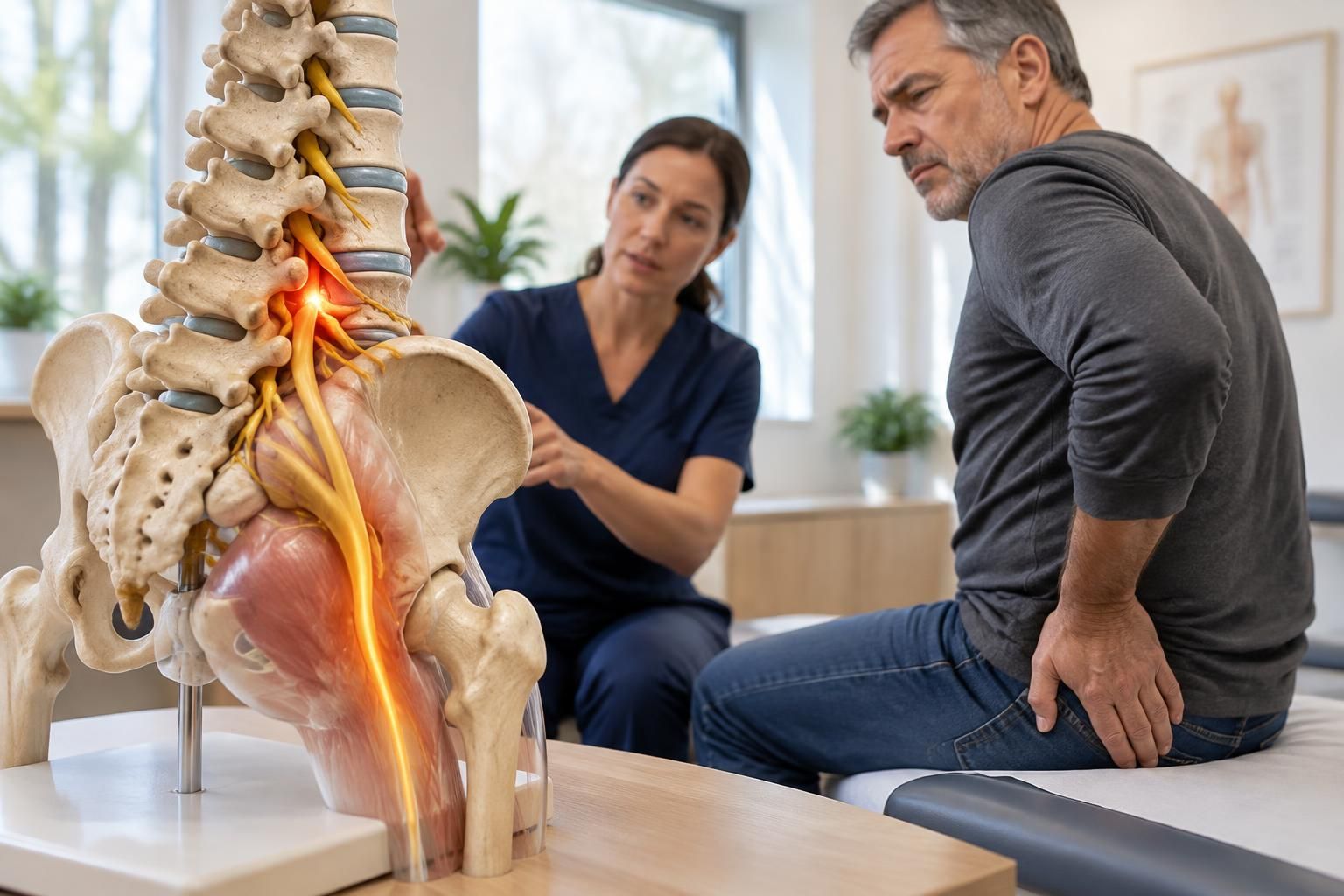
Foraminal stenosis is the narrowing of the opening through which a nerve root exits the spine. When it irritates a lumbar nerve, it can contribute to sciatica, low back pain that travels down the leg, tingling or, at times, weakness.
However, an MRI image alone is not enough to establish the cause of symptoms: narrowing may be visible without causing pain, and other issues can produce similar sensations. In Villeray–Saint-Michel–Parc-Extension, as elsewhere in the Montréal area, the assessment therefore takes into account the pattern of symptoms, strength, sensation and activities that have become difficult.
Driving, travelling by public transit or prolonged sitting at work can make pain more noticeable for some people. The connection varies from one case to another: the goal is to understand what is happening in your situation, without inferring a diagnosis from a single symptom or image.
Key takeaways
A narrow passage: the foramen is the opening between two vertebrae through which a nerve root passes.
Variable symptoms: pain, numbness and weakness do not necessarily occur together.
MRI does not decide on its own: the side and level must match the examination and symptoms.
Function matters: walking, sleep and strength help measure progress.


Lumbar foraminal stenosis: understanding narrowing and sciatica
The foramen is a small lateral canal, separate from the central spinal canal, that allows a nerve to pass as it exits the spine. If this space decreases, the nerve root may be irritated or compressed, particularly in certain positions or under load.
Several changes can contribute to narrowing: a disc that loses height or bulges, osteoarthritis-related bone spurs, thickening of the facet joints, scoliosis or vertebral slippage. These factors may occur together, and their presence on imaging does not by itself demonstrate nerve compression responsible for pain.
Stenosis may occur at different levels, including L4-L5 or L5-S1. Certain movements, such as standing for a long time or arching the back, sometimes increase symptoms; other people do not notice this relationship. An MRI performed while lying down does not necessarily reproduce the stresses experienced when walking or extending the back.
For a complementary overview of the mechanisms and management options, you may consult this guide to foraminal narrowing. It remains essential to interpret general information in light of an assessment tailored to the individual.
Pain travelling down the leg: symptoms and limits of interpretation
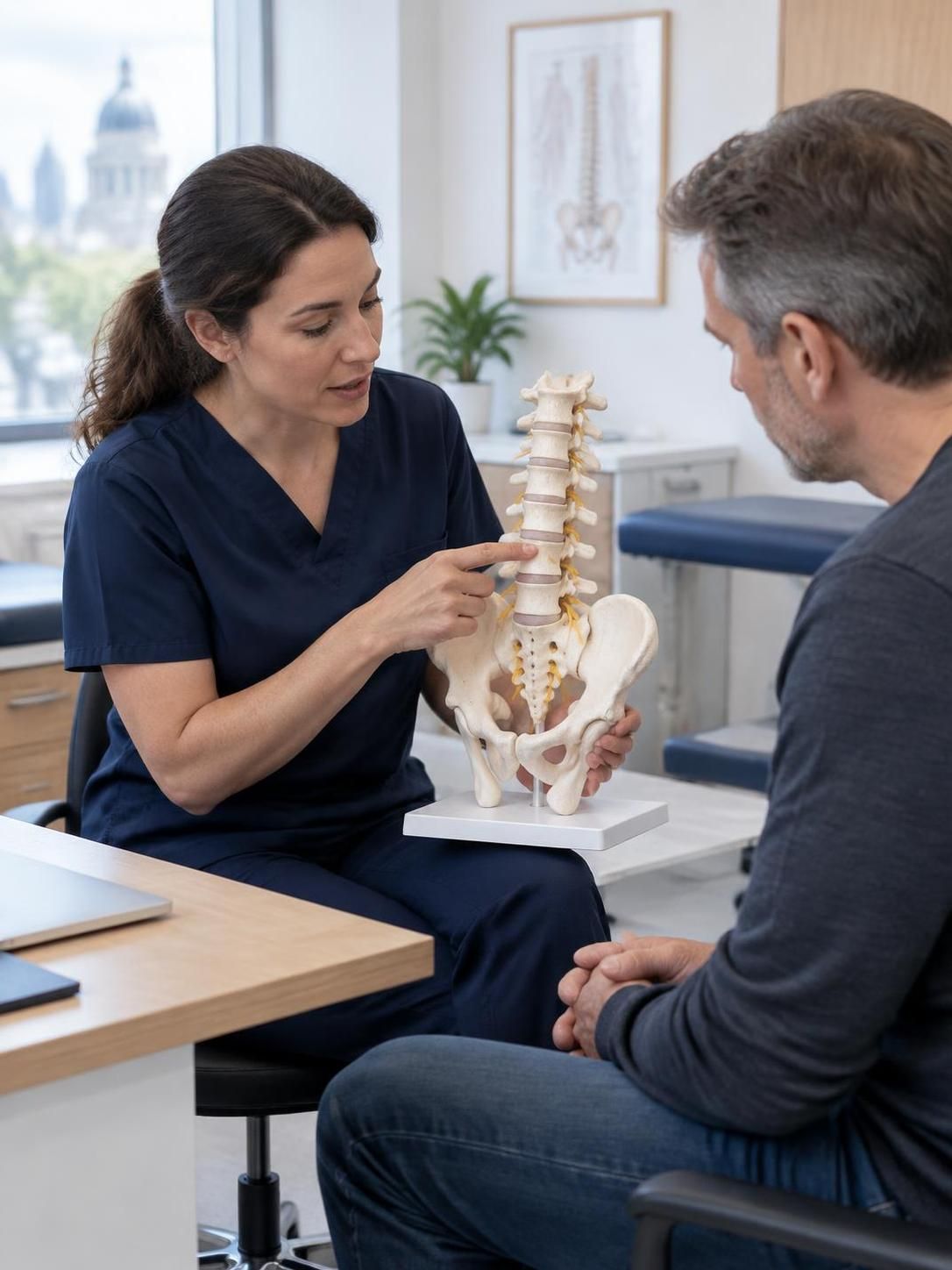
Irritation of a lumbar nerve root can cause pain that starts in the low back or buttock and extends into the thigh, calf or foot. Tingling, loss of sensation or weakness may also occur, but their location does not always make it possible to identify the affected level with certainty.
Sciatica refers to a group of symptoms associated with irritation of nerve roots that contribute to the sciatic nerve. Pain felt in the leg may also come from the hip, a peripheral nerve or other structures. The examination notably compares the strength of different muscles, reflexes, sensation and walking ability.
Weakness differs from pain that temporarily limits movement. For example, a foot that catches increasingly often or new difficulty lifting the front of the foot deserves prompt attention. The onset and progression of neurological symptoms influence clinical decision-making more than the intensity of a single number in a report.
To better distinguish possible causes and associated signs, the resource on the causes and diagnosis of sciatica can help you prepare for a consultation. It does not replace an individualized medical diagnosis.
What MRI can—and cannot—establish
MRI shows the discs, joints and space around the nerve roots. The professional checks whether the reported level and side correspond to the symptomatic limb, as well as to the examination findings and activities that trigger pain.
Several abnormalities may coexist, such as central stenosis, a hip condition or peripheral neuropathy. To explore the clinical interpretation of this issue further, this article on the diagnosis of foraminal stenosis offers an additional reference point; an image, even one described as severe, does not by itself constitute a complete diagnosis.
| Finding | What it may suggest | Useful caution |
|---|---|---|
| Pain radiating into the leg | Nerve root irritation or another cause of referred pain | The pattern may overlap among several causes. |
| Tingling or numbness | Possible sensory involvement | A peripheral nerve can produce similar signs. |
| Muscle weakness | Motor involvement to be assessed | Progressive weakness warrants prompt reassessment. |
| Narrowing on MRI | Anatomical change in the foramen | Correlation with symptoms and the examination is essential. |
Assessment and follow-up: connecting imaging to daily life
An assessment takes into account the duration of symptoms, their progression, the positions that change them and their effect on activities. The examination may include walking, certain back movements, strength, sensation and reflexes. Depending on the clinical picture and whether imaging may change management, a professional may recommend tests or medical referral.
In a neighbourhood such as Villeray–Saint-Michel–Parc-Extension, a person who needs to alternate between the métro, walking and office work can track concrete indicators: distance travelled before symptoms begin, tolerance for sitting, sleep and the ability to carry out usual tasks. These measures help determine whether function is improving, even when pain fluctuates from day to day.
Useful follow-up documents pain, strength, sensation and walking ability separately. Temporary improvement is not always enough to justify continuing an approach indefinitely: the plan should specify the intended outcome, when reassessment will occur and the reasons for adjusting it.
Ask which hypothesis best explains your symptoms and which examination findings support it.
Clarify the measurable goal: walk longer, sleep better or return to a specific activity.
Discuss the options, their limitations, contraindications and when the plan will be reviewed.
Promptly report any new widespread numbness or weakness that appears or progresses.
Sciatica treatment: stepwise options and the role of decompression
When the situation allows, management may begin with information, temporary activity modification and a gradual return to movement. Exercises may be recommended based on tolerance and findings; a movement that sends pain further down the leg or increases numbness should be reassessed rather than continued forcefully.
Medications may be discussed with an authorized professional, taking into account other health conditions, expected benefits and adverse effects. An injection may be considered in certain persistent presentations; it targets a specific situation and does not guarantee lasting relief. The choice depends on clinical correlation, goals and risks specific to each person.
Motorized spinal decompression is a form of controlled, progressive traction. For certain patients selected after an assessment, it may aim to temporarily modify the mechanical stresses on discs and nerve roots, but it is not appropriate for all cases of sciatica and results vary.
This approach does not put a disc “back in place,” does not replace an urgent assessment and cannot promise that surgery will be avoided. There is no universal number of sessions: functional progress, tolerance, contraindications and the relevance of the diagnosis should guide any decision. To learn about the options offered in Montréal, visit Clinique TAGMED’s motorized spinal decompression page.
If symptoms persist despite appropriate management or if a neurological deficit progresses, a specialist opinion may be indicated. Depending on the cause and stability of the spine, decompression surgery, such as a foraminotomy, may be discussed; it aims to free space around the nerve, but its appropriateness and risks must be assessed individually.

When to seek care for foraminal stenosis and neurological symptoms
A consultation is indicated if pain persists or returns, travels below the knee, limits walking or disrupts sleep. Numbness, loss of sensation, weakness or reduced function also warrant a clinical assessment, especially if the change is new.
Urgent medical assessment is required in the event of loss of bladder or bowel control, loss of sensation in the saddle area, significant or rapidly progressive weakness, or foot drop that appears or worsens. Major trauma, fever or feeling generally unwell, as well as pain occurring in the context of cancer or infection, also call for prompt assessment.
These signs do not allow for a diagnosis from a distance and should not automatically be attributed to stenosis visible on an image. If an urgent symptom is present, do not delay assessment to try a new conservative approach.
For pain that travels down the leg, an assessment can help clarify the likely cause, signs to monitor and whether a conservative approach is appropriate. TAGMED’s Montréal clinic is located in Mont-Royal, near Outremont and Côte-des-Neiges; this does not mean it has an address in every neighbourhood in the city.
Frequently asked questions about foraminal stenosis and sciatica
Is foraminal stenosis the same as central stenosis?
No. The foraminal form narrows the opening through which a nerve root exits, whereas central stenosis involves the spinal canal. However, both can coexist.
Does severe stenosis on MRI mean severe pain?
Not necessarily. The degree of narrowing describes anatomy, but does not by itself predict symptom intensity or their effect on function.
Can standing or walking worsen symptoms?
Yes, for some people, particularly if posture or load increases irritation. Responses vary; note the positions that worsen or relieve symptoms so you can discuss them during a consultation.
When should you seek care for pain consistent with sciatica?
Seek care if pain persists, limits walking, disrupts sleep or is accompanied by numbness or weakness. Loss of bladder or bowel control, saddle anaesthesia or rapidly progressive weakness requires urgent assessment.
Is motorized spinal decompression suitable for all foraminal stenosis?
No. It may be considered for certain profiles after an assessment, but results vary and contraindications exist. It does not replace urgent medical assessment or a specialist opinion when indicated.
If low back pain travels down your leg or if numbness concerns you, an assessment can clarify the signs to monitor and options suited to your situation. Explore the sciatica management options in Montréal or contact the clinic for information.
This content is educational and does not replace a personalized assessment or medical advice.
Sylvain Desforges, B.Sc., D.O., N.D., osteopath and naturopath
