

Three-dimensional spinal deformity involving a sideways curve and vertebral rotation.
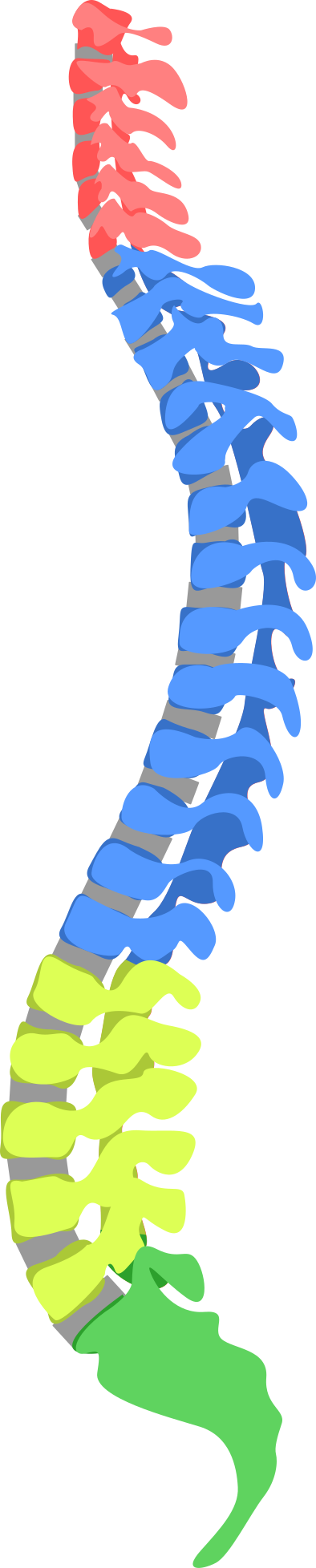
mikeingram1; recoloration : MJL — CC0 1.0. Image source.

Understanding the mechanism
Scoliosis is a three-dimensional spinal deformity involving a sideways curve and vertebral rotation. It may be idiopathic during growth, congenital, neuromuscular or degenerative in adulthood. A simple postural asymmetry is not the same as structural scoliosis. Age, remaining growth and the type of curve influence both the risk of progression and the need for follow-up.
Symptoms and warning signs
An uneven shoulder height, waist asymmetry or a rib prominence on forward bending may draw attention. Adolescent scoliosis does not necessarily hurt. In adults, fatigue, pain or neural compression can contribute to disability. Unusual substantial pain in a child, neurological findings or rapid progression requires specialist assessment rather than attributing the presentation solely to posture.
Diagnosis and investigations
Diagnosis uses examination and, when justified, standing radiographs to measure the curve. Rotation and overall balance also matter. MRI is not routine for every curve but may be indicated in atypical presentations. Imaging surveillance should avoid unnecessary radiation and answer a specific question about progression or management. A photograph alone cannot provide the same assessment as a clinical and radiographic evaluation.
Treatment and outlook
Management depends on progression risk and functional impact. Observation, scoliosis-specific exercise, bracing during growth or surgery may be considered in different situations. Adult care often focuses strongly on function and associated symptoms. A general exercise programme cannot replace specialist evaluation when a curve is progressing or substantially disabling, and treatment choices need to reflect the individual's priorities.
The role of TAGMED care
At TAGMED, supportive care may address selected pain and functional limitations following assessment. Decompression, laser, shockwave therapy and manipulation should not be described as reliably correcting every structural scoliosis. Goals must distinguish comfort and endurance from changing the curve itself. A growing child needs appropriate surveillance even when pain improves, because symptoms and curve progression are not equivalent.
Practical follow-up
In adolescents, follow-up should also consider body image, social activity and engagement with the programme. Clear explanations help distinguish monitoring curve progression from treating pain that may have a separate cause. These goals can coexist without being interchangeable.
Frequently asked questions
Does poor posture cause every scoliosis?
No. Structural curves involve mechanisms beyond ordinary postural habits.
Can scoliosis be painless?
Yes, particularly during growth; lack of pain does not remove the need for indicated follow-up.
Do exercises always replace a brace?
No. Indications depend on progression risk and skeletal maturity.
Can adults receive supportive care?
Yes, with functional goals and assessment of any associated complications.
What should be compared over time?
Measured curvature, growth, balance and capacity according to the specialist follow-up plan.
Conceptual diagram: the steps depend on clinical findings and do not provide an individual diagnosis.
Medical references
- American Academy of Orthopaedic Surgeons. Scoliosis Overview.
- American Academy of Orthopaedic Surgeons. Kyphosis (Roundback) of the Spine.
References document the topic; their inclusion does not imply endorsement of TAGMED services by those organizations.
Educational information from The Spine Page. This entry does not replace an individual assessment. Documentary version: October 12, 2026. Sylvain Desforges, B.Sc., D.O., N.D., osteopath and naturopath.
TAGMED clinic contact details
For non-urgent consultations and information about available services.
Clinique TAGMED — Terrebonne
1150, rue Lévis, Suite 200
Terrebonne (Québec) J6W 5S6
450‑704‑4447
Clinique TAGMED — Montréal
1140, avenue Beaumont
Mont-Royal (Québec) H3P 3E5
1‑877‑672‑9060