


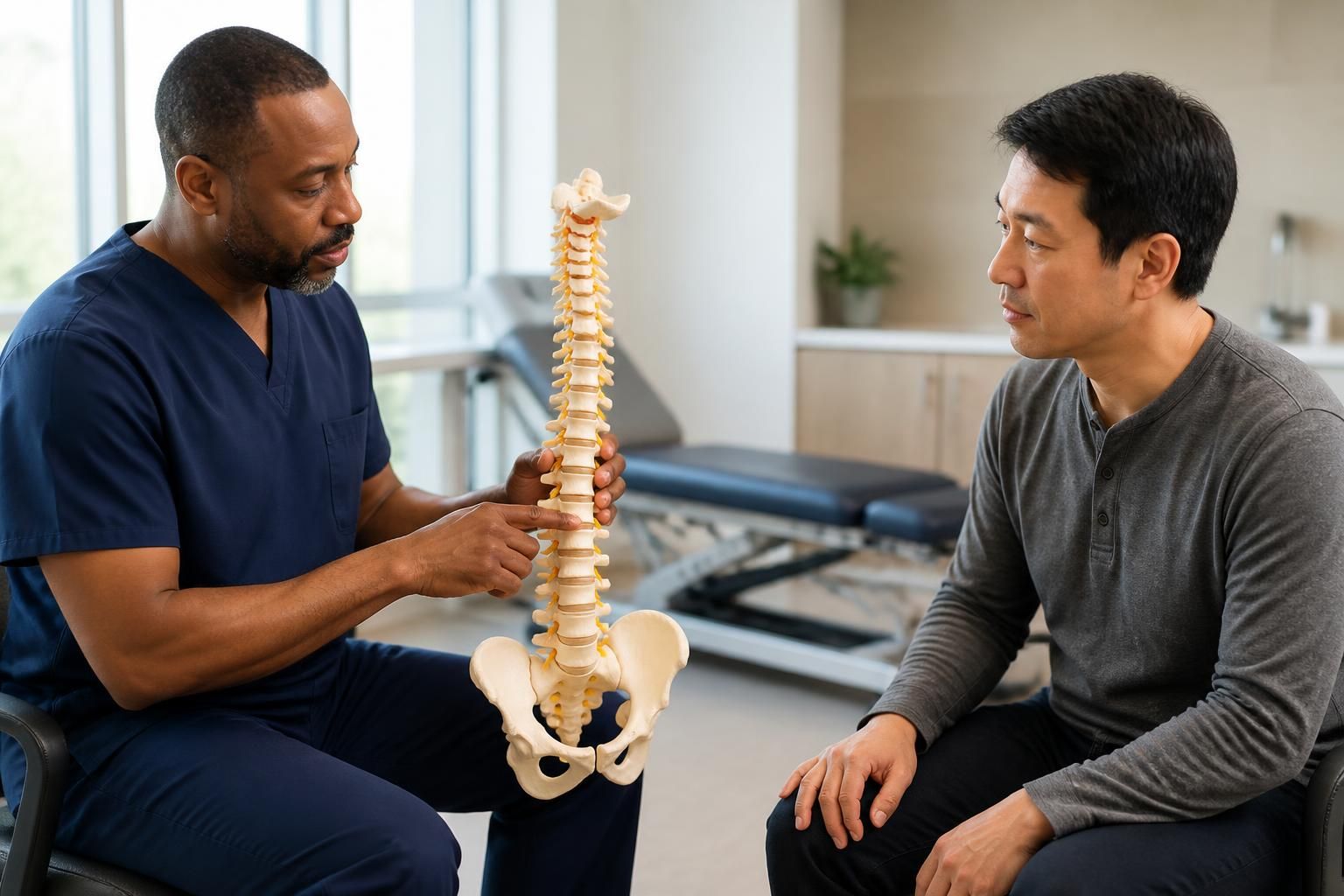
Sciatica, whether acute or chronic, often presents as intense pain radiating from the lower back into the leg, which can cause concern and confusion among Saint-Léonard residents experiencing these symptoms. The distinction between acute sciatica, which appears suddenly and tends to resolve within a few weeks, and a chronic form, which develops gradually with persistent symptoms, is essential to best tailor diagnostic steps and medical follow-up.
In this context, it is important to understand that diagnosis is based on a precise clinical assessment, supplemented as needed by imaging examinations and electrodiagnostic tests. This approach helps determine possible causes, thereby providing appropriate treatment options. In Saint-Léonard, care takes individual characteristics into account, particularly in relation to occupational activity, lifestyle habits, and factors affecting each patient’s progression.



In brief: key points for understanding acute and chronic sciatica in Saint-Léonard
Distinguishing acute from chronic sciatica: medical diagnostic considerations in Saint-Léonard
The distinction between acute and chronic sciatica is a crucial first step in understanding low back pain that radiates into the leg. In Saint-Léonard, where the working population and office workers are exposed to prolonged postures, this distinction guides clinical and therapeutic decisions.
Acute sciatica often presents as sharp, throbbing pain, sometimes described as stabbing, that occurs suddenly and may be associated with a disc herniation or trauma. Although very painful, this form may respond favourably to relative rest, pain medication, and appropriate care. Chronic sciatica, on the other hand, develops gradually, with pain that persists beyond six weeks and may indicate prolonged nerve irritation or a more complex mechanical cause, such as foraminal stenosis or disc degeneration.
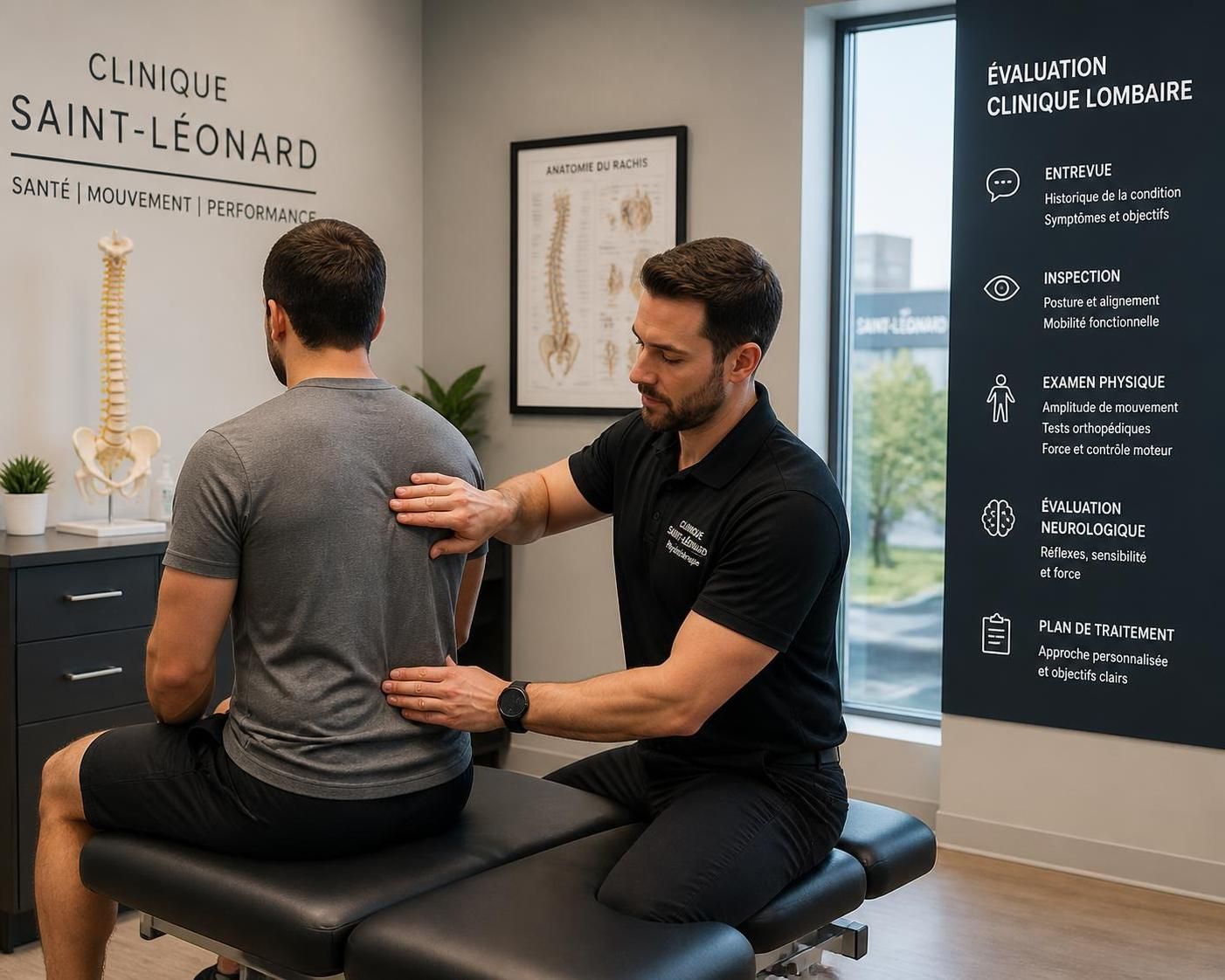
An accurate diagnosis in Saint-Léonard involves a complete medical history, a functional examination assessing lumbar mobility, muscle strength, and reflexes, as well as monitoring associated signs such as numbness or weakness. It is important not to assign a premature diagnosis to pain and to consider symptoms as a whole.
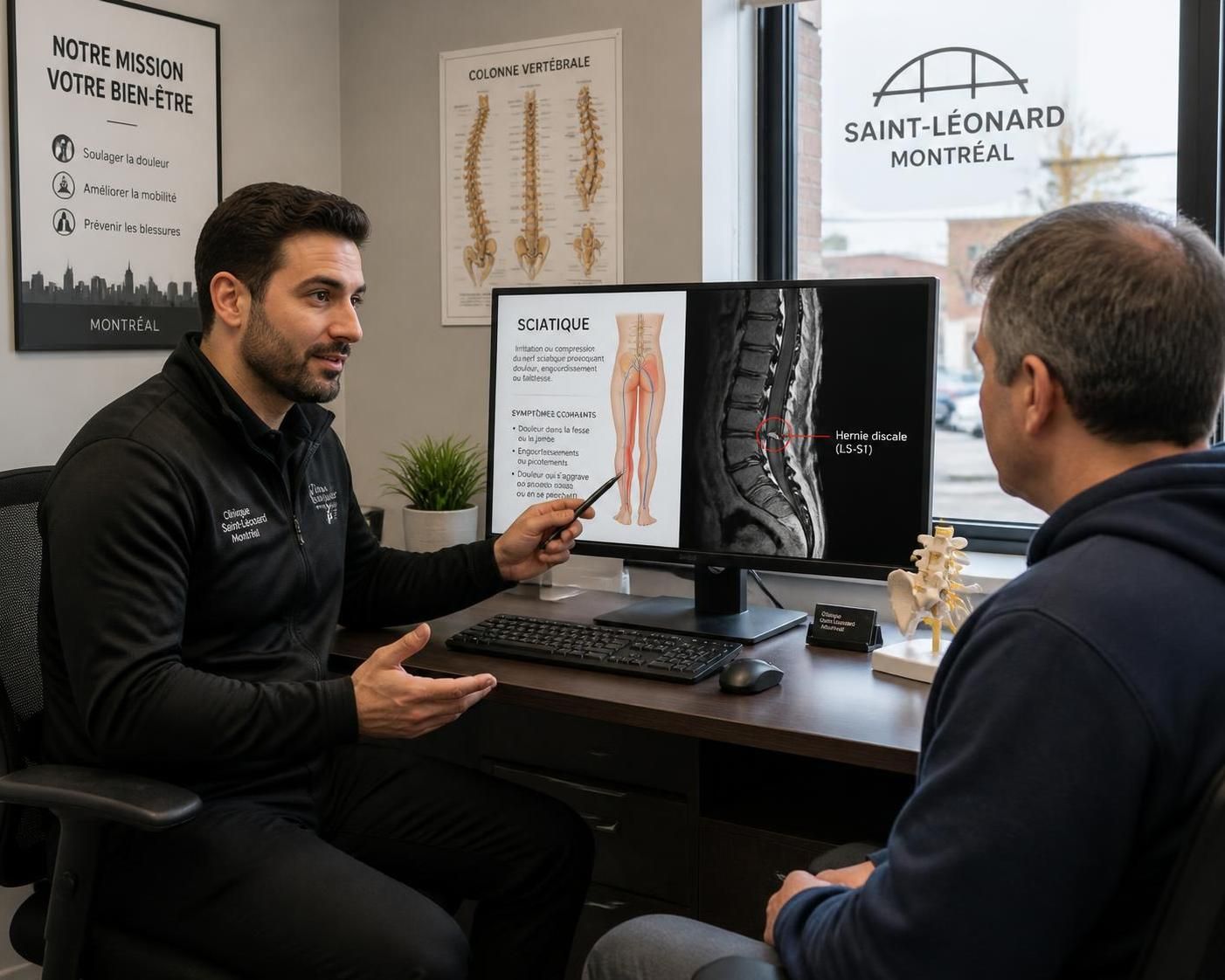
Medical imaging, particularly MRI, is often recommended when symptoms persist or worsen, in order to identify a possible disc herniation, nerve impingement, or stenosis. Electrodiagnostic examinations may supplement the diagnosis by specifying the level of nerve involvement.
Lastly, in Saint-Léonard, consideration of local factors, such as lifestyle, remote work, or public transit commutes, makes it possible to tailor treatment recommendations and prevention strategies.
Clinical mechanisms underlying sciatica: essential understanding for an accurate diagnosis
Sciatica corresponds to irritation or compression of the lumbar nerve roots, primarily the L4, L5, and S1 roots, which form the sciatic nerve. This lumbosacral radiculopathy may result from a disc herniation, arthritic osteophytes, spinal canal stenosis, or spondylolisthesis.
Typical symptoms include radiating pain extending from the buttock to the back or side of the leg and down to the foot, often described as burning, electric, or stabbing. This pain may be accompanied by numbness, tingling, and muscle weakness, which can affect mobility and the ability to walk normally.
The distinction between radicular pain and referred pain is essential. Radiculopathy produces pain following a precise path associated with the affected nerve root. For example, an L5 disc herniation may cause symptoms on the outer side of the leg and the top of the foot. Pain at the front of the thigh, however, is more consistent with femoral neuralgia, involving the femoral nerve.
Clinical tests such as the Lasègue sign, straight-leg raise, or slump test help identify nerve irritation. These tests, which involve moving the leg and spine, may reproduce radicular pain, supporting the suspicion of lumbosacral radiculopathy consistent with sciatica.
In addition, the neurological examination assesses muscle weakness, sensation, and reflexes, including the Achilles and patellar reflexes, which may be altered depending on the level of nerve injury.
To further understand the possible causes of sciatica, consult resources dedicated to lumbosacral radiculopathy and its mechanisms.




Factors influencing the progression of sciatica in Saint-Léonard
The presentation and intensity of sciatica symptoms can vary considerably depending on several environmental and behavioural factors, as well as individual characteristics.
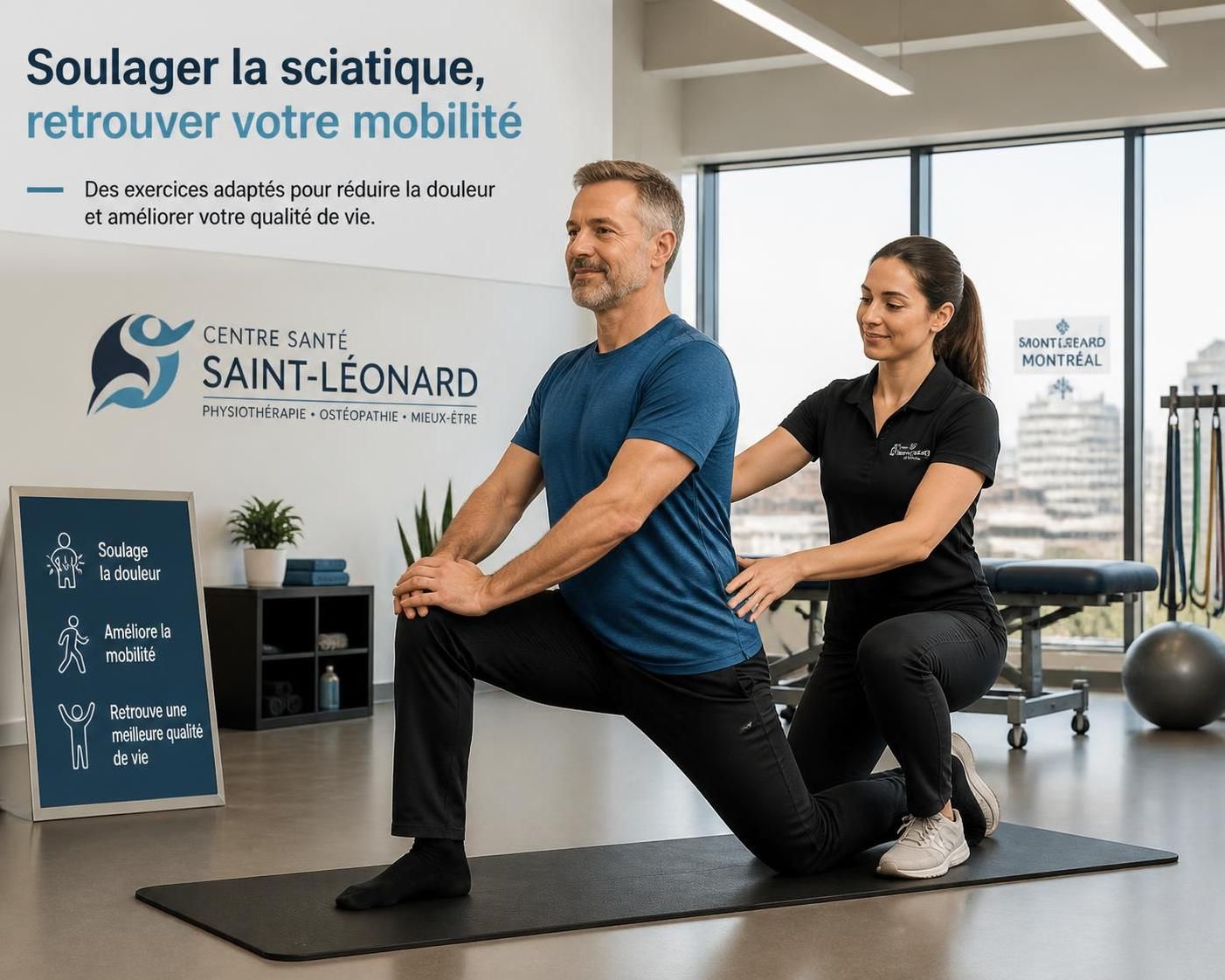
In Saint-Léonard, where many workers spend long hours sitting, particularly in office jobs or while working remotely, prolonged posture can worsen sciatic nerve compression. Likewise, car or public transit commutes contribute to maintaining a prolonged static position that may exacerbate pain.
Activities involving flexion or extension of the lumbar spine, such as lifting heavy loads, repeated twisting, prolonged walking, or climbing stairs, may also worsen symptoms in some patients. In others, these same movements may provide temporary relief by changing spinal mechanics.
Sleep may also be disrupted by sciatic pain, particularly when the chosen position places additional pressure on the nerve root. The use of ergonomic pillows or adjusting nighttime posture may help reduce this type of discomfort.
In all cases, it is important to emphasize that responses to different factors vary from one person to another. This is why, in Saint-Léonard, a personalized clinic assessment can identify aggravating or relieving factors, then guide appropriate treatment.
- Prolonged sitting, typical of office jobs and remote work.
- Physical activities involving lower-back flexion and extension.
- Repetitive movements and heavy lifting.
- Sleep adjustments and nighttime positioning.
When is medical consultation necessary for sciatic pain in Saint-Léonard?
Although acute sciatica can sometimes be managed with conservative measures at home, certain clinical signs call for prompt medical consultation to prevent complications and allow for optimal care.
Priority reasons for consultation include:
- Persistent or recurrent sciatic pain that does not improve after a few weeks.
- Pain radiating well below the knee, possibly accompanied by sensations of numbness or tingling.
- Progressive muscle weakness in the affected leg, impairing walking or daily activities.
- The onset of sensory loss, reflex changes, or numbness in the genital area, a possible sign of saddle anaesthesia.
- Unexplained urinary or bowel problems, indicating urgent neurological involvement.
- The presence of fever, significant weight loss, or a context of major trauma, cancer, or suspected infection.
In these situations, it is crucial to promptly consult a health-care professional for a thorough clinical assessment and appropriate follow-up, particularly in Saint-Léonard, where the proximity of specialized centres facilitates access to multidisciplinary care.
Sciatica management options in Saint-Léonard: the role of motorized spinal decompression
The treatment of sciatica, particularly when it persists beyond the first few weeks, is based on a gradual approach tailored to the patient’s profile. In Saint-Léonard, several options may be considered according to the likely cause, symptom severity, and individual tolerance:
- Gradual return to or maintenance of activity to the extent that the patient tolerates movement without worsening symptoms.
- Ergonomic advice to avoid prolonged positions that may worsen nerve compression.
- Appropriate exercises aimed at improving lumbar stability, joint mobility, and local blood circulation.
- Physiotherapy and manual care, including approaches such as specific osteopathy or the use of precise techniques such as the precision percussion device, offered in particular by TAGMED Clinic in Mont-Royal.
- Symptom-relieving medication, under medical advice, to relieve inflammatory or neuropathic pain.
- Motorized spinal decompression, a form of progressive, controlled spinal traction that may be offered to certain patients compatible with disc herniation or foraminal stenosis, following a specialized assessment. This approach aims to temporarily modify the stresses placed on discs and nerve roots to improve tolerance to movement and reduce pain.
- Specialized interventions or surgery, reserved for cases involving severe neurological deficits or significant nerve compression that persists despite conservative treatment.
It is important to understand that spinal decompression is not a universal solution and does not replace an urgent medical assessment. In addition, results vary among patients, and no fixed protocol is suitable for everyone. Unlike conventional traction, this method is motorized and controlled to provide precise, safe treatment.
To learn more about the advanced motorized spinal decompression options available near Saint-Léonard, TAGMED Clinic offers recognized expertise.
| Approach | Indications | Benefits | Limitations |
|---|---|---|---|
| Gradual activity | Acute sciatica without deficit | Maintains mobility and limits muscle loss | May require guidance to respect tolerance limits |
| Physiotherapy / Osteopathy | Sciatica with mild or chronic symptoms | Improved joint range of motion, pain reduction | Results vary depending on the practitioner and condition |
| Spinal decompression | Disc herniation, foraminal stenosis | Controlled traction, possible improvement in radicular pain | Not effective for all types of sciatica; requires an assessment |
| Medication | Inflammatory or neuropathic pain | Symptom relief | Possible side effects, not curative |
| Surgery | Progressive motor deficit or intractable pain | Mechanical correction of the compressive cause | Surgical risks, variable recovery |
The video above illustrates the main criteria and medical examinations used to distinguish acute sciatica from chronic sciatica, essential information for anyone in Saint-Léonard wishing to better understand their health condition.
This second video provides a detailed explanation of motorized spinal decompression, one of the treatment options offered in the Greater Montreal area, including Saint-Léonard, to relieve certain forms of sciatica.
{“@context”:”https://schema.org”,”@type”:”FAQPage”,”mainEntity”:[{“@type”:”Question”,”name”:”Quels sont les symptu00f4mes qui diffu00e9rencient une sciatique aiguu00eb du2019une sciatique chronique ?”,”acceptedAnswer”:{“@type”:”Answer”,”text”:”La sciatique aiguu00eb se caractu00e9rise souvent par une douleur intense du2019apparition soudaine qui tend u00e0 diminuer en quelques semaines. La sciatique chronique, au contraire, u00e9volue lentement avec des douleurs prolongu00e9es et des u00e9pisodes ru00e9currents, nu00e9cessitant une u00e9valuation plus approfondie.”}},{“@type”:”Question”,”name”:”Quand faut-il consulter rapidement u00e0 Saint-Lu00e9onard en cas de sciatique ?”,”acceptedAnswer”:{“@type”:”Answer”,”text”:”Il est conseillu00e9 de consulter rapidement en cas de faiblesse musculaire progressive, de perte de contru00f4le urinaire ou intestinal, du2019anesthu00e9sie de la selle, ou de douleur persistante malgru00e9 un traitement conservateur.”}},{“@type”:”Question”,”name”:”La du00e9compression neurovertu00e9brale convient-elle u00e0 toutes les sciatiques ?”,”acceptedAnswer”:{“@type”:”Answer”,”text”:”Non, cette technique est indiquu00e9e uniquement chez certains patients pru00e9sentant une hernie discale ou une stu00e9nose compatible, apru00e8s une u00e9valuation clinique spu00e9cialisu00e9e. Elle ne remplace pas une prise en charge urgente ni la chirurgie quand elle est nu00e9cessaire.”}},{“@type”:”Question”,”name”:”Quels examens sont souvent requis pour poser un diagnostic pru00e9cis de sciatique ?”,”acceptedAnswer”:{“@type”:”Answer”,”text”:”Lu2019IRM est lu2019examen du2019imagerie de ru00e9fu00e9rence pour visualiser les structures vertu00e9brales et nerveuses. Le test de conduction nerveuse ou lu2019u00e9lectromyographie peuvent u00eatre utilisu00e9s pour pru00e9ciser le niveau du2019atteinte nerveuse.”}},{“@type”:”Question”,”name”:”Comment adapter son environnement de travail pour ru00e9duire les douleurs sciatiques ?”,”acceptedAnswer”:{“@type”:”Answer”,”text”:”Favoriser une position assise ergonomique, utiliser un fauteuil adaptu00e9, limiter les pu00e9riodes prolongu00e9es en position statique et intu00e9grer des pauses actives sont des mesures utiles pour gu00e9rer ou pru00e9venir la sciatique u00e0 Saint-Lu00e9onard.”}}]}What symptoms distinguish acute sciatica from chronic sciatica?
Acute sciatica is often characterized by intense pain with sudden onset that tends to decrease within a few weeks. Chronic sciatica, on the other hand, progresses gradually with prolonged pain and recurrent episodes, requiring a more thorough assessment.
When should you promptly consult in Saint-Léonard for sciatica?
It is advisable to seek prompt consultation in cases of progressive muscle weakness, loss of bladder or bowel control, saddle anaesthesia, or persistent pain despite conservative treatment.
Is spinal decompression appropriate for all types of sciatica?
No, this technique is indicated only for certain patients with a compatible disc herniation or stenosis, after a specialized clinical assessment. It does not replace urgent care or surgery when it is necessary.
What examinations are often required to make an accurate diagnosis of sciatica?
MRI is the reference imaging examination for visualizing spinal and nerve structures. Nerve conduction testing or electromyography may be used to specify the level of nerve involvement.
How can you adapt your work environment to reduce sciatic pain?
Promoting an ergonomic seated position, using an appropriate chair, limiting prolonged periods in static positions, and incorporating active breaks are useful measures for managing or preventing sciatica in Saint-Léonard.
If you experience pain consistent with acute or chronic sciatica, a professional assessment in Mont-Royal may help clarify the likely cause, identify signs to monitor, and determine whether appropriate conservative care is suitable.
Book an appointment for an assessment
Sylvain Desforges, B.Sc., D.O., N.D., osteopath and naturopath
This content is for educational purposes and does not replace a personalized consultation.
