

Dysfunction of a lumbar or lumbosacral nerve root, potentially producing sensory or motor findings in a lower limb.
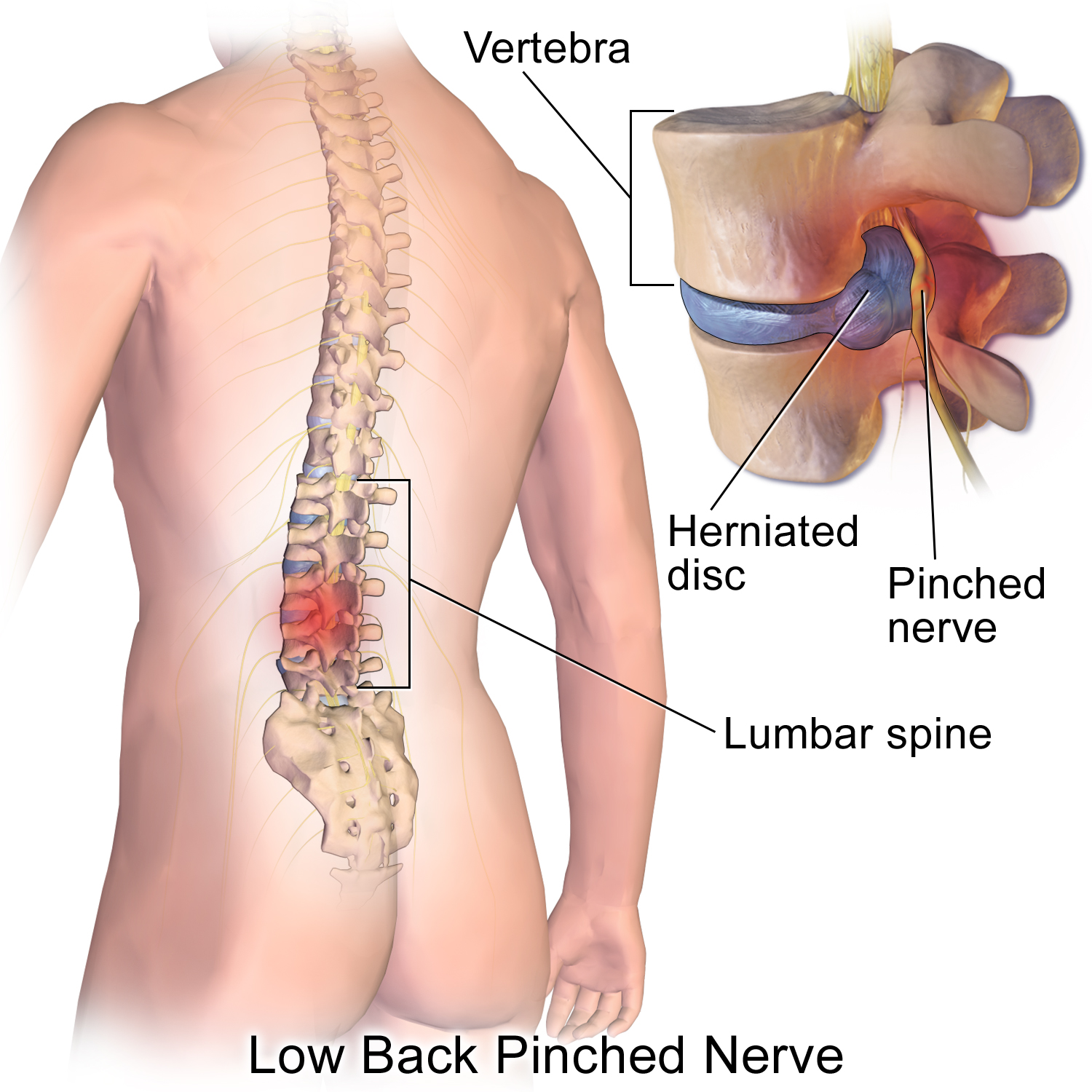
Blausen.com staff (2014), Medical gallery of Blausen Medical 2014, WikiJournal of Medicine 1(2), DOI: 10.15347/wjm/2014.010 — CC BY 3.0. Image source.

Understanding the mechanism
Lumbar radiculopathy means impaired function of a lumbar or sacral nerve root. A disc herniation may produce both mechanical pressure and inflammatory irritation, whereas foraminal stenosis reduces the room around an exiting root. Radicular pain can occur without measurable neurological loss. The term radiculopathy is more specific when compatible sensory, motor or reflex changes are identified.
Symptoms and warning signs
L5 involvement may affect lifting the foot, while S1 involvement may reduce push-off when standing on the toes. These patterns overlap and cannot establish a diagnosis at home. Progressive weakness, new numbness around the perineum or new bladder dysfunction requires urgent assessment. A new inability to empty the bladder is an emergency rather than a reason to await a routine appointment.
Diagnosis and investigations
Assessment compares strength, sensation, reflexes and walking on both sides. A nerve tension test can reproduce symptoms but is not conclusive alone. Hip disease, peripheral neuropathy and vascular disease are important alternatives. MRI is particularly relevant when neurological loss progresses or when persistent symptoms make an intervention a realistic option. Electrodiagnostic testing can clarify uncertain localization.
Treatment and outlook
Management reflects the severity of neurological findings and their effect on daily activities. Modified activity, progressive rehabilitation and individualized medical pain management are common initial steps. Injections and surgery belong to specialist medical care when indicated. Pain may settle before numbness or weakness recovers; improvement should therefore be assessed through function as well as symptom intensity.
The role of TAGMED care
At TAGMED, assessment comes before considering conservative treatment. Motorized spinal decompression is a form of traction and cannot guarantee disc resorption or nerve recovery. NICE recommends not offering traction for low back pain with or without sciatica. Any proposed trial therefore requires a clear explanation of uncertainty, measurable goals and reassessment. Worsening neurological findings must prompt referral rather than escalation of passive treatments.
Practical follow-up
During follow-up, recording leg pain, numbness and strength separately can reveal conflicting changes. Less pain with worsening ability to lift the foot is not neurological improvement and should be reported promptly rather than interpreted as successful recovery.
Frequently asked questions
Is it always sciatica?
No. The affected root determines the distribution, which can include the front of the thigh.
Does MRI establish the diagnosis?
The finding must match the side, spinal level and neurological examination.
Should I stay in bed?
Prolonged bed rest promotes deconditioning; activity is adjusted to symptoms and clinical safety.
When is surgery considered?
With concerning deficits or persistent disability and a matching, treatable anatomical lesion.
What counts as improvement?
Walking, strength and everyday tasks matter alongside pain and sensory symptoms.
Conceptual diagram: the steps depend on clinical findings and do not provide an individual diagnosis.
Medical references
- American Academy of Orthopaedic Surgeons. Low Back Pain.
- NICE. Low back pain and sciatica in over 16s: assessment and management (NG59).
- American Association of Neurological Surgeons. Cauda Equina Syndrome.
References document the topic; their inclusion does not imply endorsement of TAGMED services by those organizations.
Educational information from The Spine Page. This entry does not replace an individual assessment. Documentary version: October 12, 2026. Sylvain Desforges, B.Sc., D.O., N.D., osteopath and naturopath.
TAGMED clinic contact details
For non-urgent consultations and information about available services.
Clinique TAGMED — Terrebonne
1150, rue Lévis, Suite 200
Terrebonne (Québec) J6W 5S6
450‑704‑4447
Clinique TAGMED — Montréal
1140, avenue Beaumont
Mont-Royal (Québec) H3P 3E5
1‑877‑672‑9060