





Sciatica with numbness or weakness in Terrebonne: what to monitor
Numbness is a sensory change; weakness is measurable loss of force. These findings do not carry the same risk and should be assessed objectively.
A heavy leg may reflect pain inhibition, whereas objective difficulty lifting the foot or rising onto the toes suggests a more concerning motor deficit.

Clinical assessment and decision points
Foot drop, rapidly progressive weakness, saddle numbness or a bladder or bowel change requires prompt or urgent assessment.
Examination compares strength, sensation, reflexes, gait, the hip and response to lumbar movement. Imaging is selected when it can change management, not merely to confirm that an abnormality exists.
| Clinical situation | Possible next step | Why it matters |
|---|---|---|
| Stable numbness without weakness | Graduated conservative plan | Follow-up confirms that the course remains safe. |
| New weakness or altered gait | Focused reassessment | The diagnosis or plan may need to change. |
| Progressive neurological deficit | Prompt medical referral | Motor function takes priority over completing a package. |
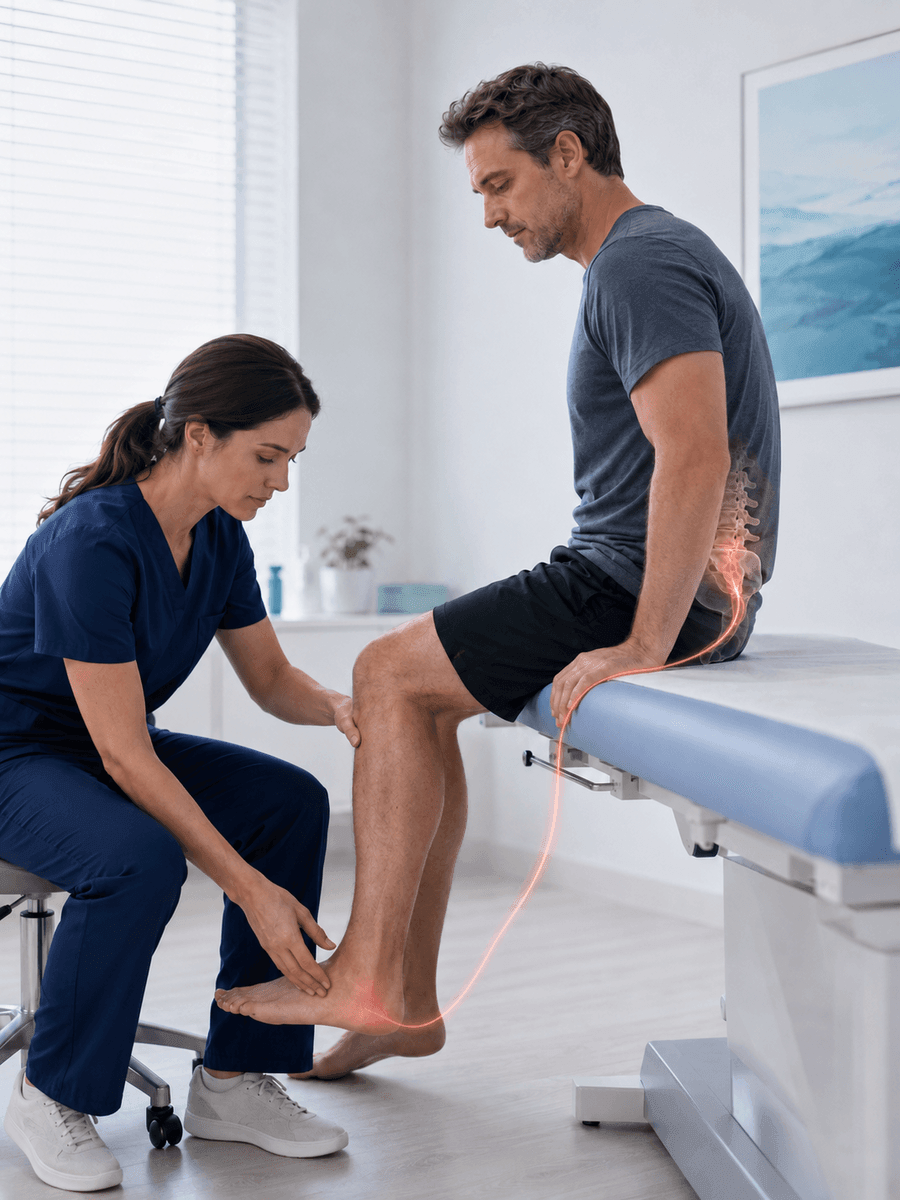

Management options in Terrebonne
Conservative care may be considered when neurological function is stable, but the plan must include repeated strength checks and explicit referral criteria.
The plan must remain reviewable. Neurological worsening, lack of measurable progress or a new atypical finding should trigger reassessment rather than automatic repetition of the same treatment.
How to build a measurable plan
Record heel and toe walking, great-toe lifting, repeated plantar flexion and side-to-side sensory comparison.
Treatment value is judged by changes that matter to the person: better walking, sleep, work, driving or activity while maintaining neurological safety.
- Define the main symptom precisely.
- Record what improves or spreads the symptoms.
- Compare strength and sensation on both sides.
- Retest L5- and S1-related motor function at planned intervals.
- Set a review date.
- Explain referral and emergency criteria.
Track progress and review the plan at the right time
A credible plan defines expected changes and a review point before care begins. Pain intensity alone is insufficient. Symptom distribution, strength, sensation, walking, sleep, positional tolerance and participation in meaningful activities provide a more complete picture of progress.
Temporary relief after treatment does not automatically confirm the proposed cause. Likewise, one more painful day does not necessarily mean that the condition is deteriorating. The trend over several days, function and neurological status should be interpreted together.
Establish a baseline
Record walking distance, sitting time, sleep, strength and one meaningful activity before starting care.
Set a review point
Decide when outcomes will be compared so an ineffective approach is not continued automatically.
Monitor neurological status
New weakness, spreading numbness or a gait change matters even when pain intensity decreases.
Compare pain and function
A person may report less pain without regaining capacity, or function better while some pain remains.
Review alternative causes
The hip, sacroiliac joint, a peripheral nerve or a systemic condition may occasionally mimic sciatica.
Escalate proportionately
Imaging, referral or a procedure should be considered when risk or functional loss justifies it.
Common errors to avoid
- Treating an MRI finding without checking whether it matches the side, symptom distribution and examination.
- Promising a fixed number of visits before establishing a working diagnosis and baseline measures.
- Confusing short-term relief with neurological or functional recovery.
- Repeating passive care despite no measurable progress in meaningful activities.
- Ignoring progressive weakness because pain fluctuates or is temporarily less intense.
- Delaying urgent assessment to finish a predetermined conservative program.
Shared decision-making is stronger when uncertainty is explained directly. Readers should understand what is confirmed, what remains probable, which alternatives are still possible and what changes would require a different plan. When symptoms persist or the diagnosis remains uncertain, a focused second opinion may be more useful than automatically adding another technique.
Questions to ask before starting care
What is the working diagnosis?
Ask which symptoms and examination findings support it.
Which outcome will be measured?
Walking, sleep, strength and meaningful activities matter as much as pain.
When will the plan be reviewed?
Set a time point and criteria to stop, change or escalate care.
Which alternatives remain possible?
Compare active care, technologies, procedures and specialist assessment.

Related Terrebonne cluster guides
Specialized local resource
This local resource is disclosed separately so readers can distinguish independent editorial information from clinical services.
Clinique TAGMED – Terrebonne
Description of assessment and non-surgical sciatica services available in Terrebonne.
Frequently asked questions
Is numbness always an emergency?
No, but progression, distribution and accompanying weakness change priority.
How is this problem assessed?
Examination compares strength, sensation, reflexes and gait, then determines whether imaging or referral is needed.
Can non-surgical care be considered first?
Yes only when neurological function remains stable and repeated checks are planned.
How soon should the plan be reviewed?
Timing depends on risk, severity and intervention. The plan should define a date and measurable goals.
Which changes should be reported promptly?
Weakness, spreading numbness, worsening gait or a new bladder or bowel change.
What should I bring to the appointment?
A symptom timeline, treatments tried, medication list, imaging reports and priority questions.
Is an MRI always required before starting care?
No. It is most useful when the result can change management, especially with neurological deficit, warning signs or persistent symptoms.
Does sciatica automatically mean a herniated disc?
No. A disc herniation is common, but stenosis, foraminal irritation or another condition can produce a similar pattern.
Is bed rest recommended?
Prolonged bed rest is generally discouraged. Modified and gradually increased activity is usually preferred when neurological findings remain stable.
When is urgent assessment required?
With a new bladder or bowel change, saddle numbness, major or rapidly progressive weakness, fever or significant trauma.
Main clinical sources
- NICE – Low back pain and sciatica in over 16s
- World Health Organization – Guideline for non-surgical management of chronic primary low back pain
- North American Spine Society – Clinical guidelines
Last editorial review: July 2026. General educational information only.
Dr. Sylvain Desforges, B.Sc., D.O., N.D., osteopath – The Spine Page
Continue researching sciatica
Compare the related guides and return to the pillar page for a complete view of sciatica treatment in Terrebonne.
The Spine Page – The best treatments for your spinal problems – www.thespinepage.com