

Pain radiating into the lower limb along a distribution compatible with sciatic nerve roots, often associated with nerve root irritation.
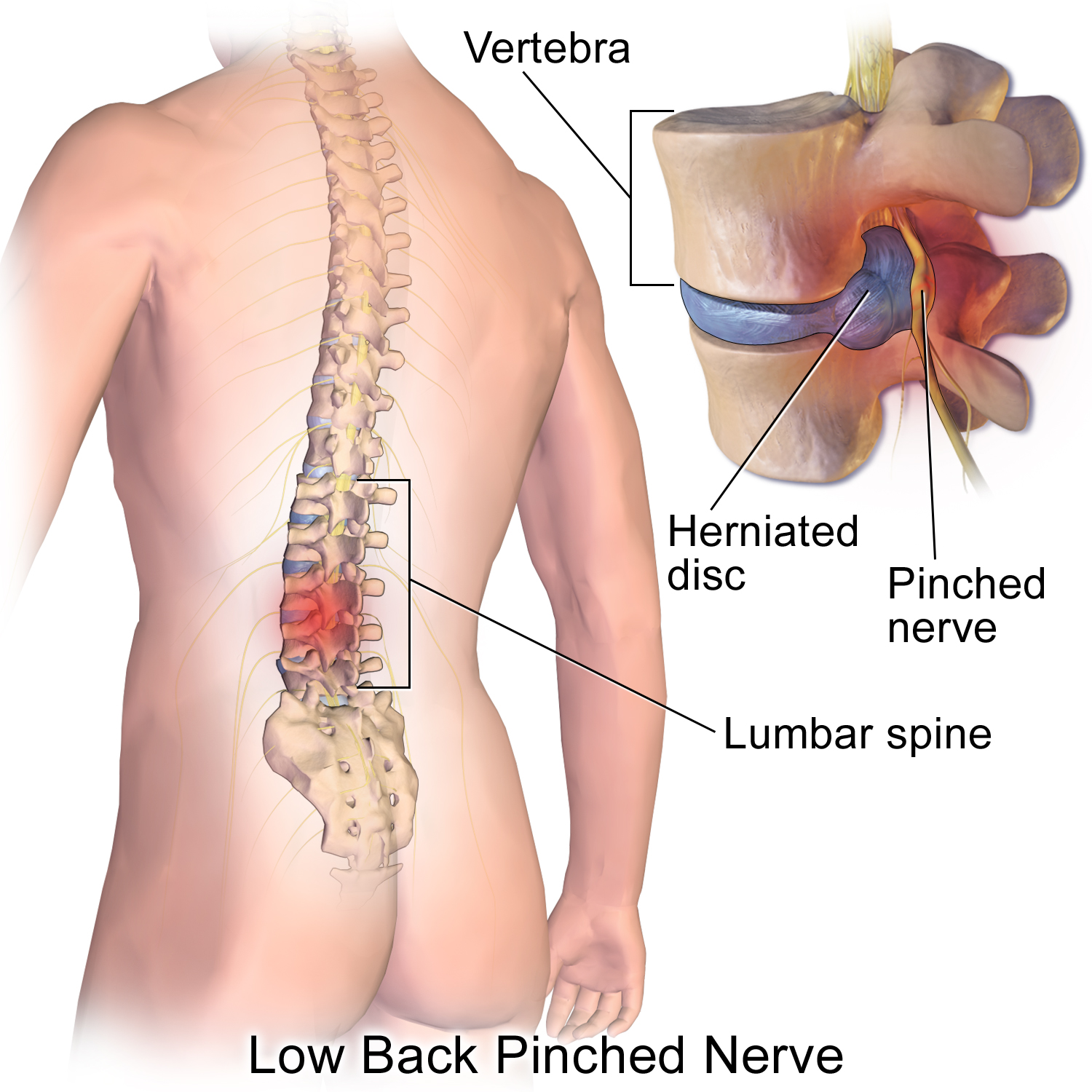
Blausen.com staff (2014), Medical gallery of Blausen Medical 2014, WikiJournal of Medicine 1(2), DOI: 10.15347/wjm/2014.010 — CC BY 3.0. Image source.

Understanding the mechanism
Sciatica describes pain travelling through the buttock and lower limb in a distribution compatible with sciatic nerve roots. It does not identify the underlying cause. A lumbar disc herniation is one possibility, but spinal stenosis and some disorders outside the spine can create similar symptoms. Establishing the source matters more than simply applying the sciatica label.
Symptoms and warning signs
Pain may feel electrical or burning and can worsen with coughing. Numbness or weakness may occur, although neither is required. Pain confined to the buttock can also arise from the hip or local tissues. New bladder dysfunction, loss of sensation around the saddle area or rapidly progressive weakness requires emergency assessment, even when a previous episode settled without treatment.
Diagnosis and investigations
The clinician maps the pain, asks how it began and identifies positions and activities that change it. A neurological examination checks for radiculopathy. Hip assessment and circulation testing may be relevant to the differential diagnosis. Routine MRI during the first few days is not always useful; imaging is most valuable when its findings are likely to change the management decision.
Treatment and outlook
Initial care commonly aims to maintain tolerable activity, protect sleep and restore everyday tasks progressively. Medication choices need to be individualized: medicines used for other neuropathic conditions are not automatically appropriate for sciatica. A worsening course or neurological deficit calls for medical reassessment. Injections and surgery are specialist options for selected patients, not inevitable next steps.
The role of TAGMED care
TAGMED can assess mechanical contributors and discuss appropriate conservative care. Motorized spinal decompression is a traction technique, and evidence does not support promising a uniform response; NICE recommends not offering traction for low back pain with or without sciatica. Any passive modality should serve a functional goal and have a reassessment point. A visible herniation is not, by itself, a reason to continue an ineffective course of treatment.
Practical follow-up
Describing how far the pain travels and what actually restricts the day is more useful than searching for a perfect posture. A changed distribution, new weakness or loss of sensation should be reported during follow-up and reassessed appropriately.
Frequently asked questions
Does sciatica mean permanent nerve damage?
No. Radicular pain can exist without persistent loss of nerve function.
Must the lower back hurt?
No. Leg pain can be dominant even when back pain is minimal.
Does a larger herniation cause worse pain?
Scan size alone does not determine pain intensity or the chance of recovery.
How many visits are needed?
There is no universal number; response, function and examination guide follow-up.
Is surgery unavoidable?
No. It is considered for selected neurological problems or ongoing disabling symptoms.
Conceptual diagram: the steps depend on clinical findings and do not provide an individual diagnosis.
Medical references
- NICE. Low back pain and sciatica in over 16s: assessment and management (NG59).
- American Academy of Orthopaedic Surgeons. Low Back Pain.
- American Association of Neurological Surgeons. Cauda Equina Syndrome.
References document the topic; their inclusion does not imply endorsement of TAGMED services by those organizations.
Educational information from The Spine Page. This entry does not replace an individual assessment. Documentary version: October 12, 2026. Sylvain Desforges, B.Sc., D.O., N.D., osteopath and naturopath.
TAGMED clinic contact details
For non-urgent consultations and information about available services.
Clinique TAGMED — Terrebonne
1150, rue Lévis, Suite 200
Terrebonne (Québec) J6W 5S6
450‑704‑4447
Clinique TAGMED — Montréal
1140, avenue Beaumont
Mont-Royal (Québec) H3P 3E5
1‑877‑672‑9060