

A transverse process is a lateral bony projection on each side of a vertebra. It provides muscle and ligament attachments and, depending on the spinal region, also contributes to relationships with the ribs or cervical blood vessels.
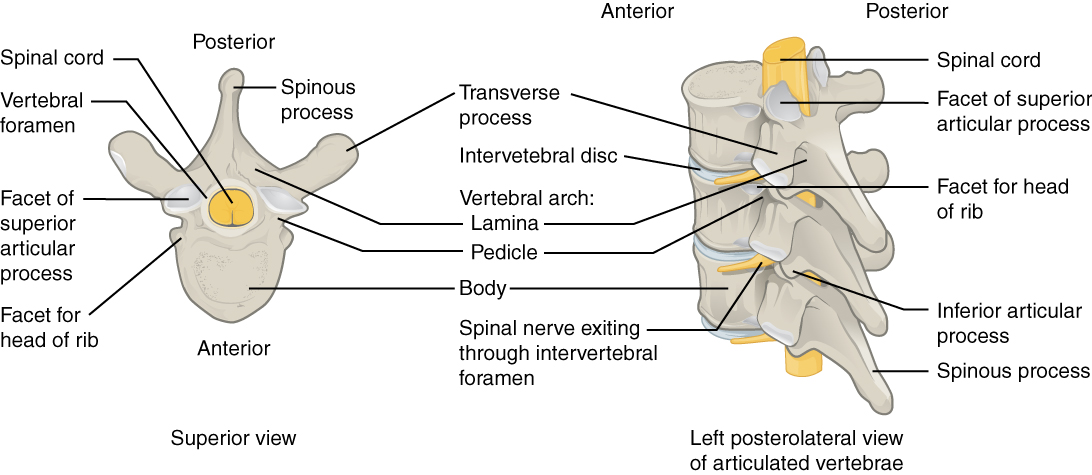
OpenStax College — CC BY 3.0. Image source.

Structure and function
Transverse processes extend to either side of the vertebral arch. They provide anchoring points and lever arms for spinal muscles. In the thoracic region, several carry a joint surface for a rib. In the neck, transverse foramina pass through them, with contents that vary by level and individual anatomy.
Possible manifestations
A fracture may follow trauma or strong pulling by attached tissues. Lateral pain and tenderness are possible but do not establish the diagnosis. After substantial impact, a transverse process fracture may accompany other injuries. Its apparently small size therefore does not remove the need to assess the person and the mechanism as a whole.
Assessment and management
Examination considers the injury mechanism, breathing, abdomen and neurological status where relevant. Bony imaging can define a suspected fracture. An isolated stable injury may be managed conservatively with pain control and a gradual return to activity. Associated injuries change priorities, and recommendations cannot be based solely on the name of the fractured projection.
Role of TAGMED care
At TAGMED, nonurgent lateral discomfort may be assessed to distinguish muscular pain from other causes. Suspected fracture requires referral first. Palpation alone cannot establish that a transverse process needs to be repositioned, and local mechanical care must respect any confirmed injury.
Warning signs
After an accident, substantial pain with weakness, breathing difficulty, abdominal pain or faintness requires urgent assessment. Local mechanical treatment should not continue before a significant associated injury has been excluded through the appropriate medical evaluation.
Frequently asked questions
Is it the central back prominence?
No. That is usually a spinous process.
Is there a rib at every level?
No. Ribs articulate with the thoracic spine.
Do all cervical foramina contain identical structures?
No. Their contents differ by level and anatomical variation.
Is a fracture always unstable?
No. The complete injury pattern determines stability.
Can nearby pain be muscular?
Yes. Several muscles attach to these projections.
Conceptual anatomical and clinical relationships; not drawn to scale.
Medical references
- OpenStax — Rice University. The Vertebral Column.
- AAOS — OrthoInfo. Fractures of the Thoracic and Lumbar Spine.
- AAOS — OrthoInfo. Cervical Fracture (Broken Neck).
References document the topic; their inclusion does not imply endorsement of TAGMED services by those organizations.
Educational information from The Spine Page. This entry does not replace an individual assessment. Documentary version: October 12, 2026. Sylvain Desforges, B.Sc., D.O., N.D., osteopath and naturopath.
TAGMED clinic contact details
For non-urgent consultations and information about available services.
Clinique TAGMED — Terrebonne
1150, rue Lévis, Suite 200
Terrebonne (Québec) J6W 5S6
450‑704‑4447
Clinique TAGMED — Montréal
1140, avenue Beaumont
Mont-Royal (Québec) H3P 3E5
1‑877‑672‑9060