

The spinous process is a posterior bony projection near the midline of a typical vertebra. It provides attachment for muscles and ligaments and contributes to the lever arms used during movements of the spine and trunk.
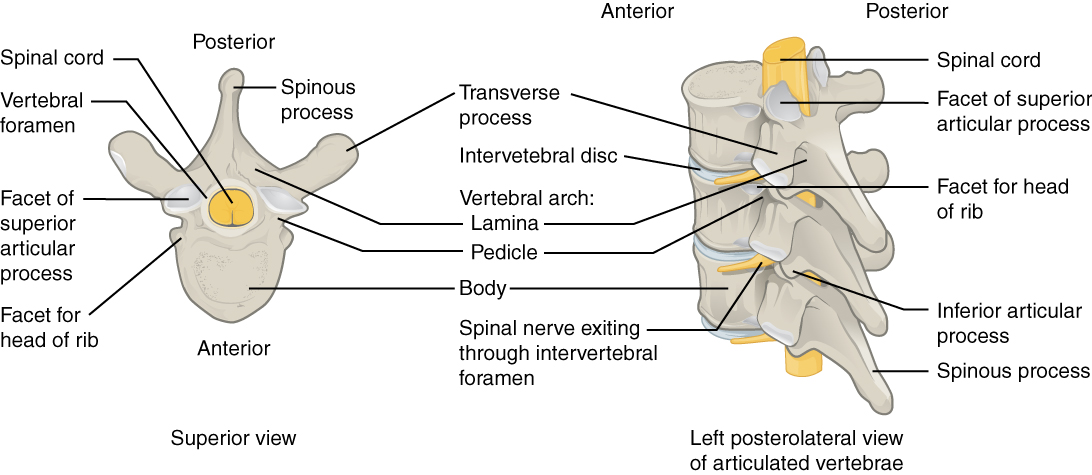
OpenStax College — CC BY 3.0. Image source.

Structure and function
Spinous processes form some of the palpable bumps along the middle of the back. Their length, direction and shape vary across regions; the atlas lacks a true spinous process. Interspinous and supraspinous ligaments contribute attachments between these projections, while several muscles use them as anchoring points.
Possible manifestations
Local tenderness may accompany bruising, muscular or ligament strain, or fracture. Contact between neighbouring processes can be described on imaging, but its presence does not prove a painful origin. A visible prominence may simply reflect normal anatomy, posture or the thickness of overlying tissues rather than a structural injury.
Assessment and management
Examination considers the mechanism, location and movements that provoke symptoms. After trauma, imaging may look for a fracture and, importantly, associated injuries. An isolated stable fracture has different implications from a more extensive injury. Palpation cannot establish displacement of an entire vertebra, and a painful bump alone does not identify a specific treatment.
Role of TAGMED care
At TAGMED, mechanical discomfort without warning signs may lead to discussion of graded activity and suitable manual care. Tenderness on pressure is insufficient to select a tissue for treatment. Suspected fracture needs assessment before local mechanical techniques or repeated pressure are attempted.
Warning signs
Substantial neck pain after a fall or impact needs timely medical assessment without manipulation. New weakness, difficulty walking or bladder or bowel changes requires urgent evaluation regardless of how tender the superficial bony prominence feels.
Frequently asked questions
Is the most visible bump abnormal?
Not necessarily. Normal anatomy varies considerably between people.
Does it indicate a displaced vertebra?
Appearance and palpation cannot establish that conclusion.
Do all processes have the same shape?
No. Some are bifid or point more strongly downward.
Does a fracture always injure the cord?
No. Associated injuries and stability determine the consequences.
Should an injured area be massaged directly?
Not before the cause and appropriate precautions have been clarified.
Conceptual anatomical and clinical relationships; not drawn to scale.
Medical references
- OpenStax — Rice University. The Vertebral Column.
- AAOS — OrthoInfo. Fractures of the Thoracic and Lumbar Spine.
- AAOS — OrthoInfo. Spine Basics.
References document the topic; their inclusion does not imply endorsement of TAGMED services by those organizations.
Educational information from The Spine Page. This entry does not replace an individual assessment. Documentary version: October 12, 2026. Sylvain Desforges, B.Sc., D.O., N.D., osteopath and naturopath.
TAGMED clinic contact details
For non-urgent consultations and information about available services.
Clinique TAGMED — Terrebonne
1150, rue Lévis, Suite 200
Terrebonne (Québec) J6W 5S6
450‑704‑4447
Clinique TAGMED — Montréal
1140, avenue Beaumont
Mont-Royal (Québec) H3P 3E5
1‑877‑672‑9060