

The vertebral arch is the posterior bony framework formed by two pedicles and two laminae in a typical vertebra. Together with the vertebral body, it encloses the vertebral foramen and helps protect neural structures within the spinal canal.
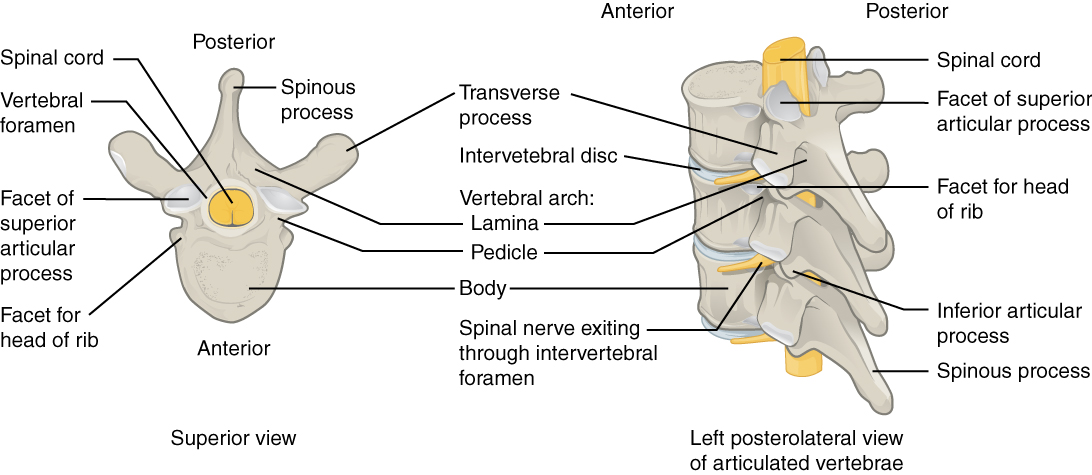
OpenStax College — CC BY 3.0. Image source.

Structure and function
The arch connects the vertebral body with the posterior projections of the vertebra. Pedicles provide its lateral attachments, while the laminae meet toward the back. Articular and muscular processes arise from this framework. The openings in successive vertebrae collectively form the spinal canal.
Possible manifestations
This arrangement protects neural tissues while providing attachments for joints, muscles and ligaments. A fracture or developmental variation can alter the arch. Its significance depends on segment stability and the space available for neural structures, rather than on the anatomical label alone. Some findings are incidental and do not explain a person’s pain.
Assessment and management
Assessment examines the mechanism of onset, pain and possible neurological impairment. CT provides detailed bony anatomy; MRI can assess surrounding ligaments and neural structures. Neither investigation is automatically needed for every backache. Surgery may remove part of the arch to relieve compression, but this requires a compatible clinical and imaging assessment.
Role of TAGMED care
TAGMED care should address the clinical presentation without attempting to change an arch simply because its shape is described as unusual. Suspected fracture, instability or significant neurological compression requires appropriate referral before local traction or manipulation is considered.
Warning signs
After substantial trauma, do not test spinal movement yourself. Progressive weakness, saddle numbness or new difficulty passing urine requires immediate medical assessment. Urgent neurological symptoms take priority over a planned course of conservative treatment.
Frequently asked questions
Is the arch a ligament?
No. It is a bony framework made of several components.
Is every arch identical?
No. Its shape differs across cervical, thoracic and lumbar regions.
Does an abnormal shape always hurt?
No. Some anatomical variations remain symptom-free.
Does laminectomy remove the entire arch?
Not necessarily; the extent depends on the operation.
Can palpation establish its condition?
No. Palpation cannot reveal deep architecture or the canal contents.
Conceptual anatomical and clinical relationships; not drawn to scale.
Medical references
- OpenStax — Rice University. The Vertebral Column.
- AAOS — OrthoInfo. Fractures of the Thoracic and Lumbar Spine.
- ACR — RSNA. Spine MRI.
References document the topic; their inclusion does not imply endorsement of TAGMED services by those organizations.
Educational information from The Spine Page. This entry does not replace an individual assessment. Documentary version: October 12, 2026. Sylvain Desforges, B.Sc., D.O., N.D., osteopath and naturopath.
TAGMED clinic contact details
For non-urgent consultations and information about available services.
Clinique TAGMED — Terrebonne
1150, rue Lévis, Suite 200
Terrebonne (Québec) J6W 5S6
450‑704‑4447
Clinique TAGMED — Montréal
1140, avenue Beaumont
Mont-Royal (Québec) H3P 3E5
1‑877‑672‑9060