

The vertebral body is the anterior, weight-bearing bony portion of a typical vertebra. It transfers loads between neighbouring discs and contributes to the front boundary of the spinal canal, with size and shape varying between spinal regions.
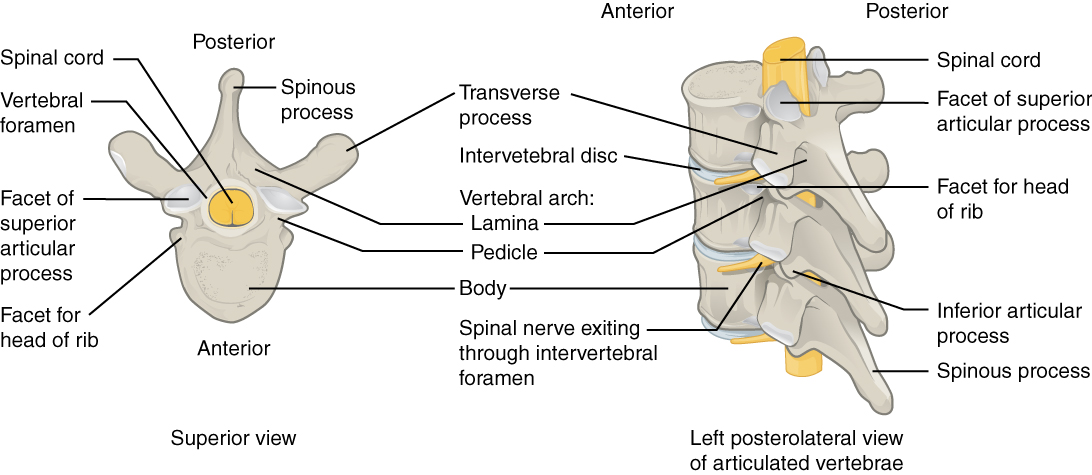
OpenStax College — CC BY 3.0. Image source.

Structure and function
The vertebral body forms the bony block in front of the vertebral arch. It contains a network of cancellous bone surrounded by a denser outer shell. Its upper and lower surfaces contribute to the vertebral endplates, which meet discs through most of the spine.
Possible manifestations
Its strength depends on bone quality and how forces are distributed. A compression fracture may produce localized pain, loss of height or deformity. Some osteoporotic fractures cause relatively few symptoms. An abnormality within the vertebral body can also reflect infection or a tumour, so the imaging description needs clinical interpretation.
Assessment and management
Assessment considers trauma, osteoporosis and neurological findings. X-rays, CT and MRI answer different questions about deformity, bone architecture, probable fracture age and surrounding tissues. Management depends on the cause and stability. Bone-health treatment, rehabilitation or specialist intervention may be needed; an imaging label alone cannot determine the appropriate pathway.
Role of TAGMED care
At TAGMED, suspected fracture requires postponing local mechanical treatments and arranging appropriate assessment. Naming this structure in a report does not independently justify traction, laser treatment or manual therapy. Subsequent physical care should respect healing and any specialist restrictions.
Warning signs
Severe pain after trauma, new weakness or urinary changes accompanying back symptoms requires urgent assessment. New neurological dysfunction may require immediate emergency department evaluation rather than a routine treatment appointment.
Frequently asked questions
Is it the whole vertebra?
No. The posterior arch and bony processes are separate components.
Does it contain the spinal cord?
No. The cord lies in the canal behind the body.
Is vertebral collapse always recent?
No. The history and sometimes MRI help establish its age.
Does a fracture always need surgery?
No. Stability and neurological involvement guide the decision.
Can bone strength be supported?
Bone-health management and appropriate loading contribute to prevention.
Conceptual anatomical and clinical relationships; not drawn to scale.
Medical references
- OpenStax — Rice University. The Vertebral Column.
- AAOS — OrthoInfo. Fractures of the Thoracic and Lumbar Spine.
- ACR — RSNA. Spine MRI.
References document the topic; their inclusion does not imply endorsement of TAGMED services by those organizations.
Educational information from The Spine Page. This entry does not replace an individual assessment. Documentary version: October 12, 2026. Sylvain Desforges, B.Sc., D.O., N.D., osteopath and naturopath.
TAGMED clinic contact details
For non-urgent consultations and information about available services.
Clinique TAGMED — Terrebonne
1150, rue Lévis, Suite 200
Terrebonne (Québec) J6W 5S6
450‑704‑4447
Clinique TAGMED — Montréal
1140, avenue Beaumont
Mont-Royal (Québec) H3P 3E5
1‑877‑672‑9060