


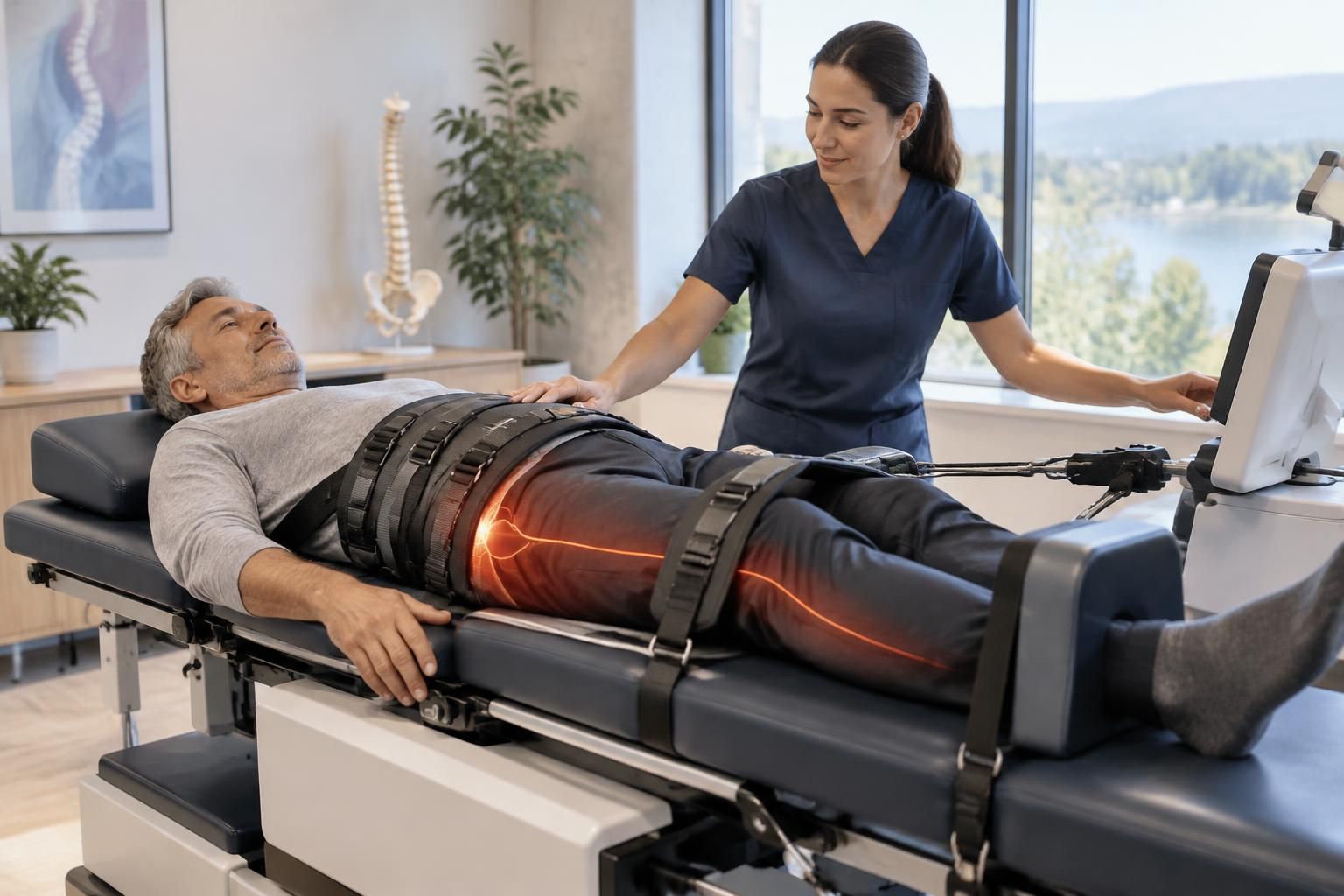
When pain that travels into the buttock or leg returns after a period of relief, it is natural to look for an option that considers its possible cause. Neurovertebral decompression is a progressive, controlled motorized lumbar traction treatment that may be considered for some people, particularly when symptoms suggest irritation related to a disc; however, it is not suitable for all cases of recurrent sciatica and does not guarantee relief.
For someone in Longueuil who spends time sitting at work or in a car, the first consideration is understanding what triggers the episodes and whether neurological signs are present. An assessment can distinguish radicular pain from other causes of low back pain, identify necessary precautions, and determine whether this approach, or another one, has a role in back care.


In brief: what you need to know about recurrent sciatica
A recurrence should be understood. The return of pain alone does not make it possible to conclude that a disc herniation has worsened.
Decompression is a selective option. This motorized traction may be discussed after an assessment, but it is neither necessary nor appropriate for everyone.
Response varies. Symptoms, their progression, examination findings, and contraindications guide the choice; no number of sessions is suitable for everyone.
Some signs require urgent action. Loss of bladder or bowel control, saddle anaesthesia, or rapidly progressive weakness requires immediate medical assessment.
To learn more about the different possible causes, consult the guidance on the causes and assessment of sciatica.
Why can sciatica return in Longueuil?
The word “sciatica” generally describes pain that radiates into the buttock and part of the leg, sometimes as far as the foot. Irritation of a lumbar nerve root may be the cause, but referred pain from muscles or joints can produce a similar pattern without involving the same condition.
A disc herniation or protrusion may irritate a nerve root; foraminal narrowing, where the nerve exits the spine, may also be involved. The L4, L5, and S1 roots can produce different symptoms, but the path of the pain is not enough to identify the root precisely or establish a diagnosis.
Episodes can fluctuate with activities, tolerance for certain positions, and the natural course of the problem. Pain that returns therefore does not automatically mean that the disc has shifted or that the situation has worsened; the clinical examination and, when indicated, imaging must be interpreted together.
In Longueuil, a car commute or a day of sitting at work can make symptoms more noticeable for some people. Others instead notice worsening when walking, climbing stairs, or bending forward; these differences help describe the problem without, on their own, revealing its cause.
Neurovertebral decompression: mechanism, indications, and limitations
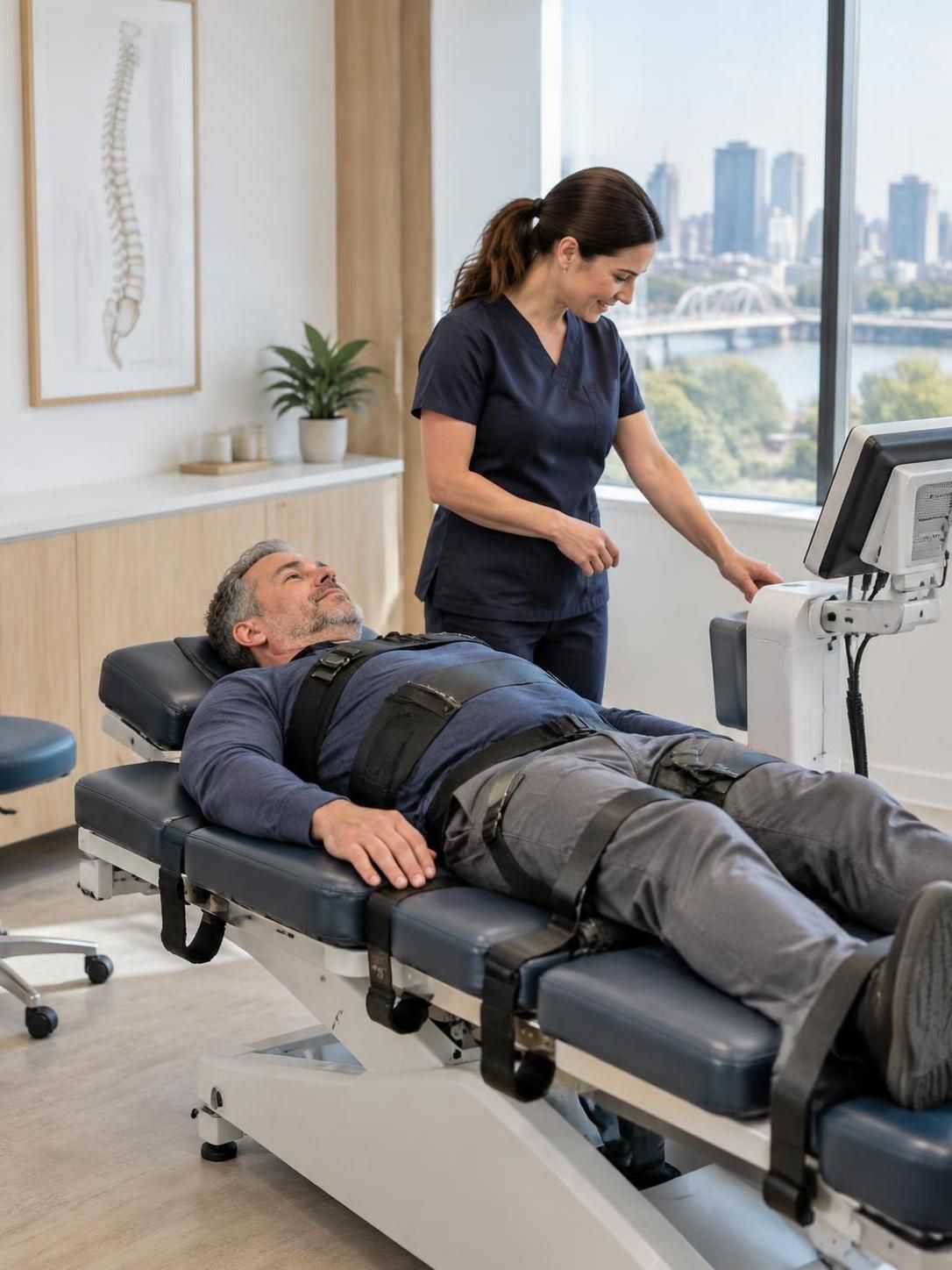
Neurovertebral decompression uses a motorized table to apply controlled traction to the lumbar region. The goal is to temporarily modify certain mechanical stresses on the spine and surrounding structures; it is not intended to put a disc “back in place” or guarantee the resolution of nerve compression.
This approach may be discussed for certain profiles with symptoms consistent with disc-related or foraminal irritation, following an examination. The presence of a herniation or protrusion on imaging alone is not enough to establish that decompression is indicated: imaging findings must correspond with the symptoms and functional assessment.
Available evidence on traction and decompression methods does not allow for a uniform outcome to be promised. Some people may report improvement, while others notice little change or tolerate traction poorly. Pain, mobility, and function should therefore be monitored, and the approach reassessed if symptoms worsen or do not progress as expected.
An overview of neurovertebral decompression for sciatica can help explain what this option involves. However, a neurovertebral decompression clinic should review health history, neurological symptoms, and contraindications before offering treatment; recent fractures, certain infections, or other health conditions may require another course of action or medical advice.
TAGMED Clinic is located at 1140 Beaumont Avenue in Mount Royal, near Outremont and Côte-des-Neiges. People in Longueuil looking for sciatica treatment in Longueuil or spinal decompression in Longueuil should confirm the actual location of services and not confuse a service area with a clinic address.
A video can illustrate how a table works, but it does not replace an assessment or a discussion of the benefits and limitations specific to your situation.
What can affect symptoms and response to treatment
Prolonged sitting, driving, trunk flexion, or certain exertions can worsen pain for some people. Others feel stiffer after inactivity and better after a moderate walk. There is no universal posture to avoid or seek; the observed effect on symptoms remains the practical guide.
For a person who regularly drives between Longueuil and other areas of the region, changing positions and taking breaks when possible may help make the trip more tolerable. These are comfort adjustments, not treatment for the cause. If pain progressively travels further down the leg, numbness progresses, or weakness appears, reassessment is indicated.
| Situation | Possible response | Cautious guidance |
|---|---|---|
| Prolonged sitting or driving | Stiffness or increased pain for some people | Change position and observe whether breaks alter symptoms. |
| Moderate-paced walking | May be tolerated or help reduce stiffness; response varies. | Stay within a comfortable range and reduce effort if symptoms intensify. |
| Bending or sudden exertion | May trigger radiating pain in certain profiles. | Adapt the movement rather than pushing through pain. |
| Coughing or sneezing | May briefly intensify radicular pain. | Report persistent worsening or worsening accompanied by loss of function. |
Exercises and movement advice can be part of sciatica treatment, provided they are adapted to tolerance and functional goals. An exercise that clearly increases leg pain should be stopped; persistent worsening, progressing numbness, or new weakness warrants an assessment rather than adding more effort.
An ergonomic aid purchased online, such as a cushion, does not treat a nerve root and may not suit every body type. The most helpful position is often one that can be varied without causing a lasting increase in symptoms.
Management options and the role of decompression
Management depends on the severity, duration, and progression of symptoms. When safe, maintaining or gradually resuming activities may help preserve function; adapted exercises and movement advice can be discussed with a professional. Physiotherapy, manual care, or other conservative approaches may be considered according to needs and available resources.
Medications should be discussed with an authorized professional, taking other health conditions and treatments already being used into account. In some situations, an injection or specialist opinion may be proposed. Surgery may be considered when significant compression, a neurological deficit, or the clinical progression warrants it; neurovertebral decompression does not replace it when it is necessary.
Conventional traction, exercises, manual care, and motorized decompression are not interchangeable interventions. Progressive decompression may be considered for a selected person, but it has not been established as superior for all profiles. Relief of nerve pain depends, among other factors, on the actual cause, tolerance, and individual progression.
At TAGMED Clinic, approaches related to sciatica may include, depending on the assessment, motorized decompression, specific osteopathy, or a precision percussor. They do not replace urgent medical services or referral to another professional when the clinical picture requires it. Results vary, and no number of sessions can be presented as suitable for everyone.
The signs indicating when to seek care for sciatic pain are helpful in choosing the appropriate level of assessment. To understand an option proposed at the clinic, information on motorized neurovertebral decompression can complement, but not replace, the discussion.
When should you seek an assessment, and which signs are urgent?
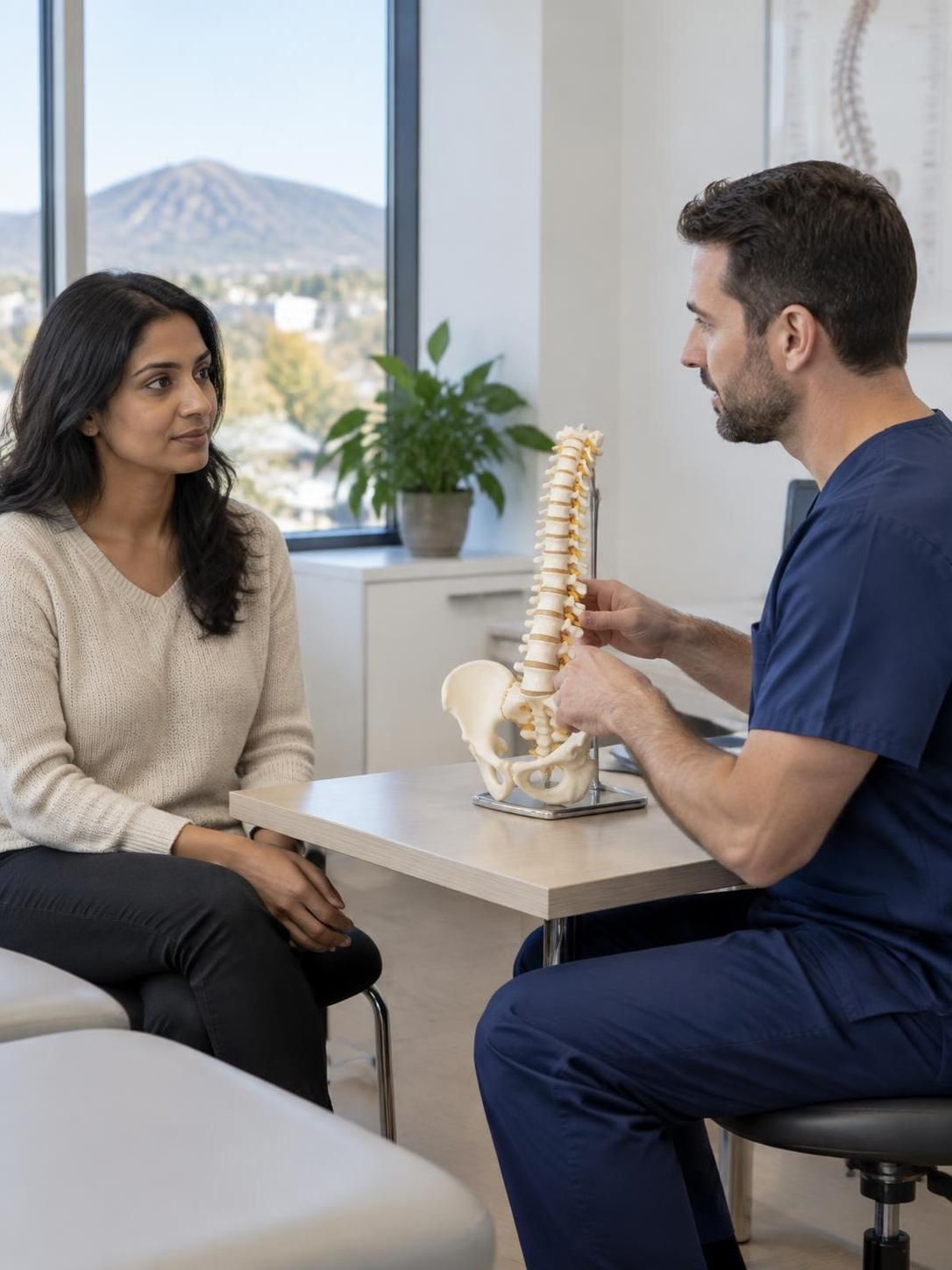
A clinical assessment is indicated if pain persists or returns, travels below the knee, disrupts sleep, or limits walking and daily activities. Numbness, loss of sensation, weakness, or loss of function also deserves clinical attention, particularly if the symptom is new or progressing.
Urgent medical assessment is required in the event of loss of bladder or bowel control, saddle anaesthesia — around the genitals and anus — or significant or rapidly progressive weakness. Fever or impaired general health, significant trauma, or pain in the context of cancer or infection also warrants prompt medical care.
These signs cannot be reliably assessed remotely. If an urgent symptom is present, do not delay assessment to try traction, exercise, or conservative treatment.
For recurrent episodes without emergency signs, note the movements or positions associated with the pain, the painful area, and changes in sensation. This information helps the professional guide the examination and determine whether imaging or another assessment is appropriate.
Frequently asked questions about decompression and recurrent sciatica
Does recurrent sciatica mean my disc herniation has worsened?
Not necessarily. A recurrence can depend on several factors and does not, on its own, indicate worsening; symptoms must be interpreted alongside the clinical examination and, if indicated, imaging.
Is neurovertebral decompression suitable for any pain that travels down the leg?
No. It may be discussed for some people after an assessment, but different causes can produce radiating pain, and some situations require another approach to care.
How many sessions should be expected?
There is no universal number. The appropriateness of continuing should be reassessed according to tolerance, changes in symptoms, and functional goals.
When should I seek care if symptoms persist?
Seek an assessment if pain recurs or limits walking, sleep, or activities, or if numbness, loss of sensation, or weakness appears. The urgent signs described above require immediate medical assessment.
Does decompression necessarily avoid surgery?
No. It may be a conservative option for certain profiles, but it does not guarantee avoiding surgery and does not replace a specialist opinion when one is indicated.
If low back pain that travels down the leg returns and limits your activities, an assessment can help clarify the likely causes, signs to watch for, and the appropriateness of a conservative approach. People in Longueuil can consult information on sciatica assessment and management options offered in Mount Royal.
Sylvain Desforges, B.Sc., D.O., N.D., osteopath and naturopath
This content is educational and does not replace a personalized assessment.
