

Dysfunction of a neck nerve root that may cause pain, sensory changes or weakness in an arm distribution.
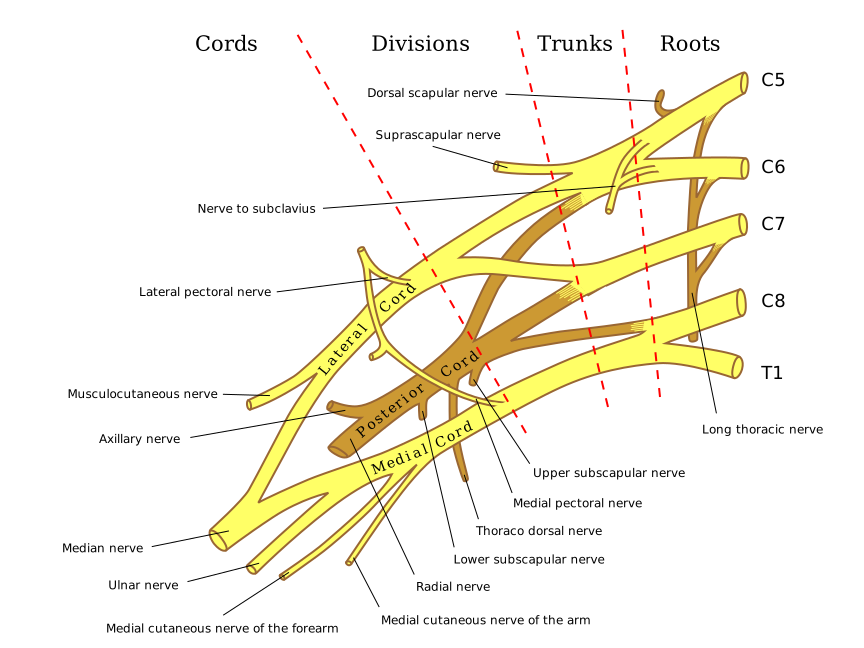
Mattopaedia, Captain-n00dle et MissMJ, d’après Gray’s Anatomy (1918) — Domaine public — PD-self. Image source.

Understanding the mechanism
Cervical radiculopathy involves a nerve root leaving the neck. A herniated disc, a bone spur or a narrowed foramen can irritate that root. It differs from myelopathy, which affects the spinal cord and can also disturb the legs. A cervical imaging abnormality is not necessarily the cause of arm symptoms, particularly when the clinical distribution does not match.
Symptoms and warning signs
Pain may extend into the shoulder blade, shoulder, arm or hand, with tingling, reduced sensation or weakness. Symptoms do not always follow a perfectly drawn dermatome. Increasing hand clumsiness, an altered walking pattern or symptoms in several limbs raise concern for spinal cord involvement. Such changes require timely medical assessment rather than assuming a simple pinched nerve.
Diagnosis and investigations
Examination combines neck movement, strength, sensation and reflexes with assessment of the shoulder and peripheral nerves. Carpal tunnel syndrome and ulnar nerve entrapment can produce similar hand symptoms. MRI assesses soft tissues when indicated, and electrodiagnostic studies can help distinguish a root disorder from a peripheral nerve lesion. A positive Spurling test is only one part of the assessment.
Treatment and outlook
Many episodes improve with conservative management. Exercise progresses according to symptom response, while medication decisions belong to an appropriate prescriber. Progressive weakness, persistent severe pain or substantial disability may require specialist review. Decisions about an injection or surgery depend on the relationship between examination findings, imaging and the course of the condition rather than the scan alone.
The role of TAGMED care
At TAGMED, gentle mobilization or cervical traction may be discussed for selected presentations after contraindications are considered. Expected benefits and uncertainty should be explained. Spinal decompression does not automatically reposition a disc. Suspected myelopathy, instability or fracture must be assessed before any traction trial; laser and shockwave treatment cannot remove spinal cord compression.
Practical follow-up
Follow-up can compare a practical task, such as holding an object or using a keyboard, alongside examination findings. Recovery is not measured only through neck movement; useful arm and hand function remains central to evaluating the management plan.
Frequently asked questions
Can shoulder blade pain originate in the neck?
Yes, although local shoulder conditions and other causes also need consideration.
Do numb fingers prove a disc herniation?
No. Several nerve roots and peripheral nerves can produce overlapping symptoms.
Is a neck collar necessary?
Prolonged unsupported use can restrict activity; any short-term use should have a specific purpose.
Can work continue?
Often, with changes to tasks, breaks and monitoring of strength.
What changes the urgency?
Increasing weakness or a new walking difficulty calls for prompt medical reassessment.
Conceptual diagram: the steps depend on clinical findings and do not provide an individual diagnosis.
Medical references
- American Academy of Orthopaedic Surgeons. Cervical Radiculopathy (Pinched Nerve).
- Johns Hopkins Medicine. Cervical Myelopathy.
- NICE. Low back pain and sciatica in over 16s: assessment and management (NG59).
References document the topic; their inclusion does not imply endorsement of TAGMED services by those organizations.
Educational information from The Spine Page. This entry does not replace an individual assessment. Documentary version: October 12, 2026. Sylvain Desforges, B.Sc., D.O., N.D., osteopath and naturopath.
TAGMED clinic contact details
For non-urgent consultations and information about available services.
Clinique TAGMED — Terrebonne
1150, rue Lévis, Suite 200
Terrebonne (Québec) J6W 5S6
450‑704‑4447
Clinique TAGMED — Montréal
1140, avenue Beaumont
Mont-Royal (Québec) H3P 3E5
1‑877‑672‑9060