

Pressure on the spinal cord. New or progressive neurological findings warrant urgent medical assessment.
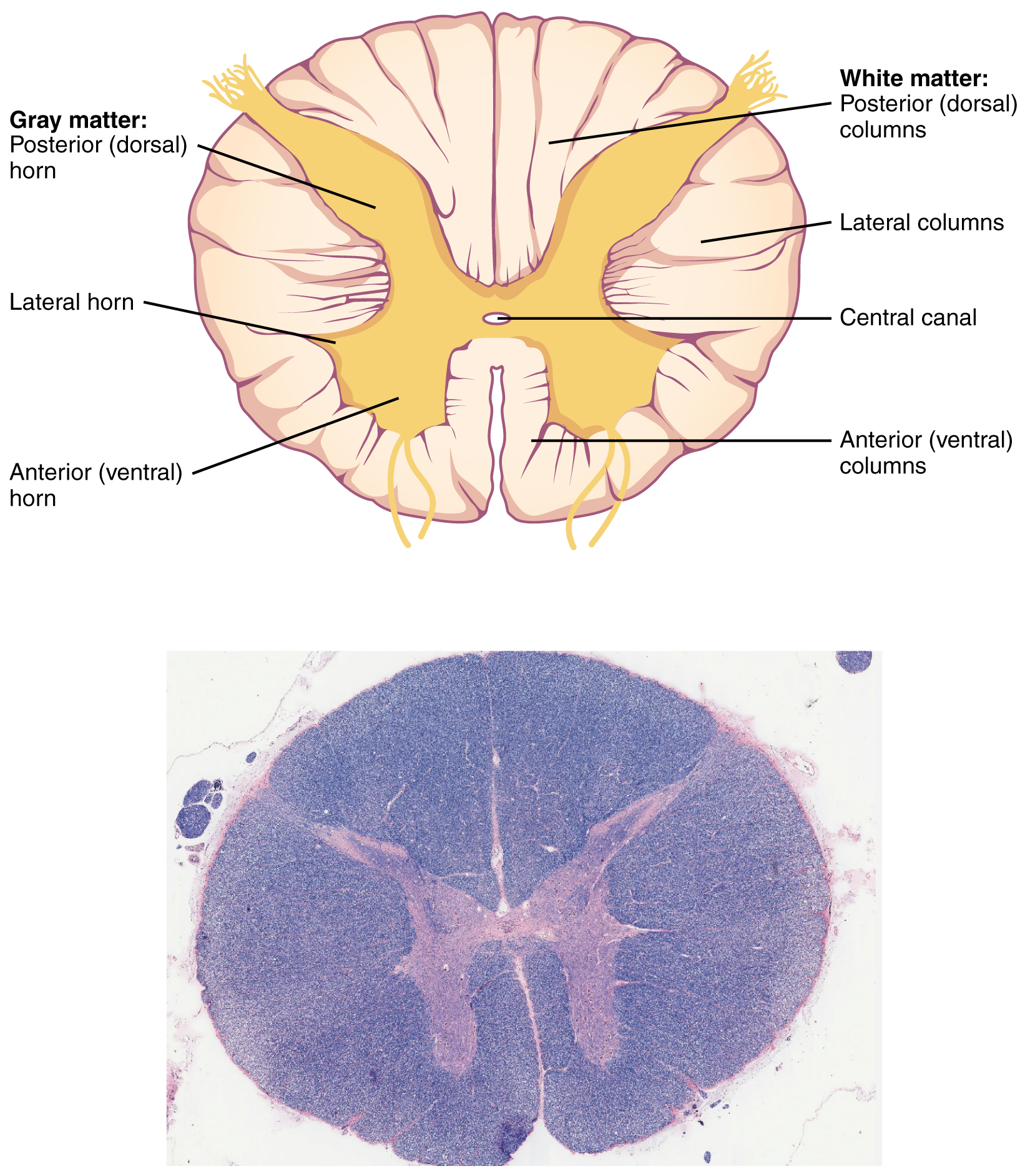
OpenStax — CC BY 4.0. Image source.

Understanding the mechanism
Spinal cord compression means pressure on the spinal cord. It can arise from degenerative narrowing, a disc herniation, fracture, tumour, hematoma or abscess. The urgency depends on both the cause and neurological function. A radiology report therefore needs clinical interpretation: the finding should neither be dismissed nor treated as a complete diagnosis without assessing the person.
Symptoms and warning signs
Weakness, sensory changes below a particular level, unsteady walking and bladder or bowel changes are concerning. A cancer history increases concern about unusual spinal pain. Fever, immune suppression, trauma or anticoagulant treatment may point towards other serious causes. New or rapidly worsening neurological symptoms are a medical emergency even when the pain itself is not especially severe.
Diagnosis and investigations
Neurological assessment is followed by appropriate imaging, usually urgent MRI when symptomatic cord compression is suspected. In a cancer-related presentation, more than one spinal level may need evaluation. Blood tests, cultures or biopsy are selected according to the suspected cause. A patient does not need to show every classical feature before urgent investigation is justified.
Treatment and outlook
Treatment may involve stabilization, surgical decompression, radiotherapy, antibiotics or therapy for an inflammatory cause. These options are not interchangeable. Metastatic compression needs an urgent oncology pathway, while infection requires infectious-disease management and sometimes surgery. Prompt assessment helps preserve neurological function. Rehabilitation subsequently addresses the remaining impairments and the precautions imposed by the underlying condition.
The role of TAGMED care
In this setting, TAGMED's role is to recognize findings requiring referral and avoid delaying appropriate care. Table-based motorized spinal decompression is not the medical or surgical treatment of spinal cord compression. Laser and shockwave therapy must not be presented as treating the tumour, infection, hemorrhage or instability responsible. Any later supportive care should follow the specialist team's instructions.
Practical follow-up
After urgent management, clarify which positions, transfers and loads are permitted to avoid conflicting advice. Restrictions depend on the cause and spinal stability; they cannot be inferred from generic back-pain guidance or from pain tolerance alone during recovery.
Frequently asked questions
Is every imaging compression an emergency?
Urgency depends on symptoms, progression and cause, assessed together by a clinician.
Can it occur without known cancer?
Yes. Degenerative, traumatic, infectious and bleeding-related causes are also possible.
Should I wait for paralysis?
No. Changes in dexterity or walking can be meaningful early warning signs.
Why is MRI useful?
It shows the cord, the surrounding space and tissues contributing to compression.
Can traction begin while waiting?
Not when symptomatic cord compression is suspected; medical assessment takes priority.
Conceptual diagram: the steps depend on clinical findings and do not provide an individual diagnosis.
Medical references
- Johns Hopkins Medicine. Myelopathy.
- NICE. Spinal metastases and metastatic spinal cord compression (NG234).
- Infectious Diseases Society of America. IDSA Clinical Practice Guidelines for Native Vertebral Osteomyelitis.
References document the topic; their inclusion does not imply endorsement of TAGMED services by those organizations.
Educational information from The Spine Page. This entry does not replace an individual assessment. Documentary version: October 12, 2026. Sylvain Desforges, B.Sc., D.O., N.D., osteopath and naturopath.
TAGMED clinic contact details
These contact details do not replace emergency care. For severe or rapidly progressive symptoms, go to an emergency department; call 911 when needed.
Clinique TAGMED — Terrebonne
1150, rue Lévis, Suite 200
Terrebonne (Québec) J6W 5S6
450‑704‑4447
Clinique TAGMED — Montréal
1140, avenue Beaumont
Mont-Royal (Québec) H3P 3E5
1‑877‑672‑9060