

Cervical examination manoeuvre intended to reproduce certain arm radicular symptoms, interpreted alongside the full examination.
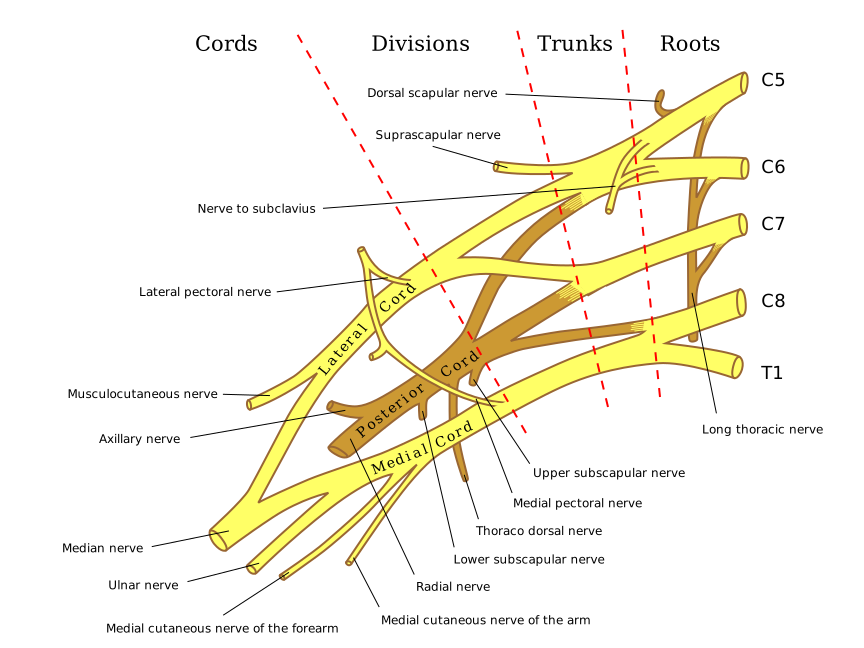
Mattopaedia, Captain-n00dle et MissMJ, d’après Gray’s Anatomy (1918) — Domaine public — PD-self. Image source.

Looking for reproduction of arm symptoms
Spurling's test is a cervical manoeuvre used when considering nerve root involvement. Depending on the variant, the clinician carefully positions the neck and applies controlled loading. Reproduction of familiar arm pain or sensations is more relevant than local neck discomfort alone.
This should not be attempted as a forceful self-test. Suspected fracture, instability, spinal cord involvement or another serious condition requires a different assessment strategy. Sensitivity is imperfect: a negative result does not exclude radiculopathy. Strength, reflexes, sensation and other manoeuvres contribute to interpretation. A positive result does not automatically select traction or manipulation as treatment. The examination should be adjusted to the individual's symptoms and risks rather than performed identically in every patient.
Interpret a finding in context
A clinical finding increases or decreases the plausibility of a diagnosis; it does not replace the full assessment. The clinician compares it with the history, strength, sensation and other relevant observations. An isolated response can be affected by pain, positioning, apprehension or normal variation. Comparison between sides and, when appropriate, between visits is often more informative than a single number. A finding becomes useful when it helps answer a specific clinical question rather than simply adding a label.
How it changes care
The result may lead to activity modification, another investigation, medical referral or continued conservative management. One test should not determine the choice of a therapeutic machine. At TAGMED, findings should help establish a working explanation and measurable goals, followed by review of response to care. Worsening strength or walking requires reassessment. Recent urinary changes or loss of perineal sensation requires emergency evaluation even when another test seems reassuring. Examination also identifies situations in which routine treatment should be postponed. The patient should leave understanding what the finding means, what remains uncertain and what change would require an earlier review.
Frequently asked questions
Is local neck pain sufficient for a positive result?
No. Reproduction of familiar radicular symptoms is the key feature in the classic interpretation.
Does a positive test establish a diagnosis?
No; it must be considered alongside the other assessment findings.
Does a normal result rule out every disease?
No. Each test addresses particular functions or diagnostic possibilities.
Must it be repeated at every appointment?
Only when repetition adds useful information for decisions or monitoring.
Does the result select a treatment?
No. Diagnosis, safety, preferences and practical goals remain essential.
Concept diagram: Controlled neck positioning → Arm symptoms → Neurological agreement → Clinical decision. This illustrates clinical reasoning rather than individual anatomy.
Role of TAGMED care
At TAGMED, this information helps clarify your history, guide assessment and determine whether conservative care is appropriate or medical referral is needed. An anatomical structure, sign or test result is not, by itself, an indication for decompression, laser, shockwave or manual treatment. Care selection depends on the cause of symptoms and your clinical circumstances.
Medical references
- StatPearls, NCBI Bookshelf. Spurling Test.
- AAOS OrthoInfo. Cervical Radiculopathy (Pinched Nerve).
References document the topic; their inclusion does not imply endorsement of TAGMED services by those organizations.
Educational information from The Spine Page. This entry does not replace an individual assessment. Documentary version: October 12, 2026. Sylvain Desforges, B.Sc., D.O., N.D., osteopath and naturopath.
TAGMED clinic contact details
For non-urgent consultations and information about available services.
Clinique TAGMED — Terrebonne
1150, rue Lévis, Suite 200
Terrebonne (Québec) J6W 5S6
450‑704‑4447
Clinique TAGMED — Montréal
1140, avenue Beaumont
Mont-Royal (Québec) H3P 3E5
1‑877‑672‑9060