





Scheuermann kyphosis vs postural kyphosis: rigid curve, imaging and treatment
Scheuermann kyphosis is a rigid structural deformity that develops during growth and includes vertebral wedging and endplate abnormalities. Postural kyphosis is flexible and does not produce the same vertebral shape changes.
Scheuermann disease typically appears in adolescence and may persist into adulthood. The classic radiographic definition includes anterior wedging of at least 5 degrees in three consecutive vertebrae, although diagnostic features also include irregular endplates, Schmorl nodes and disc-space changes. Postural kyphosis corrects when the person stands or extends and does not show structural wedging.

Assessment and differential diagnosis
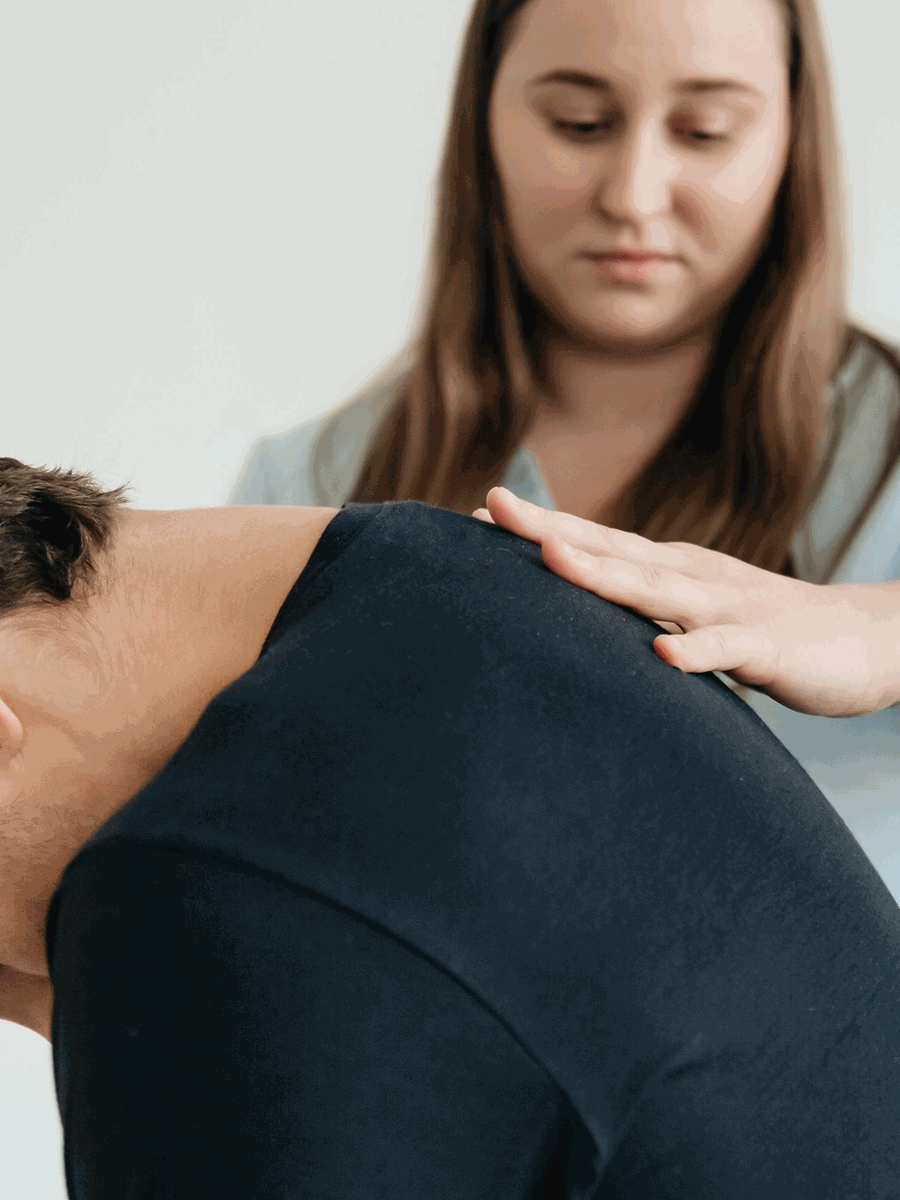
The examination distinguishes a flexible rounded posture from a fixed angular curve and evaluates hamstring tightness, lumbar lordosis, shoulder balance, neurological findings and pain. Standing full-spine radiographs measure the Cobb angle and assess vertebral wedging, endplates and global sagittal alignment. Hyperextension lateral views can show curve flexibility. MRI is not routinely required but may be used for neurological symptoms, atypical pain or preoperative planning. The thoracolumbar form can be more painful and mechanically stressful than a purely thoracic curve.
| Clinical pattern | Possible next step | Why it matters |
|---|---|---|
| Flexible rounded posture without vertebral wedging | Postural kyphosis more likely | Education and exercise are usually appropriate. |
| Rigid adolescent curve with characteristic wedging | Scheuermann kyphosis likely | Curve magnitude and skeletal maturity guide treatment. |
| Growing adolescent with moderate progressive curve | Bracing may be considered | Braces work best before skeletal maturity. |
| Severe progressive deformity, refractory pain or neurological compromise | Surgical assessment | Curve size is one factor, not the only indication. |

Treatment and decision-making
Mild asymptomatic curves may be observed. Exercise programs focus on thoracic extension, trunk strength, hamstring and hip flexibility, postural endurance and conditioning; exercise may improve symptoms and function but cannot be assumed to remodel a mature structural curve. Bracing is considered for skeletally immature people with moderate progressive deformity and requires adherence over substantial daily wear time. Surgery is reserved for severe, progressive or highly symptomatic curves, neurological compromise or major quality-of-life impact. Modern surgery is commonly posterior-only fusion with careful selection of fusion levels to reduce junctional problems.
How to interpret the condition in practice
A rigid structural curve should not be treated as a simple posture habit, while a flexible postural curve should not be labelled as a permanent deformity. The distinction changes expectations for exercise, bracing and surgery.
Check flexibility
A structural curve persists during active correction and extension.
Use standing images
Supine imaging underestimates global alignment.
Assess maturity
Bracing depends strongly on remaining growth.
Measure symptoms
Pain, fatigue and function matter in addition to the angle.
Review the whole spine
Compensatory lumbar lordosis and cervical posture influence balance.
Discuss surgical thresholds carefully
No single Cobb angle mandates surgery in isolation.
How to monitor the condition and avoid interpretation errors
A credible plan should define what improvement means before treatment begins and should explain how the diagnosis will be reconsidered if the expected response does not occur. Pain intensity can change independently from neurological function, walking tolerance, sleep or participation. For uncommon conditions, progression and safety are often more important than day-to-day symptom fluctuation.
Create a baseline
Record symptom distribution, strength, sensation, walking, sleep, medication use and the activities that matter most.
Use a planned review point
Decide when the response will be reviewed rather than continuing automatically until a treatment package is completed.
Separate relief from diagnosis
Temporary improvement after medication, injection, manual care or a device does not prove the proposed structure was the true cause.
Watch the neurological trajectory
New weakness, spreading numbness, gait change or autonomic symptoms matter even if pain decreases.
Review alternative causes
Degenerative, inflammatory, infectious, oncological and postoperative mechanisms may overlap.
Escalate proportionately
Imaging, specialist referral or surgery should be considered when the risk or functional loss justifies it.
Common errors to avoid
- Treating the most unusual imaging finding instead of the clinically relevant lesion.
- Assuming that a stable imaging abnormality explains a changing symptom pattern.
- Using one negative test to exclude a condition that remains clinically plausible.
- Repeating passive treatment despite no measurable functional progress.
- Generalizing results from a small specialist series to every person with the same label.
- Delaying urgent assessment to complete a predetermined number of visits.
Shared decision-making is strongest when uncertainty is stated directly. A provider should explain what is confirmed, what remains probable, which alternatives still matter and what findings would change the plan. For rare or controversial diagnoses, a second opinion from a clinician experienced with the specific condition may be more useful than adding another non-specific treatment.
Questions before choosing care
What is the leading diagnosis?
Ask which symptoms and examination findings support it.
What alternative remains possible?
Common competing causes should be reviewed before an invasive procedure.
What test changes management?
Avoid testing or imaging that cannot alter the next step.
What outcome matters?
Track function, neurological safety and meaningful activity.
A single symptom, image or treatment response rarely establishes the complete cause by itself.
Relevant specialized resources
Some resources may share ownership or editorial direction; this relationship is disclosed and the links are included for contextual relevance.
Dr Sylvain Desforges
Professional information about spinal posture and assessment.
Frequently asked questions
Is Scheuermann kyphosis the same as poor posture?
No.
Can a person straighten a Scheuermann curve voluntarily?
Not fully.
How is it diagnosed?
Standing radiographs and clinical rigidity are central.
What is the classic wedging criterion?
At least 5 degrees in three consecutive vertebrae.
Can adults have symptoms?
Yes.
Can exercise correct the curve permanently?
Exercise can improve function and appearance but may not remodel a mature rigid curve.
When is a brace used?
During growth for selected moderate progressive curves.
When is surgery considered?
For severe progressive deformity, refractory pain, neurological compromise or major quality-of-life impact.
Does every curve worsen?
No.
Does The Spine Page diagnose Scheuermann disease?
No.
Sources consulted
- O’Donnell et al. — Scheuermann kyphosis current concepts
- Scoliosis Research Society — Scheuermann kyphosis
- Hu et al. — Treatment approaches systematic review
Last editorial review: July 2026. General educational information only.
Dr. Sylvain Desforges, B.Sc., D.O., N.D., osteopath — The Spine Page
Continue exploring spine health
Use the condition and treatment hubs to compare related guides.
The Spine Page — The best treatments for your spinal problems — www.thespinepage.com