

Pain related to irritation of a nerve root or its ganglion, which may radiate into a limb without necessarily causing neurological loss.
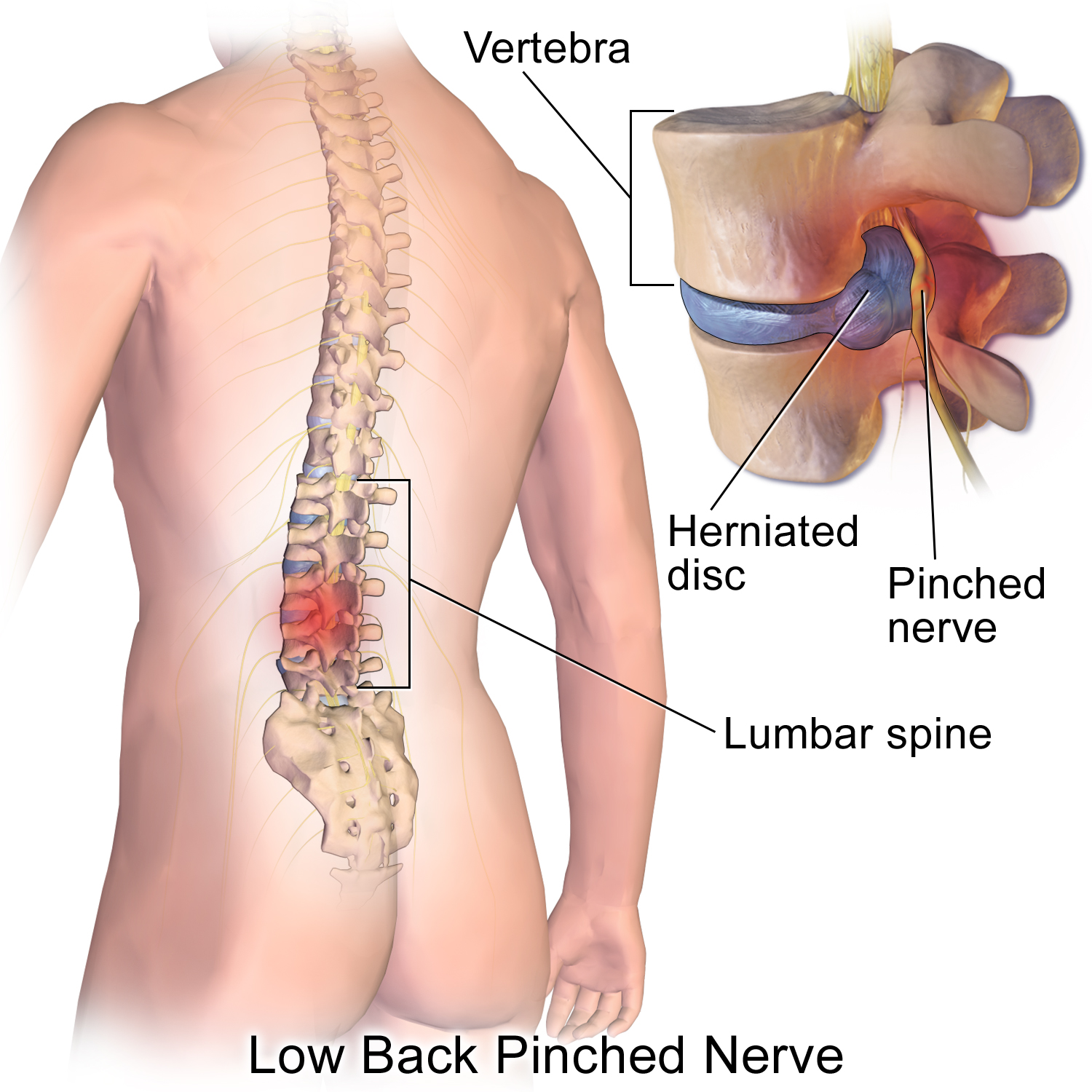
Blausen.com staff (2014), Medical gallery of Blausen Medical 2014, WikiJournal of Medicine 1(2), DOI: 10.15347/wjm/2014.010 — CC BY 3.0. Image source.

Root-related pain and radiculopathy
Irritation of a nerve root can produce shooting, burning or electric pain extending into an arm or leg. Inflammation and mechanical loading may both contribute. The distribution does not always follow a textbook dermatome perfectly and can vary between people. Radicular pain does not necessarily cause weakness or loss of a reflex.
Radiculopathy more specifically describes impaired root function supported by sensory, motor or electrophysiological findings. Pain referred from a joint or muscle can resemble nerve-related radiation. Examination therefore considers symptom reproduction, distribution and associated deficits. A visible disc herniation becomes more clinically relevant when its level and side match the history and findings. Conversely, the mere presence of a disc bulge cannot establish the source of an arm or leg symptom.
Neurological assessment and test limitations
The clinician compares strength, sensation, reflexes and walking, then relates findings to the distribution of symptoms. A spinal root, peripheral nerve, spinal cord problem or systemic disease can produce different patterns. MRI describes selected structures; electromyography and nerve conduction studies assess selected aspects of function. No test answers every question. The usefulness of a test depends on the clinical hypothesis and on how long the problem has been present. Reporting whether symptoms affect one side or both helps guide the examination.
Referral and recovery
A new or progressive deficit needs prompt medical assessment. Sudden onset accompanied by facial changes, speech difficulty or loss of balance requires emergency services. Altered saddle sensation or urinary retention also requires immediate medical attention. Once the cause has been clarified, recovery may involve medical treatment, fall prevention and graded rehabilitation. Its speed depends partly on the severity and duration of the problem. Musculoskeletal care at TAGMED may complement an appropriate plan but cannot replace investigation of a deficit or guarantee nerve regeneration. Reassessment should track useful activities and objective neurological findings, not pain alone.
Frequently asked questions
Are radicular pain and radiculopathy identical?
No. Root-related pain can occur without an objective loss of root function.
Must it be painful?
No. A neurological problem may predominantly affect sensation or strength.
Does normal MRI exclude every problem?
No; peripheral or functional abnormalities may require different investigations.
Does the symptom always locate the cause?
No. Different structures can produce partly overlapping symptom distributions.
When is earlier review needed?
New weakness, progression or difficulty walking requires prompt medical assessment.
Concept diagram: Irritated root → Limb pain → Check for deficit → Clinical agreement. This illustrates clinical reasoning rather than individual anatomy.
Role of TAGMED care
TAGMED offers motorized spinal decompression, a form of traction. Initial assessment considers whether symptoms, neurological findings and imaging, when indicated, agree. The value of this approach remains uncertain depending on the condition; NICE recommends against offering traction for low back pain with or without sciatica. It does not guarantee disc resorption, disc repair or correction of stenosis. Alternatives, contraindications, functional goals and stopping criteria should be discussed before any trial.
Medical references
- AAOS OrthoInfo. Cervical Radiculopathy (Pinched Nerve).
- NIAMS, NIH. Back Pain.
- NICE. Low back pain and sciatica in over 16s: assessment and management (NG59).
References document the topic; their inclusion does not imply endorsement of TAGMED services by those organizations.
Educational information from The Spine Page. This entry does not replace an individual assessment. Documentary version: October 12, 2026. Sylvain Desforges, B.Sc., D.O., N.D., osteopath and naturopath.
TAGMED clinic contact details
For non-urgent consultations and information about available services.
Clinique TAGMED — Terrebonne
1150, rue Lévis, Suite 200
Terrebonne (Québec) J6W 5S6
450‑704‑4447
Clinique TAGMED — Montréal
1140, avenue Beaumont
Mont-Royal (Québec) H3P 3E5
1‑877‑672‑9060