

Low back pain attributed to a lumbosacral transitional vertebra after assessment; this anatomical variant is not always painful.
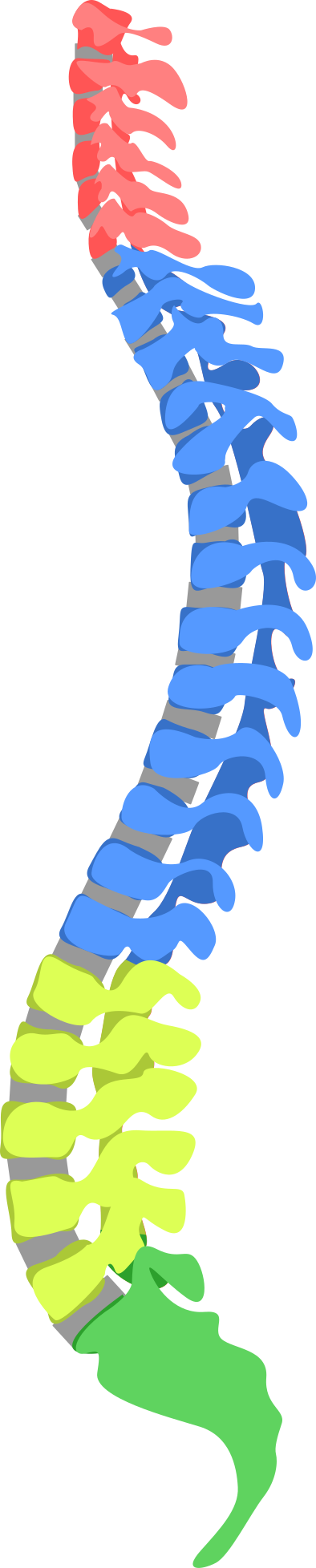
mikeingram1; recoloration : MJL — CC0 1.0. Image source.

Understanding the mechanism
Bertolotti syndrome means pain attributed to a lumbosacral transitional vertebra. An enlarged transverse process may form a joint or fuse with the sacrum or ilium. This anatomy develops early in life and can alter local loading. However, not everyone with a transitional vertebra develops a painful syndrome, making the distinction between anatomy and diagnosis important.
Symptoms and warning signs
Pain can be lumbar or buttock-dominant and sometimes one-sided. It may arise from the pseudo-joint, an adjacent segment or associated nerve irritation. No particular pain map proves the origin alone. Progressive weakness needs urgent assessment. New urinary retention, loss of bladder or bowel control, or saddle numbness requires immediate emergency care rather than being attributed to a known anatomical variant.
Diagnosis and investigations
Radiographs, CT or MRI define the anatomy and associated abnormalities according to the clinical question. Correct vertebral numbering is essential, particularly before injection or surgery. The clinician checks whether the structural finding matches the presentation; a specialist diagnostic injection can sometimes contribute. The diagnosis involves more than simply identifying an enlarged transverse process on a scan.
Treatment and outlook
Management often begins with load modification, progressive activity and pain management. Targeted injections or surgery may be offered to carefully selected patients when the source is sufficiently established. Evidence remains limited and techniques vary. An operation is not justified solely because a transitional vertebra exists, and treatment goals should reflect the actual disability and uncertainty.
The role of TAGMED care
At TAGMED, any conservative support should target function rather than promise to correct congenital anatomy. Decompression cannot separate a bony fusion or remove a pseudo-joint. Manual treatment, laser and shockwave therapy are not universal treatments for Bertolotti syndrome. Insufficient benefit should prompt reconsideration of the source and referral needs rather than continuing an open-ended course based on the imaging label.
Practical follow-up
The record should clarify how each report names the level, particularly when labels differ. To monitor treatment, choose an activity limited by pain rather than judging progress only through improved symmetry in a photograph. Functional change is more relevant to the patient.
Frequently asked questions
Is this anatomical variant always painful?
No. A transitional vertebra can be completely asymptomatic.
Can manipulation make it disappear?
No. Its bony configuration is not corrected in that way.
Why count vertebrae carefully?
Accurate numbering helps avoid intervention at the wrong level in this anatomy.
Does an injection prove everything?
It may add evidence, but its response still needs contextual interpretation.
When is specialist review useful?
With persistent disabling pain or when a targeted intervention is being considered.
Conceptual diagram: the steps depend on clinical findings and do not provide an individual diagnosis.
Medical references
- International Journal of Spine Surgery. A Review of Symptomatic Lumbosacral Transitional Vertebrae: Bertolotti's Syndrome.
- American Journal of Neuroradiology. Lumbosacral Transitional Vertebrae: Classification, Imaging Findings, and Clinical Relevance.
References document the topic; their inclusion does not imply endorsement of TAGMED services by those organizations.
Educational information from The Spine Page. This entry does not replace an individual assessment. Documentary version: October 12, 2026. Sylvain Desforges, B.Sc., D.O., N.D., osteopath and naturopath.
TAGMED clinic contact details
For non-urgent consultations and information about available services.
Clinique TAGMED — Terrebonne
1150, rue Lévis, Suite 200
Terrebonne (Québec) J6W 5S6
450‑704‑4447
Clinique TAGMED — Montréal
1140, avenue Beaumont
Mont-Royal (Québec) H3P 3E5
1‑877‑672‑9060