



In Pierrefonds-Roxboro, surgery may be considered when pain radiating down the leg persists despite well-adapted conservative treatments, or when nerve compression causes significant or progressive weakness. The decision is based on the correlation between symptoms, clinical examination and imaging findings, not on an image of a disc herniation alone.
For most people, assessment begins with a medical consultation and non-surgical care. An intervention becomes an option to discuss when symptoms, their duration and their effect on walking, sleep or daily activities warrant a specialist opinion. Some neurological signs, however, require urgent assessment rather than a planned approach.


In brief: surgical indications for sciatica
Pain alone is not enough. A correlation must be established between the symptoms, the examination and the likely cause.
Conservative treatments are generally tried first, when the situation allows and no urgent signs are present.
Progressive weakness changes the priority. It warrants prompt medical assessment, without waiting for usual care to take effect.
The treatment decision is individualized. The expected benefits, risks, preferences and alternatives should be considered together.
When can surgery for sciatica be discussed in Pierrefonds-Roxboro?
Sciatica often refers to pain related to irritation or compression of a nerve root in the lower back. It may extend into the buttock and leg, sometimes as far as the foot, and may be accompanied by tingling, numbness or weakness. However, a painful pathway alone cannot determine the cause or whether surgery is needed.
Surgery may be discussed if a disc herniation or spinal canal narrowing compresses a nerve root and symptoms remain highly limiting despite appropriate management. The duration of symptoms matters, but it is not an automatic threshold: progression, severity, neurological deficits and assessment findings guide the evaluation.
In Pierrefonds-Roxboro, a person who must frequently stop while walking or can no longer tolerate sitting at work may request reassessment. This does not mean that surgery is already indicated; it helps clarify the diagnosis and possible options. The causes and diagnostic steps for sciatica may also help prepare questions to ask.
Different situations, different decisions
Radicular pain without loss of strength does not present in the same way as progressive weakness in the foot or leg. In the latter case, medical assessment must be expedited because a motor deficit can alter the degree of urgency. Care is therefore not simply a matter of comparing one person’s pain level with another’s.
A herniation visible on imaging may also be present in a person who does not have corresponding symptoms. The diagnosis is based on the history of symptoms and examination, followed by imaging when relevant. The correlation among these elements helps determine whether an intervention could treat the targeted problem.
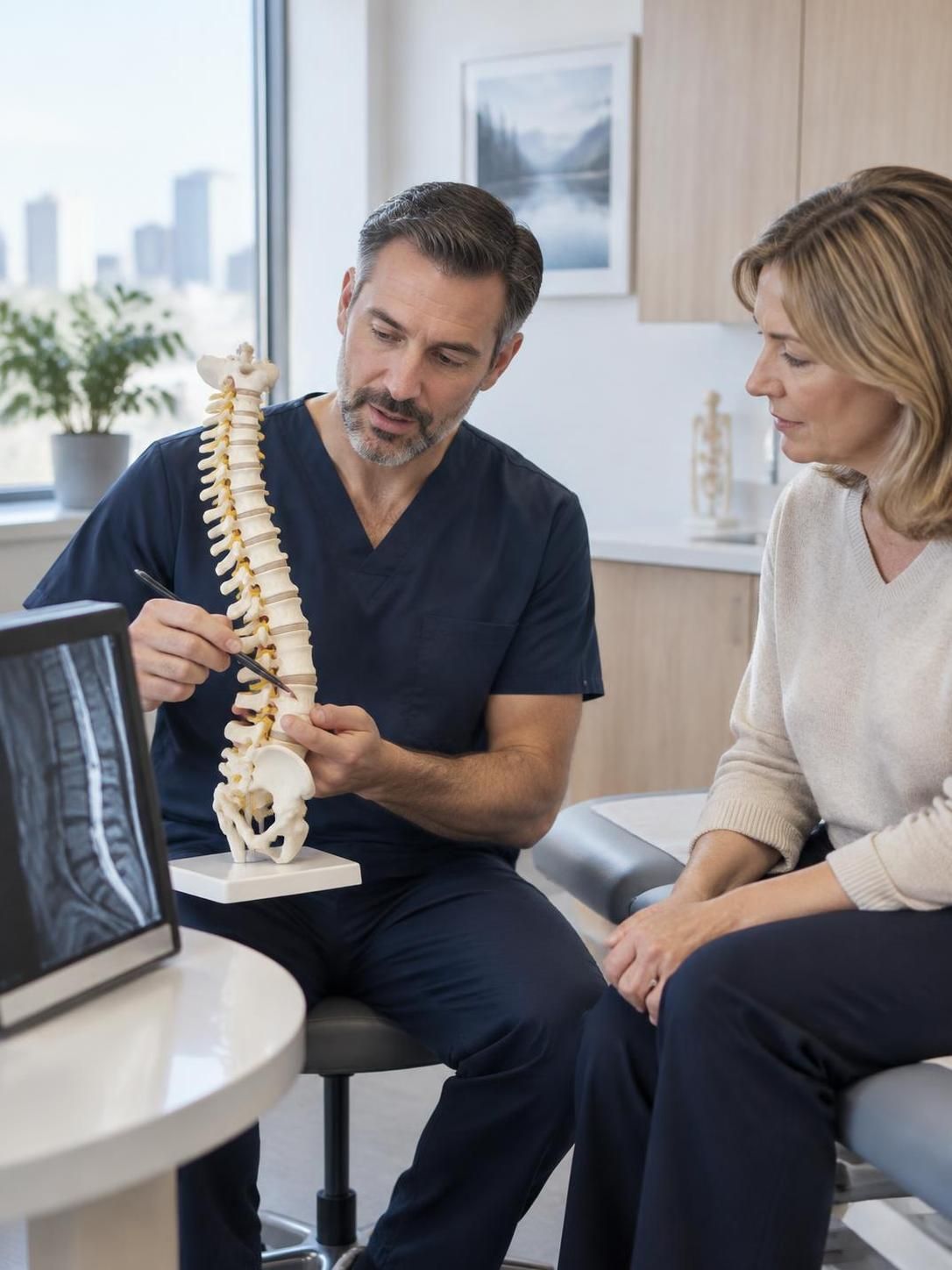
Assessment before a treatment decision
Before considering surgery, the clinician seeks to understand where any compression is located and whether it explains the observed signs. The examination may assess sensation, muscle strength, reflexes and certain movements. The description of the pain—its onset, progression and the activities that change it—completes these observations.
Magnetic resonance imaging may be requested when its findings are likely to guide management, particularly if an intervention is being considered or neurological signs warrant it. It is not necessarily required at the start of every episode. The result must be interpreted cautiously: an abnormality does not automatically prove that it is responsible for the symptoms.
A specialist opinion makes it possible to discuss the diagnosis, realistic goals of surgery and risk assessment. Depending on the clinical picture, the opinion may come from a spine specialist or a surgeon. You can ask which structure would be treated, which symptoms are likely to improve and which other options remain reasonable.
| Observed situation | What it may mean | Possible next step |
|---|---|---|
| Stable pain, without significant weakness | Non-surgical management may remain appropriate. | Clinical follow-up and adjustment of care based on progression. |
| Persistent and highly limiting pain | A compressive nerve-related cause may require more in-depth assessment. | Medical consultation and discussion of a specialist opinion. |
| New or rapidly worsening weakness | A neurological deficit must be assessed without delay. | Urgent medical assessment. |
Which conservative treatments should be tried before surgery?
When the situation is stable and no urgent signs are present, management often begins with maintaining or gradually resuming tolerated activities. A short walk may be suitable for some people, while another person may need to temporarily adjust the duration or pace of their travel. Pain that clearly intensifies or travels further down the leg calls for adjustment and, if it persists, reassessment.
Advice on movement, individualized exercises or physiotherapy care may be among the options depending on the situation and available professionals. Medications may also be discussed with an authorized professional, taking into account other health conditions and possible adverse effects. No approach is equally suitable for every profile.
Motorized neurovertebral decompression is controlled traction that may be considered for certain patients after assessment. It aims to temporarily alter the mechanical stresses on the lumbar region; results vary, the evidence does not support it as a universal solution and a number of sessions cannot be established for everyone. It does not replace either urgent medical assessment or a surgical opinion when one is warranted.
In Mount Royal, near Outremont and Côte-des-Neiges, Clinique TAGMED includes motorized neurovertebral decompression, specific osteopathy or the precision percussor among its approaches, depending on the assessment. This care does not replace a medical consultation or emergency services. The information on neurovertebral decompression may help in understanding this option and its limitations.
An injection may sometimes be discussed for certain symptoms, while surgery may be considered if the targeted problem remains disabling or if a neurological deficit warrants it. These options have different goals and risks; they do not necessarily exclude one another throughout every course of care. The choice depends on the clinical findings and discussion with the professionals involved.
What types of procedures and what limitations should be understood?
For certain disc herniations, a procedure may aim to remove the portion of the disc compressing a nerve root. In the presence of narrowing, the procedure may instead seek to free up space around the nerves. The technique depends on the identified cause, the location of the compression and the person’s overall health.
The goal is generally to reduce pressure on a nerve structure and improve symptoms consistent with this compression. A procedure does not guarantee the resolution of all low back pain, as it may have several sources. Risks, recovery, the possibility of persistent or recurring symptoms and non-surgical options should be part of the discussion.
Surgery is not necessarily the only possible next step after conservative treatment. If symptoms remain stable, it may be appropriate to review the goals, adjustments and follow-up strategy. Conversely, waiting without reassessing progressive weakness is not a prudent approach.
When should you seek an urgent medical consultation?
A medical consultation is indicated if pain persists or returns, travels below the knee, limits walking or disrupts sleep. Spreading numbness, loss of sensation, weakness or decreased function also warrant assessment, especially if these signs are new or worsening.
Go to the emergency department without delay in the event of loss of bladder or bowel control, numbness in the saddle area, or significant and rapidly progressive weakness. Fever or poor general health, significant trauma, pain in the context of cancer or infection, or rapid worsening also require urgent medical assessment.
These signs cannot establish a diagnosis remotely, but they may indicate a situation requiring prompt assessment. To better identify the signs that indicate when to seek care for sciatica, educational resources can supplement, but not replace, a professional’s opinion.
Frequently asked questions about surgery for sciatica
Does a disc herniation mean surgery is needed?
No. A herniation visible on imaging is not enough to indicate surgery. Symptoms, examination findings and the correlation between the observed compression and the signs must be considered together.
How long should conservative treatments be tried?
There is no single duration applicable to every situation. The decision depends on progression, functional limitation and the possible presence of a neurological deficit; progressive weakness requires prompt assessment.
Does surgery always relieve leg pain?
No, no outcome can be guaranteed. The benefit depends in particular on the cause being treated and the correlation between the diagnosis and symptoms; some pain may persist or have another origin.
When should you seek care without delay in Pierrefonds-Roxboro?
Loss of bladder or bowel control, saddle anesthesia or significant weakness that progresses rapidly warrants urgent assessment. If in doubt about rapid worsening, contact health services without delay.
Can neurovertebral decompression replace indicated surgery?
It should not be considered an automatic replacement for surgery or urgent medical assessment. Its appropriateness varies from person to person and must be determined after an appropriate examination.
If pain radiating down your leg is limiting your activities in Pierrefonds-Roxboro, an assessment may help clarify the likely cause, signs to watch for and the relevance of a conservative approach. To explore options related to sciatica, you can visit the sciatica management in Montréal page.
This content is educational and does not replace a personalized assessment or medical advice.
Alice Dupont, Health Journalist
