


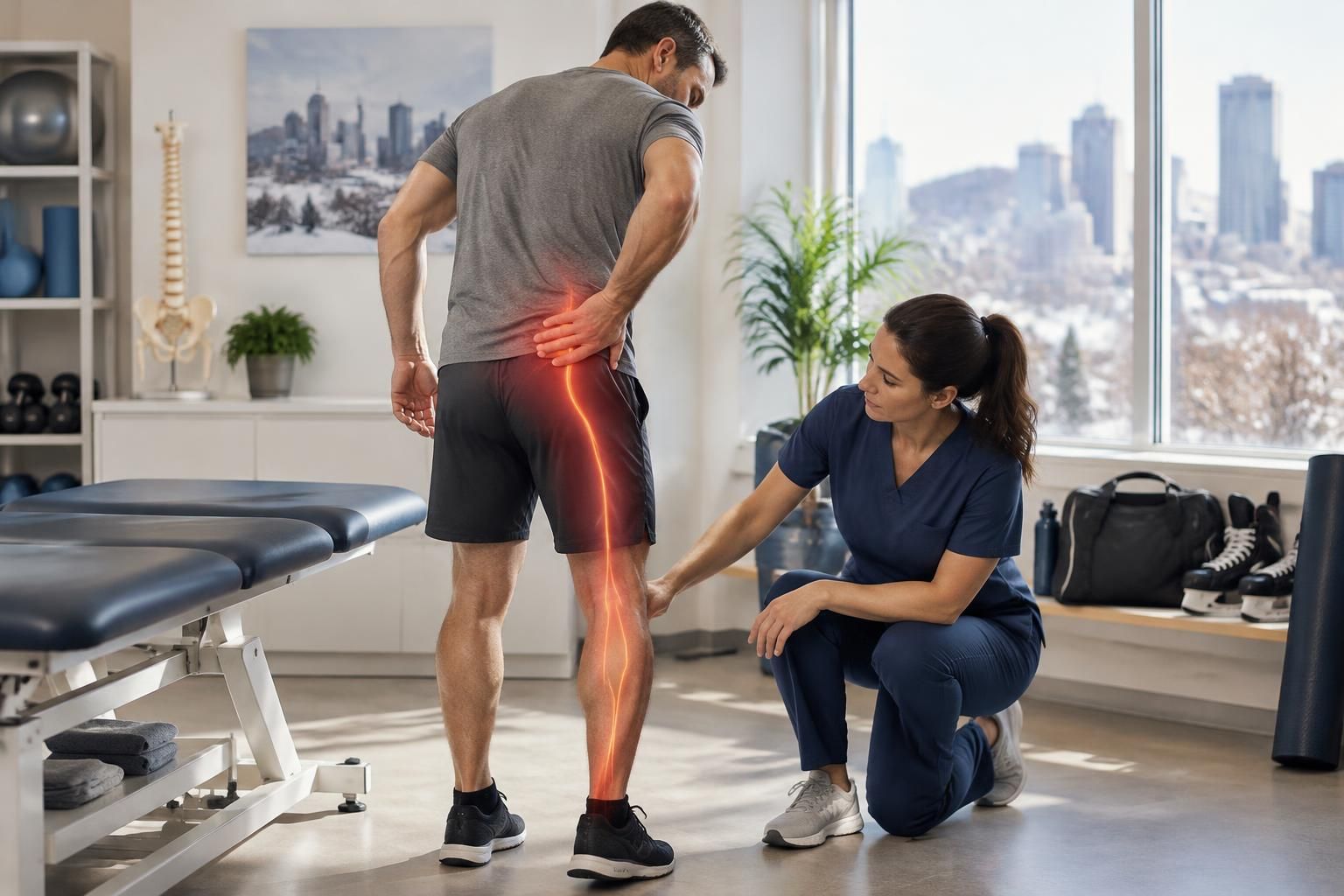
For Montréal athletes, pain that starts in the lower back or buttock and travels down the leg can disrupt training without necessarily requiring a complete stop. With sports-related sciatica, returning to activity depends mainly on how symptoms evolve, the ability to move normally, and whether neurological signs are present; a universal rule based solely on a pain number is not enough.
Running, ice hockey, weight training, and sports involving changes of direction place different demands on the trunk and legs. Low back pain that appears after a session does not by itself identify its cause: nerve root irritation, muscle pain, or another problem can appear similar. The goal is therefore to adapt activity cautiously, without dismissing weakness or numbness that is progressing.
In brief: sciatica and training for Montréal athletes
Keep moving if it is tolerable. Walking and light activities may be preferable to prolonged rest, provided they do not worsen symptoms.
Observe the response after exertion. Pain that travels farther down the leg, becomes more intense, or persists longer after training warrants an adjustment.
Return gradually. Returning to sport is assessed according to walking, activity-specific movements, and how symptoms evolve over the following hours, not according to a fixed date.
Have neurological signs assessed. Loss of strength, reduced sensation, or persistent symptoms warrant a clinical assessment.
A practical guideline: choose an activity that allows you to move with controlled technique and without notable worsening. If you are unsure about the nature of the pain, the differences between low back pain and sciatica can help explain why these terms do not refer to the same thing.



Recognizing sports-related sciatica without confusing pain with a diagnosis
The word sciatica generally describes pain associated with irritation of a nerve root in the lower back, often felt in the buttock and along the leg. Tingling, numbness, or weakness may also occur. The pattern varies from person to person and cannot, by itself, determine which root is involved or establish the cause.
A disc herniation or protrusion can contribute to irritation of a nerve root, but it is not the only possible explanation. Pain originating from muscles, joints, or other structures can also radiate into the buttock or thigh without corresponding to true radicular pain. The history of symptoms, clinical examination, and, in some situations, imaging are interpreted together.
For someone who trains, the context matters: did the pain begin during a sprint, after a long bike ride, or the day after a weight-training session? Coughing, sneezing, sitting, bending the trunk, or explosive movements can change symptoms, but their effects differ among individuals. A sports injury and radicular pain can also coexist.
In Montréal, a car ride after a session or several hours sitting while working remotely can make symptoms more noticeable. This context does not establish the cause, but it can help identify factors that worsen pain and communicate them during a consultation. The possible causes and diagnostic steps are detailed in this educational resource.

Adapting running, cycling, and hockey to symptoms
There is no list of prohibited sports that suits everyone. During a painful flare-up, running, mountain biking, combat sports, football, rugby, tennis, or heavy weight training can be difficult to tolerate, particularly if impacts, rotations, or loads increase symptoms. This does not mean these activities are dangerous for every person who has had sciatica.
Low-impact options such as walking, stationary cycling, or an elliptical trainer may sometimes make it possible to maintain cardiovascular activity. Cycling, however, involves a forward-leaning position that bothers some people; swimming depends on the stroke and tolerance of the movements. An activity is therefore not automatically beneficial simply because it is generally considered gentle.
Ice hockey combines accelerations, bending, rotations, and contact. If symptoms are active, it is best to avoid testing tolerance during a game or intense session. Returning to isolated, controlled movements, once walking and daily movements are better tolerated, can make it possible to gradually assess readiness, ideally with advice suited to the situation.
| Activity | What to monitor | Possible adaptation |
|---|---|---|
| Walking | Pain that spreads or altered gait | Shorten the outing or slow down |
| Stationary cycling | Symptoms worsened when sitting or leaning forward | Adjust posture or choose another activity |
| Running | Poorly tolerated impact, increasing pain, or altered stride | Temporarily return to walking or a less demanding activity |
| Ice hockey | Pain during accelerations, rotations, or contact | Avoid intense play until functional tolerance improves |
This table is a guide, not a prescription. Returning to sport with sciatica must take pain, function, and neurological symptoms into account. A threshold such as 5/10 is not a guarantee of safety: less intense pain can still be accompanied by loss of strength or worsening after exertion.
Returning to training gradually and limiting recurrences
Returning can begin when basic movements—walking, standing, and completing daily tasks—are sufficiently tolerated. The first training session should be shorter and less intense than usual, using an activity that is easy to stop or modify. Increasing only one variable at a time, such as duration or intensity, makes the response easier to interpret.
Monitor symptoms during activity, immediately afterward, and over the following 24 to 48 hours. Mild, temporary soreness does not have the same significance as pain that travels farther down the leg, spreading numbness, or new weakness. If these changes occur, stop the activity triggering them and seek an assessment rather than pushing through to follow a program.
Injury prevention also relies on practical factors: progression of loads, recovery, sleep, varied movements, and preparation suited to the demands of the sport. Core strengthening can be part of a plan, but no single exercise prevents all cases of sciatica. Stretches or nerve mobilizations are not appropriate for every profile and should be stopped if they worsen or prolong symptoms.
Sports clinics in Montréal and licensed professionals can contribute to assessment or physical rehabilitation according to their expertise and the person’s needs. Access to individualized advice is particularly helpful when symptoms recur, interfere with sleep, or prevent a return to sport-specific movements. A simple activity and symptom-response journal can help make the consultation more precise.
Prolonged bed rest is generally not a return-to-activity strategy; maintaining ordinary activities within the limits of tolerance and safety is often preferred. Heat or cold may provide temporary relief for some people without necessarily treating the cause. Natural products and essential oils are not automatically risk-free: seek advice from a pharmacist or professional, particularly during pregnancy, with a chronic condition, or when taking medication.
An assessment can clarify whether the pain suggests radicular involvement, muscle pain, or another problem, and help identify appropriate adaptations. Depending on the presentation, options may include activity advice, individualized exercises, physiotherapy, manual care, medications recommended by a licensed professional, an injection, or, more rarely, a surgical opinion.
Neurovertebral decompression: an option for certain profiles only
Neurovertebral decompression is progressive, controlled motorized lumbar traction. After an assessment, it may be considered for certain patients with symptoms compatible with a disc herniation or protrusion, disc narrowing, or foraminal stenosis. Its purpose is to temporarily change certain mechanical stresses; it does not put a disc back into place and is not appropriate for all cases of sciatica.
Results vary, and the number of sessions cannot be determined uniformly in advance. This approach does not replace adapted activity, exercises when indicated, or urgent medical assessment. Contraindications and situations requiring medical referral must be reviewed before considering treatment.
It differs from conventional traction through the use of a motorized device and controlled parameters, but this does not mean it is superior to other options in every case. Manual care, exercises, medications, injections, or surgery have different roles depending on symptoms and assessment. Clinique TAGMED, located at 1140 Beaumont Avenue in Mont-Royal, near Outremont and Côte-des-Neiges, presents its information on neurovertebral decompression without this approach being considered universal.
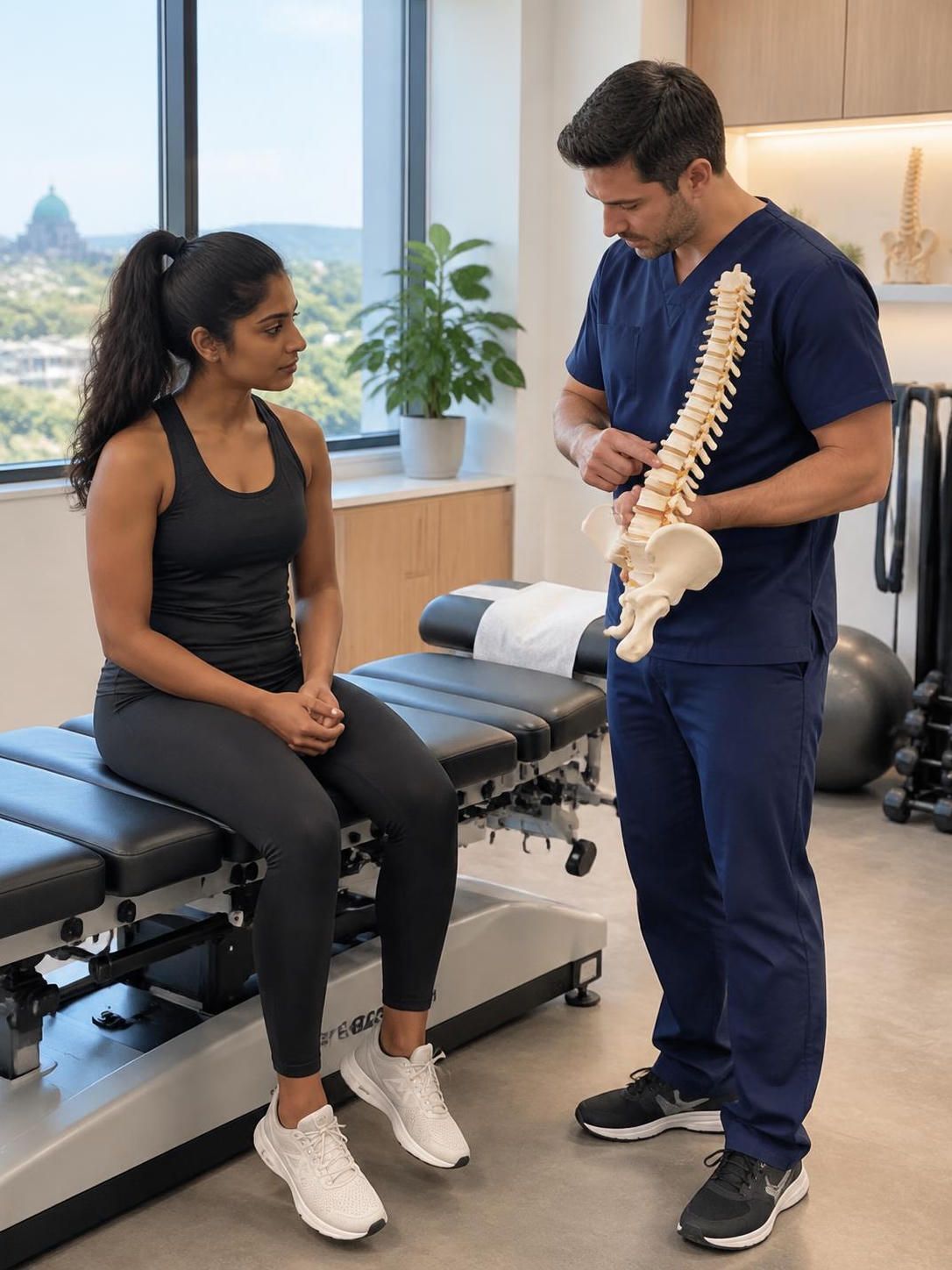
When to seek care for pain that travels down the leg
A clinical assessment is indicated if pain persists or returns, travels below the knee, limits walking, or disrupts sleep. Numbness, loss of sensation, weakness, or reduced function also warrant professional attention, especially if symptoms change.
Urgent medical assessment is necessary in cases of loss of bladder or bowel control, numbness in the saddle area, significant or rapidly progressive weakness, fever or impaired general health, major trauma, or pain in the context of cancer or infection. Rapid worsening should also be taken seriously; these signs cannot be reliably assessed remotely.
To better prepare for a consultation, note when symptoms began, the path of the pain, the movements that change it, and any changes in strength or sensation. A resource on the signs that indicate when to seek care can complement these guidelines without replacing an individualized assessment.
Frequently asked questions about sciatica and sport
Should you stop all sports when sciatica appears?
Not necessarily. Gentle activity may still be possible if it does not worsen symptoms and function remains normal; intense exertion may need to be temporarily reduced.
Can you run with sciatic pain?
Running may be poorly tolerated during a flare-up. Consider a gradual return once walking and daily activities are better tolerated, and stop if pain increases or travels farther down the leg.
Does pain below the knee necessarily mean sciatica?
No. The path of the pain may suggest nerve irritation, but it is not enough to confirm the cause. Clinical history and examination help distinguish among different possibilities.
When should you seek care for these symptoms?
Seek care if pain persists, recurs, or limits walking, or if numbness or weakness occurs. Loss of bladder or bowel control, saddle numbness, or rapidly progressive weakness requires urgent assessment.
Pain that compromises running, hockey, or your training may warrant an assessment to clarify its likely cause, signs to watch for, and the appropriateness of a conservative approach. To explore the options offered in Montréal, you can discover sciatica care at Clinique TAGMED.
Dr. Sylvain Desforges, B.Sc., D.O., N.D., osteopath
This content is educational and does not replace an individualized assessment.
