


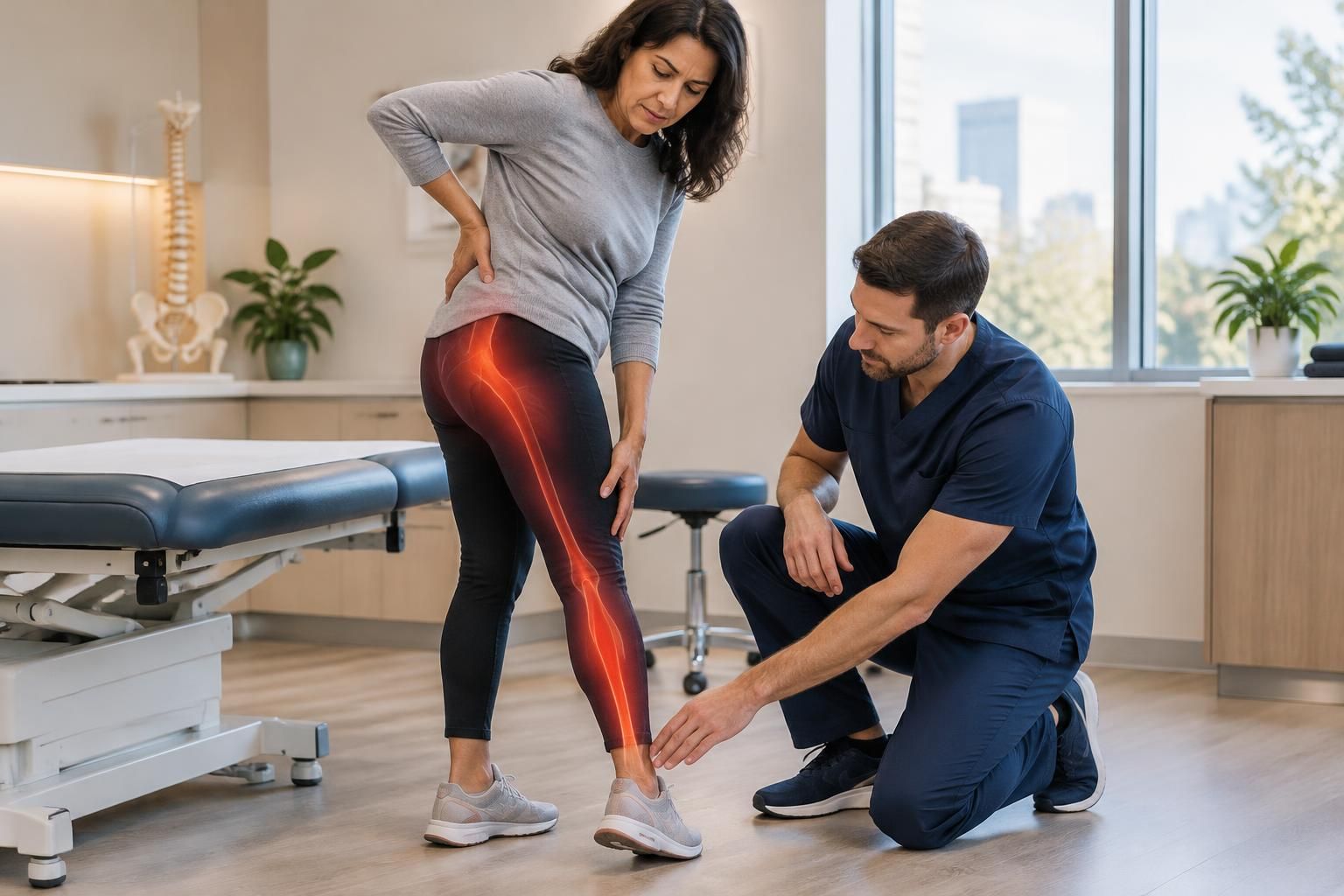
Sciatica may present as low back pain that travels through the buttock and down one leg, sometimes to the calf or foot. A burning sensation, tingling, numbness, or muscle weakness may also accompany the pain, but none of these signs, on its own, confirms the cause.
In Montréal-Nord, as elsewhere, the useful reference point is the overall picture: where symptoms begin, how far they spread, what makes them worse, and their effect on walking, sleep, or work. This information helps determine whether an assessment is warranted and whether signs require urgent attention.


In brief: signs that may suggest sciatica
Radiating pain: it may start in the low back or buttock and extend into the thigh, calf, or foot.
Nerve sensations: burning, electric-shock sensations, tingling, or numbness may accompany the pain.
Changes in function: difficulty walking, sitting, or driving should be taken into account, especially if it worsens.
Possible emergency: bladder or bowel problems, saddle numbness, or significant and progressive weakness require urgent assessment.
Buttock pain and pain radiating down the leg
The term “sciatica” is often used to describe pain that travels down the leg. Clinically, it may be radicular pain, meaning pain related to irritation of a nerve root in the low back, but other conditions can produce similar symptoms. The pain may be sharp, electric, burning, or accompanied by unusual sensations.
The pattern varies from person to person. Some people mainly feel pain in the buttock and back of the thigh; others feel it in the calf or foot. The pain does not need to reach the toes to warrant assessment, and its path alone cannot identify the nerve root involved.
Pain that worsens while sitting, especially during a car ride or a day of working from home, can be a useful detail to describe. Coughing, certain back movements, walking, or climbing stairs may also change symptoms, but these responses differ depending on the cause and the individual.
To better recognize possible manifestations, see this guide on the signs that can help recognize sciatica. However, it remains necessary to distinguish described symptoms from a confirmed diagnosis.

Burning, tingling, or numbness: what should you watch for?
Nerve irritation can cause sensations that differ from typical muscle pain. A burning sensation, tingling, or an area with reduced sensation may occur in the buttock, leg, or foot. It is helpful to note their location, frequency, and progression rather than relying on a single description.
Muscle weakness requires particular attention. A leg that seems less stable, difficulty lifting the foot, or new difficulty walking may warrant prompt assessment, especially if the problem progresses. Pain alone may fluctuate; loss of strength or function should not be minimized.
The L4, L5, and S1 roots can guide the examination, but sensory territories overlap. Pain in the front of the thigh, for example, may suggest femoral neuralgia or a hip condition more than classic sciatica; the examination helps distinguish between these possibilities.
The pain pattern alone is not enough to establish the cause
A disc herniation or protrusion can irritate a nerve root, but osteoarthritis, foraminal narrowing, and other causes are also possible. Hip pain, peripheral neuropathy, or, more rarely, a circulatory problem can also explain leg pain.
The assessment connects the symptom history with strength, sensation, reflexes, and walking. An X-ray does not directly show nerves or discs; an MRI is not routinely needed and is considered mainly when its result could change management. For criteria that may warrant diagnostic imaging, see this resource on the usefulness of MRI in certain cases of sciatica.
When to seek care for sciatica in Montréal-Nord
A consultation is appropriate if pain persists, returns frequently, or limits important activities. Pain below the knee, difficulty walking, disrupted sleep, loss of sensation, or weakness warrant assessment, particularly if these symptoms change or become more intense.
Seek urgent medical assessment if you lose control of your bladder or bowels, have numbness in the saddle area (between the thighs and around the genitals), or have significant or rapidly progressive weakness. Fever with spinal pain, worsening general health, significant trauma, or pain in the context of cancer or infection also warrant prompt attention.
These signs cannot establish a diagnosis remotely, but they may indicate a problem that should not wait for routine care. If you are unsure whether it is urgent, contact the appropriate medical services. Additional guidance is available on this page about emergency signs associated with sciatica.
For less urgent symptoms, a thorough assessment identifies onset, side, aggravating and relieving factors, as well as treatments already tried. It also checks practical effects: tolerated walking duration, sitting, driving, sleep, and daily activities.
Symptom profile
Note their onset, pattern, and the positions that change them.
Neurological examination
Compare strength, sensation, reflexes, and walking when relevant.
Functional follow-up
Monitor sleep, work, driving, and changes over time.
In Montréal-Nord, commuting and prolonged periods of sitting can make symptoms more noticeable without revealing their cause. The SOS Sciatica guide on when to seek care can help prepare questions to ask a health professional.
Factors that change symptoms and management options
Sitting, driving, bending the back, walking, or sleeping may worsen or relieve symptoms depending on the individual profile. An activity tolerated by one person may be uncomfortable for another; therefore, there is no universal posture or exercise to use without considering the response.
When safe, maintaining or gradually resuming activities is often preferable to prolonged inactivity. Adapted exercises or manual care may be considered depending on the assessment. If a movement makes the pain travel farther down, increases numbness, or is accompanied by new weakness, stop it and seek reassessment.
Medications can be discussed with an authorized professional, taking medical history and individual risks into account. An injection or specialist opinion may be considered in some cases; surgery may be discussed in particular when significant compression, a neurological deficit, or persistent progression warrants it. Each option has its indications and limitations.
Motorized spinal decompression is not indicated for everyone
Motorized spinal decompression is a form of controlled traction that may be considered for certain patients after an assessment. It aims to temporarily change the mechanical stresses applied to the back and may be discussed in certain presentations consistent with disc involvement or foraminal narrowing. It does not put a disc “back in place” and does not guarantee relief or avoidance of surgery.
Results vary, available evidence does not support it as a universal solution, and no number of sessions is right for everyone. Contraindications, neurological symptoms, and the possibility of other causes must be reviewed before considering it. It never replaces urgent assessment.
At Clinique TAGMED, located at 1140 Beaumont Avenue in Mont-Royal, near Outremont and Côte-des-Neiges, certain non-surgical approaches related to sciatica may be discussed depending on the assessment. Montréal-Nord residents can consult the overview of sciatica management options in Montréal for information about services; the appropriateness of an approach must be determined individually.
A useful plan specifies what will be monitored and when it will be reviewed. Pain is only one indicator: walking, strength, sensation, sleep, and participation in activities also help assess progress.
Comparing signs and knowing what to do
| Observed manifestation | What it may suggest | Cautious guidance |
|---|---|---|
| Pain from the buttock to the thigh or calf | Possible radicular pain, among other causes | Have it assessed if it persists or limits activities. |
| Burning, tingling, or numbness | Possible nerve irritation | Note the affected area and watch for any progression. |
| Weakness or difficulty walking | Possible motor function impairment | Seek assessment promptly, especially if it worsens. |
| Bladder or bowel problems, saddle numbness | Concerning neurological sign | Obtain urgent medical assessment. |
This table is a guide, not a diagnosis. To clarify a possible explanation, the professional must relate symptoms to the examination and, if needed, imaging; an abnormality seen on an image is not automatically enough to explain the pain.
Two informational videos can complement this reading, without replacing a personal assessment:
Tolerance for walking and daily activities can help track progress, but a change in strength or sensation should be taken seriously.
Frequently asked questions about signs of sciatica
Does the pain have to travel down to the foot?
No. It may remain in the buttock, thigh, or calf. The pattern helps guide the assessment but does not, on its own, confirm the cause.
Does pain that worsens while sitting confirm sciatica?
No. This response can occur with different back or hip problems. It is a detail to describe, not a diagnosis.
When should you seek care for pain that travels down the leg?
Seek care if it persists, returns, disrupts sleep, or limits walking, or if numbness or weakness appears. Rapidly progressive weakness or bladder or bowel problems require urgent assessment.
Is an MRI always necessary?
No. Imaging is mainly helpful when its results could change management or clarify a persistent or concerning situation. It must be interpreted alongside symptoms and the examination.
Is walking recommended if sciatica is possible?
Tolerated walking may be maintained or gradually resumed, but it is not appropriate in the same way for everyone. Stop and seek advice if symptoms travel farther down, numbness progresses, or strength decreases.
If low back pain travels into the buttock or leg, or if it is accompanied by tingling, numbness, or weakness, an assessment can help clarify the likely cause, signs to monitor, and the appropriateness of a conservative approach. Clinique TAGMED, in Mont-Royal, presents its resources on motorized spinal decompression and options related to sciatica.
Sylvain Desforges, B.Sc., D.O., N.D., osteopath and naturopath
This content is educational and does not replace a personalized assessment or medical advice.
