


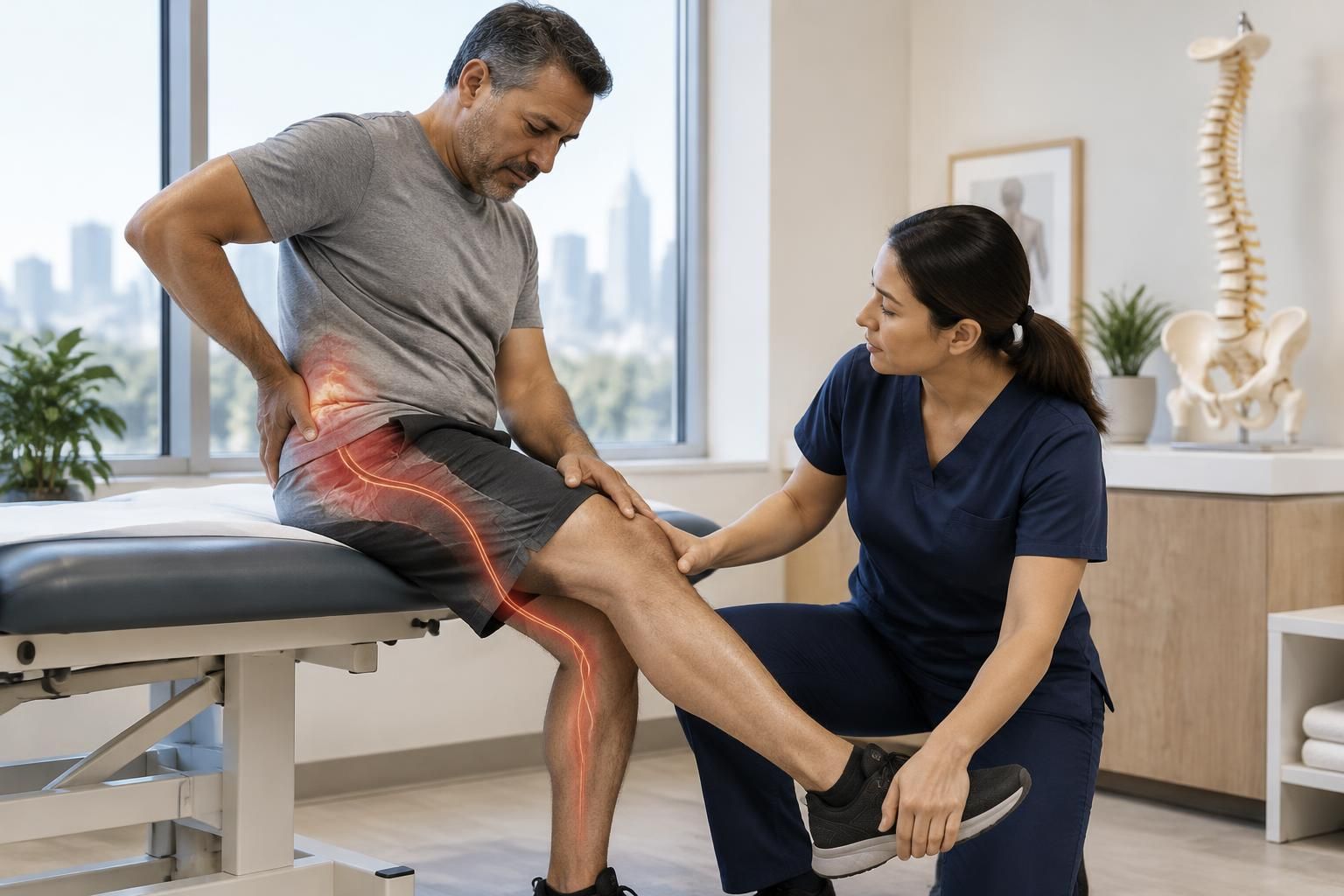
Low back pain that travels through the buttock and down the leg may be consistent with sciatica, sometimes associated with disc narrowing. In Dollard-des-Ormeaux, as elsewhere in the Greater Montréal area, driving, commuting and long periods of sitting can make symptoms harder to manage; however, they cannot identify the cause on their own.
A bulging disc or a disc herniation can irritate a nerve root, but other issues can cause pain that radiates into the leg. The most cautious approach is to monitor how symptoms evolve, avoid prolonged immobility and seek an assessment if pain limits your activities, is accompanied by numbness or weakness, or worsens.
In brief: initial guidance for sciatica related to disc narrowing
The path of the pain alone is not enough to confirm the cause. A clinical examination and the progression of symptoms help determine whether a nerve root is irritated.
Gentle movement is generally preferable to prolonged bed rest. Adjust your activities based on your tolerance and stop a movement that clearly increases pain in the leg.
Progressive weakness or urinary symptoms require urgent attention. These signs should not wait for a routine appointment.
For comfort accessories, some readers look for a lumbar cushion or hot-cold compress; these products do not treat the cause, and their usefulness varies from person to person.


What does disc narrowing mean when pain travels down the leg?
Sciatica refers to pain related to irritation of a nerve root that contributes to the sciatic nerve. This nerve originates in the low back, passes through the buttock region and continues into the leg. Because it contributes to sensation and certain movements, irritation can lead to pain, tingling, numbness or, sometimes, weakness.
The term “disc narrowing” is often used to describe reduced space between two vertebrae or a change in a disc. On its own, it does not prove that a disc is compressing the nerve. A disc herniation or protrusion may contribute to symptoms, but imaging must be interpreted alongside the history of pain and the physical examination.
The L4, L5 and S1 roots are frequently involved in low back pain radiating to the leg. Certain pain patterns can guide the assessment, but they cannot determine with certainty which root is affected. Similar pain may also be referred from joints or muscles, or be related to narrowing of the spinal canal or a foramen, the opening through which a nerve root passes.
Discomfort arising from the buttock may also have a muscular origin, particularly around the piriformis; pain at the front of the thigh may instead suggest femoral neuralgia. These distinctions matter because they affect management options. To explore possible causes further, see the guidance on the causes and diagnosis of sciatica.
Which symptoms should you monitor, and when should you seek an assessment?
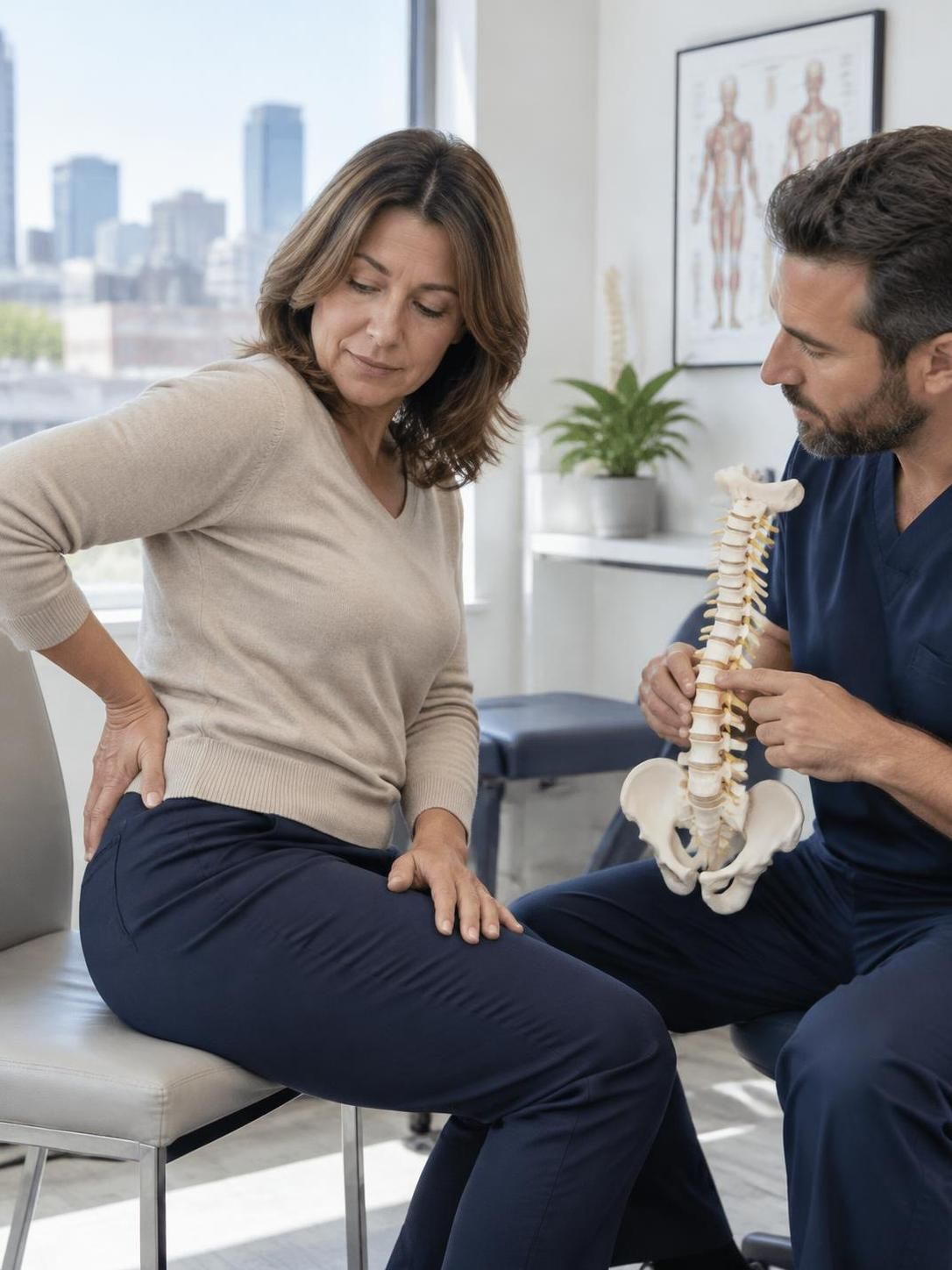
Pain that travels below the knee, tingling or an area of reduced sensation may accompany nerve irritation. New difficulty lifting the foot, pushing off with the toes or walking normally deserves particular attention. Note how long symptoms have been present, what changes them and whether weakness or numbness is progressing.
A medical consultation or assessment by a qualified professional is appropriate when pain persists, returns often, disrupts sleep or limits walking and work. In Dollard-des-Ormeaux, a day spent driving or at the office can make breaks difficult; however, breaking up sitting time and observing the body’s response may help describe the issue more clearly during an appointment.
Have your symptoms assessed if pain remains significant or recurs, travels below the knee, limits your mobility, disrupts sleep, or is accompanied by numbness, loss of sensation, weakness or loss of function.
Seek urgent medical help if you lose control of the bladder or bowels, have new difficulty urinating, saddle numbness, significant or rapidly progressing weakness, fever or a decline in general health. Significant trauma, pain in the context of cancer or infection, or rapid worsening also warrant assessment without delay.
These signs cannot establish a diagnosis remotely. If you have an urgent symptom, contact the appropriate medical services rather than trying an exercise or treatment at home.
Care recommendations vary depending on the situation, and medications are not suitable for everyone. Guidance from Assurance Maladie on what to do and when to seek care can serve as a general reference, without replacing an assessment tailored to your health status.
Adjusting sitting, walking and sleeping positions
Prolonged sitting can worsen symptoms for some people, without being the sole cause of sciatica. In the car or at the office, a seat that does not force you to slump and regular changes in position can improve comfort. Getting up periodically and walking a few steps is often more realistic than trying to maintain perfect posture for hours.
Responses to movement vary. Bending forward, rapid twisting or lifting a load may increase pain for some people; for others, a short walk or a slightly reclined position is better tolerated. If you need to lift an object, keep it close to your body and bend your knees as much as possible, without forcing yourself into a position that triggers sharp pain.
For sleep, lying on your side with a pillow between your knees or on your back with your legs supported may provide temporary relief. There is no universal position: change positions if an area becomes painful and avoid turning rest into prolonged immobility. Guidance regarding positions that may worsen sciatica should be adapted to your actual response.
An exercise is not automatically beneficial simply because it stretches the back or buttock. Stop if pain travels further down the leg, numbness increases or weakness appears; individualized progression is more cautious than a rigid program found online.
Which options may contribute to sciatica treatment?
When emergency signs are absent, management can begin by maintaining or gradually resuming tolerated activities. Movement advice, tailored exercises and manual care may be considered depending on the assessment. The goal is to preserve function and reduce symptoms, without promising the same outcome for everyone.
A physician or pharmacist can discuss appropriate medications, taking into account contraindications, other treatments and your medical history. Injections are sometimes considered in certain persistent situations. Surgery may be assessed when compression and symptoms warrant it, particularly in the presence of a significant neurological deficit; the decision depends on the clinical picture, not solely on the word “herniation” in an imaging report.
| Option | Possible role | Key consideration |
|---|---|---|
| Gradual activity and tailored exercises | Maintain mobility and support a return to activities. | Modify or stop a movement that worsens neurological symptoms. |
| Medication or injection | Reduce symptoms in certain situations, based on the advice of an authorized professional. | Benefits, risks and indications should be reviewed individually. |
| Motorized spinal decompression | Controlled traction that may be considered for certain patients after assessment. | Results vary; it is not indicated for everyone and does not replace urgent care. |
| Specialist opinion or surgery | Assess significant compression or a deficit that warrants it. | The decision is based on progression, examination and relevant imaging findings. |
Motorized spinal decompression applies progressive, controlled traction. For certain patients with a profile compatible with disc or foraminal involvement, it may be discussed to temporarily modify mechanical stresses around the discs and nerve roots. It does not put a disc back into place and does not guarantee relief or avoidance of surgery.
An assessment is needed before considering this approach, as certain conditions or contraindications may lead to choosing another option or first seeking medical advice. No number of sessions is suitable for everyone. Decompression differs from exercises, manual care, injections and surgery; it does not automatically replace them.
TAGMED Clinic, located at 1140 Beaumont Avenue in Mount Royal, near Outremont and Côte-des-Neiges, presents approaches that may include, depending on the assessment, motorized spinal decompression, specific osteopathy or precision percussive therapy. People from Dollard-des-Ormeaux and other areas can consult information on the indications and limitations of spinal decompression without assuming that it will be appropriate for their situation.
Frequently asked questions about disc narrowing and sciatica
Does disc narrowing confirm a disc herniation?
No. This expression sometimes describes reduced space between vertebrae, but it does not on its own confirm a herniation or nerve compression. Symptoms, examination and, when relevant, imaging should be considered together.
Should you stay in bed when pain travels down the leg?
Brief rest in a comfortable position may help, but prolonged immobility may perpetuate stiffness and loss of capacity. Gradually resume tolerated activities and have worsening symptoms reassessed.
When should you seek care for pain consistent with sciatica?
Seek an assessment if pain persists or recurs, limits walking or sleep, or is accompanied by numbness or weakness. Rapidly progressive weakness, saddle numbness, or a urinary or bowel problem requires urgent medical help.
Is motorized spinal decompression suitable for all cases of sciatica?
No. It may be considered for certain patients after an assessment, but the causes of pain and contraindications vary. Results vary, and this approach does not replace an urgent assessment or other indicated care.
Does pain radiating into the leg always come from the sciatic nerve?
No. Referred pain, a muscular condition or another nerve irritation may cause similar symptoms. The pain pattern alone is not enough to establish the cause.
If low back pain travels down your leg and complicates your mobility or work in Dollard-des-Ormeaux, an assessment may help clarify the likely cause, the signs to monitor and the relevance of a conservative approach. To review the options offered in Montréal, visit the page dedicated to sciatica treatment in Montréal.
Sylvain Desforges, B.Sc., D.O., N.D., Doctor of Osteopathy
This content is educational and does not replace a personalized assessment or medical advice.
