


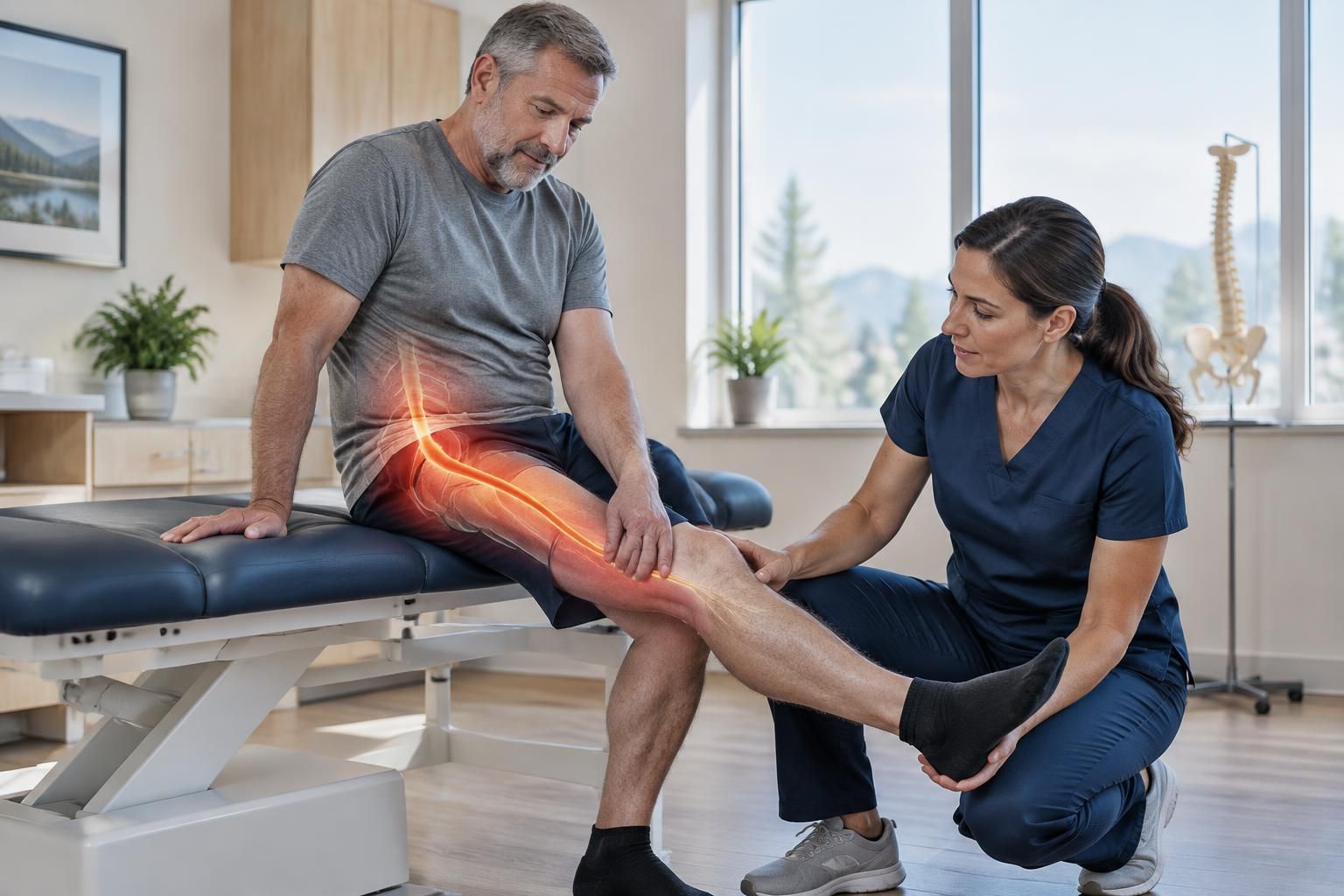
Sciatic pain in the thigh may be related to irritation of a nerve root in the lower back, but its location alone is not enough to determine its cause. Pain in the back of the thigh may suggest involvement along the sciatic pathway; at the front, it may instead suggest femoral neuralgia or a hip problem, among other possibilities.
In Mount Royal, as elsewhere in the Montréal area, driving, commuting by public transit, or long periods of sitting at work can make symptoms more difficult to tolerate. However, the appropriate course of action depends on how they progress, whether numbness or weakness is present, and your ability to walk and carry out your usual activities.
Sciatic Pain in the Thigh: What Symptoms May Indicate
A possible pathway, not a diagnosis. Pain that starts in the lower back or buttock and travels down the back of the thigh may be consistent with nerve irritation.
Variable sensations. Burning, electric-shock sensations, tingling, or numbness may accompany pain, but are not present in everyone.
Function also matters. Weakness, difficulty walking, or loss of sensation warrant clinical attention, especially if they are progressing.
The sciatic nerve is formed by nerve roots that emerge from the lower spine and sacrum. It passes through the buttock region, then travels down the back of the thigh before branching toward the leg and foot. There is one on each side, and symptoms often affect only one leg.
The term “sciatica” is commonly used to refer to pain associated with irritation of a lumbar or sacral nerve root. Pain radiating into the leg may be accompanied by tingling, reduced sensation, or, sometimes, reduced strength. Pain limited to the thigh, without symptoms in the buttock or lower in the leg, does not on its own confirm sciatica.
The affected area provides clues, but it does not automatically identify the nerve root involved. The history of symptoms, assessment of strength and sensation, and mobility of the back and hip must be considered together. To better distinguish possible causes and assessment steps for sciatica, an educational resource may help prepare for a consultation without replacing one.
Causes of Thigh Pain: Sciatica and Other Possibilities
A herniated or bulging disc can irritate a nerve root and cause symptoms in the buttock or leg. Other spinal changes, such as narrowing of a nerve passageway, may also contribute to radicular pain. However, the presence of an abnormality on imaging does not prove that it explains the symptoms: it must be interpreted in light of the examination and progression.
Not all causes of thigh pain are related to the sciatic nerve. Muscle or tendon pain, a hip problem, referred pain from the back, or involvement of another nerve can produce similar sensations. Pain mainly at the front of the thigh may in particular suggest femoral neuralgia, whereas pain at the back is more often associated with the sciatic pathway; these patterns do not replace an examination.
| What you notice | What it may suggest | Why assessment remains useful |
|---|---|---|
| Pain from the buttock to the back of the thigh | Nerve root irritation or referred pain from the back | The pathway alone does not confirm the source or the level involved. |
| Pain mainly at the front of the thigh | Femoral neuralgia, hip involvement, or another musculoskeletal cause | Strength, sensation, and hip movements help guide the assessment. |
| Pain with tingling or numbness | Possible nerve involvement, among other explanations | Progressive loss of sensation should be assessed. |
Coughing or sneezing can sometimes worsen radicular pain, and certain positions can make it more or less noticeable. This pattern is a clue to share with a health professional, not proof of a herniated disc. Unusual, rapidly increasing pain or pain accompanied by general symptoms requires particular attention.
Relieving Sciatic Pain Without Straining the Thigh
When no emergency signs are present, relative rest is generally preferable to prolonged bed rest. It may be reasonable to temporarily reduce movements that clearly aggravate the pain while maintaining tolerable short periods of movement, then gradually resume activities. A short walk may be suitable for some people; for others, the duration or pace may need to be adjusted first.
Prolonged sitting, particularly when working from home or travelling by car around Mount Royal, may increase discomfort for some people. Taking movement breaks and varying positions may be more realistic than seeking a perfect posture. Heat or cold may provide temporary relief: choose what feels good and protect your skin by avoiding direct or prolonged application.
Exercises for sciatica are not universal. Mobility movements, gentle stretches, or neural mobilization may be recommended after an assessment, but an exercise that is helpful for one profile may worsen symptoms in another. Stop the movement and seek advice if pain travels farther down the leg, numbness increases, or weakness appears; there is no need to “push through” pain.
Observe changes: note the positions or activities that alter the pain, as well as its progression in the thigh or leg.
Adapt rather than stop everything: temporarily reduce difficult tasks and maintain movements that remain comfortable and safe.
Seek advice before pushing yourself: a professional can determine whether exercises or manual care are appropriate for your symptoms.
A professional massage may sometimes reduce muscle tension in the buttock, but it does not necessarily treat nerve root irritation. Manual care, like exercises, should be selected based on the assessment and should not worsen symptoms. The selection of exercises suited to sciatic symptoms can serve as an informative starting point without replacing a personalized plan.
Medical Consultation in Mount Royal: When to Seek Help
A clinical assessment is indicated if pain persists, regularly recurs, travels below the knee, limits walking, or disrupts sleep. It is also appropriate to consult a professional in the event of numbness, loss of sensation, weakness, or difficulty carrying out your usual tasks. The examination helps clarify which signs to monitor and determine whether further investigations are needed.
Urgent medical assessment is required in the event of loss of bladder or bowel control, numbness in the saddle area (between the legs), or significant or rapidly progressing weakness. Fever or feeling generally unwell, major trauma, pain in the context of cancer or infection, or rapid worsening also warrant prompt care. Do not try to determine these situations remotely.
During a consultation, the professional may assess strength, reflexes, sensation, and movements of the back and hip. Imaging is not automatically required for all sciatic pain; its usefulness depends in particular on the signs observed, the progression, and the clinical question. Guidance provided by Assurance Maladie on when to seek care may help identify situations that require medical attention.
In Mount Royal, access to a consultation can also make it possible to discuss the practical effects of commuting, office work, or sleep on symptoms. It is helpful to describe what triggers or relieves the pain, how long it has been present, and whether sensation or strength has changed. These details help guide the assessment without presuming a diagnosis.
Sciatica Treatment: Choosing an Approach Based on the Assessment
The treatment of sciatica depends on the likely cause, the intensity of symptoms, and their effects on activities. A gradual approach may combine guidance to maintain tolerable activity, adapted exercises, and, where appropriate, manual care. Medication may also be discussed with an authorized professional, who will consider contraindications and your personal situation.
Neurovertebral decompression is motorized, gradual, controlled traction. It may be considered for certain patients after an assessment, particularly when a disc or foraminal profile is considered compatible; its goal is to temporarily modify certain mechanical stresses, not to “put a disc back into place.” Results vary, the evidence does not support presenting it as a solution for all cases of sciatica, and no set number of sessions is suitable for everyone.
This approach does not replace exercises and other conservative options when they are indicated, nor urgent medical assessment. Contraindications and situations requiring medical referral must be reviewed before beginning sessions. An injection may be discussed in certain circumstances; a specialist opinion or surgery may be considered if compression and neurological signs warrant it. These options address different situations and are not interchangeable.
In Mount Royal, Clinique TAGMED, located at 1140 Beaumont Avenue near Outremont and Côte-des-Neiges, indicates that it offers, depending on the assessment, motorized neurovertebral decompression, specific osteopathy, or precision percussive therapy. A consultation makes it possible to determine whether these options are relevant or whether a different referral is preferable. Information on the approaches offered for sciatic pain in Montréal describes a clinical resource without guaranteeing results.
Preventing sciatic pain relies less on perfect posture than on sustainable habits: varying positions, gradually resuming activity after a painful period, and developing strength and mobility according to one’s abilities. It is not always possible to prevent a recurrence, but identifying changes in symptoms early may support an informed decision about the next steps.
Frequently Asked Questions About Sciatic Pain in the Thigh
Can pain limited to the thigh be sciatica?
It is possible, but thigh pain can also come from the hip, muscles, or another nerve root. The pathway and associated symptoms must be interpreted alongside the clinical examination.
When should you seek care for pain that travels down the leg?
Seek care if the pain persists or recurs, limits walking, or is accompanied by numbness, loss of sensation, or weakness. Urinary or bowel problems, saddle anesthesia, or rapidly progressing weakness require urgent assessment.
Should you avoid moving when your thigh hurts?
In the absence of emergency signs, relative rest is often preferable to prolonged bed rest. Maintain tolerable movement and resume gradually; stop an exercise that worsens or spreads symptoms.
Is neurovertebral decompression suitable for all cases of sciatica?
No. It may be considered for certain profiles after an assessment, but it is not indicated for all causes, and results vary. It does not replace urgent care when warning signs are present.
Is imaging always necessary?
No, it is not automatically required. Its value depends on the examination, progression, and the presence of signs that could change management.
If pain in the thigh or leg limits your mobility or activities, an assessment may help clarify the likely cause, the signs to monitor, and whether a conservative approach is appropriate. The consultation does not predetermine the appropriate treatment; this depends on your situation and the examination.
Request an Assessment in Mount Royal
Dr. Sylvain Desforges, B.Sc., D.O., N.D., osteopath
This content is educational and does not replace a personalized assessment.
