


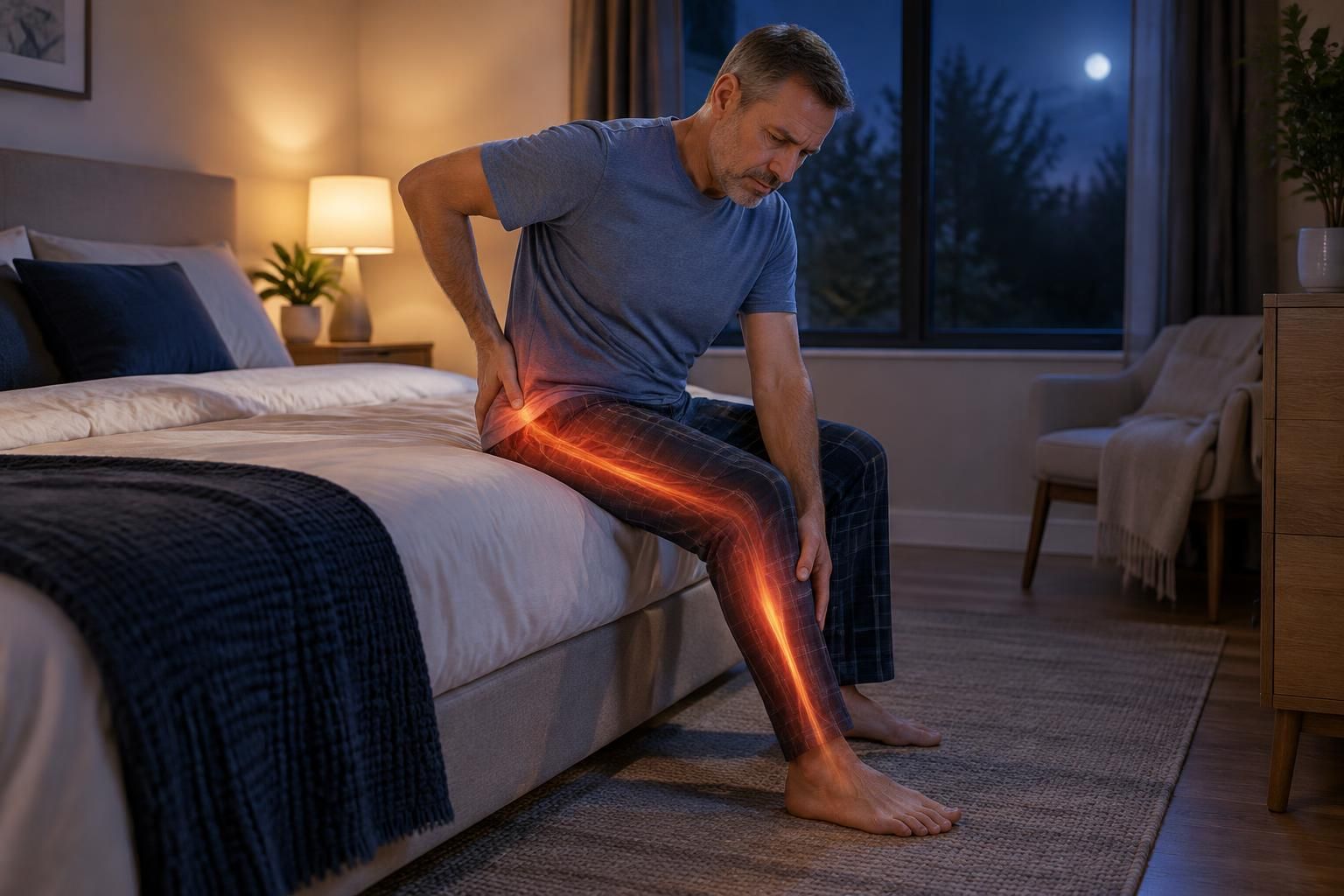
Nighttime sciatica may feel more intense when you lie down or may wake you in the middle of the night. This variation does not automatically mean that the sciatic nerve is more compressed: immobility, certain positions, and how the brain processes pain when things are quiet can contribute to discomfort.
In Le Sud-Ouest, as elsewhere in Montréal, long periods of sitting at work or while commuting can also influence symptoms. To find solutions for sciatica, it is important to consider how symptoms change throughout the day, sensations in the leg, and neurological signs, rather than drawing conclusions from a single bad night.


Key points about sciatic pain at night
Nighttime pain does not prove worsening. Its intensity may vary with position, immobility, and pain sensitivity.
The pain pattern alone is not enough to identify the cause. Pain that travels down the leg may have different origins and should be interpreted in the context of all symptoms.
Simple adjustments may help. Changing position or walking gently for a few minutes may sometimes be more comfortable than remaining still.
Some signs require prompt attention. Progressive weakness or bladder or bowel problems require urgent assessment.
Why nighttime sciatica can disrupt sleep
The term “sciatica” commonly refers to pain that starts in the lower back or buttock and travels down the leg. It may be consistent with irritation of a lumbar nerve root, sometimes related to a herniated disc or age-related changes, but the pain pattern alone does not confirm a diagnosis.
At night, remaining in the same position for a long time can make certain postures less tolerable. Pelvic twisting, keeping the legs straight, or prolonged pressure on a sensitive area can contribute to pain waking you; conversely, some people feel better lying down. Responses vary from one person to another.
Quiet surroundings and fewer distractions can also make sensations more noticeable. The pain is real, even if its perceived intensity changes depending on the time, fatigue, and attention paid to the body. Biological rhythms influence pain sensitivity, but it would be unwise to attribute every awakening to a specific hormonal drop or infer the condition of a disc from it.
Finally, “nighttime pain” does not always mean the same thing. Pain that occurs mainly after several hours in one posture and eases with movement differs from constant, progressive pain accompanied by poor general health or unaffected by position changes. To better distinguish the possibilities, consult these guidelines on the possible causes and assessment of sciatica.

Causes of sciatica and signs to watch for
Pain that travels down the back of the thigh or below the knee may suggest nerve irritation, but other structures in the lower back, hip, or nearby tissues can produce similar symptoms. Numbness, tingling, and weakness are useful details to report, but they cannot on their own precisely locate the affected nerve root.
The consultation is based first on the history of symptoms and a clinical examination: painful areas, mobility, sensation, and strength can be assessed. A professional may also check whether certain movements reproduce or change the pain. Imaging is not necessary in every case; its usefulness depends in particular on symptom progression, the examination, and the clinical question.
An isolated episode after a long day does not allow conclusions to be drawn about a herniated disc or spinal stenosis. Conversely, pain that persists, returns frequently, or limits walking and sleep deserves assessment, even in the absence of an urgent sign. Note when symptoms appear, how far down they travel, and what relieves or worsens them.
| What you notice | What it may suggest | A cautious guide |
|---|---|---|
| Pain after a long period in the same position | Reduced tolerance of this posture or mechanical sensitivity | Try a gentle position change and observe the effect. |
| Tingling or numbness in the leg | Possible nerve irritation, to be interpreted alongside the examination | Seek advice if the symptom persists, progresses, or is accompanied by weakness. |
| Persistent pain and overall worsening | A situation requiring clinical assessment | Book an appointment rather than relying only on sleep advice. |
For more general guidance on pain that occurs at bedtime, this article on nighttime sciatica may supplement the information, without replacing a personalized assessment.
Relieving nighttime pain: cautious positions and strategies
The best sleeping position with sciatica is one that allows you to rest without worsening symptoms. On your side, some people appreciate a pillow between their knees; on your back, support under the knees may be comfortable. These options are not universal medical rules: keep the one that helps you and stop any adjustment that increases pain, numbness, or tingling.
If pain wakes you, first try changing position slowly. If remaining in bed is still uncomfortable, you may get up for a few minutes and walk gently around the room, provided it is safe to do so. There is no need to do intense stretches or force a painful movement in the middle of the night.
- Vary your positions when immobility becomes uncomfortable, without sudden movements.
- Plan a calm transition before bedtime and avoid sitting without interruption throughout the evening.
- Try one adjustment at a time, such as a support pillow, to determine whether it truly improves your comfort.
- Stop a movement if pain travels farther down the leg, numbness spreads, or weakness appears.
A mattress or pillow can change comfort, but no accessory alone treats every possible cause. Be wary of promises of an “ideal” model: preferences and symptoms vary. For general advice on pain at rest, you can also consult this information on nighttime sciatic pain.
When to seek medical care in Le Sud-Ouest
Persistent or recurring pain, pain radiating below the knee, regularly disrupted sleep, or difficulty walking justify seeking clinical advice. The same applies to persistent numbness or loss of sensation. In Le Sud-Ouest, commuting and prolonged sitting can complicate daily life, but they cannot identify the cause of the pain.
Seek a clinical assessment if symptoms last, return, limit your activities, or are accompanied by numbness, loss of sensation, or weakness, even if the weakness does not seem urgent.
Seek urgent medical assessment if you lose bladder or bowel control, have numbness around the genitals or anus, significant or rapidly progressive weakness, fever or poor general health, major trauma, or pain in the context of cancer or infection. Rapid worsening also requires immediate attention.
These signs cannot establish a diagnosis remotely, but they should not be minimized. If the situation seems urgent, contact the appropriate medical services rather than waiting for a comfort measure to take effect.
Sciatica treatment: options to tailor
Management depends on the examination, symptom progression, and the likely cause. When safe, maintaining or gradually resuming usual activities may be preferable to prolonged strict rest. Movement advice and tailored exercises may help some people; a movement that worsens symptoms should be reassessed rather than continued at all costs.
Physiotherapy, manual care, or medications may be considered depending on the situation and the professionals involved. Medications should be discussed with an authorized health professional, particularly because of possible contraindications and interactions. An injection or specialist opinion may be appropriate for certain profiles; surgery is considered when the clinical situation, a neurological deficit, or significant compression warrants it.
Neurovertebral decompression is a motorized, gradual, and controlled form of lumbar traction. Following an assessment, it may be considered for certain patients with symptoms consistent with disc or foraminal involvement, but it is not suitable for all cases of sciatica. It aims to temporarily modify certain mechanical stresses; it does not “put” a disc back in place, does not guarantee results, and never replaces urgent assessment.
Choosing this approach requires a prior examination, screening for contraindications, and reassessment of the response. The number of sessions cannot be universally determined, and results vary. It should not be presented as necessarily avoiding surgery or as superior for everyone to exercises, manual care, medications, or other options.
TAGMED Clinic, located at 1140 Beaumont Avenue in Mount Royal, near Outremont and Côte-des-Neiges, offers approaches that may include, depending on the assessment, motorized decompression, specific osteopathy, or precision percussive therapy. To compare these options with other measures, consult the sciatica management options and TAGMED’s page on neurovertebral decompression.
Frequently asked questions about nighttime sciatica
Does sciatica that is more painful at night mean it is getting worse?
Not necessarily. Posture, immobility, and pain sensitivity can change symptoms. However, lasting worsening, new symptoms, or weakness should be assessed.
Should you get up when pain wakes you?
If you can do so safely, changing position or walking gently for a few minutes may be more comfortable than remaining still. Avoid intense efforts and movements that worsen symptoms.
Which pillow should you use to sleep with sciatic pain?
A pillow between the knees when lying on your side or under the knees when lying on your back may suit some people. Choose based on your comfort and stop if symptoms worsen.
When should you seek medical care?
Seek advice if pain persists, returns, disrupts sleep, or limits walking, or if numbness or weakness occurs. Bladder or bowel problems, saddle numbness, or rapidly progressive weakness require urgent assessment.
Is neurovertebral decompression indicated for all cases of sciatica?
No. It may be considered for certain patients after an assessment, but it is not suitable for everyone and results vary. It does not replace urgent medical assessment or other management options.
If pain travelling down your leg wakes you or limits your days, an assessment may help clarify the likely cause, signs to watch for, and whether a conservative approach is appropriate. The Mount Royal clinic sees people from Montréal, including Le Sud-Ouest, according to their needs and situation.
View sciatica assessment options
Sylvain Desforges, B.Sc., D.O., N.D., Doctor of Osteopathy
This content is educational and does not replace a personalized assessment or medical advice.
