


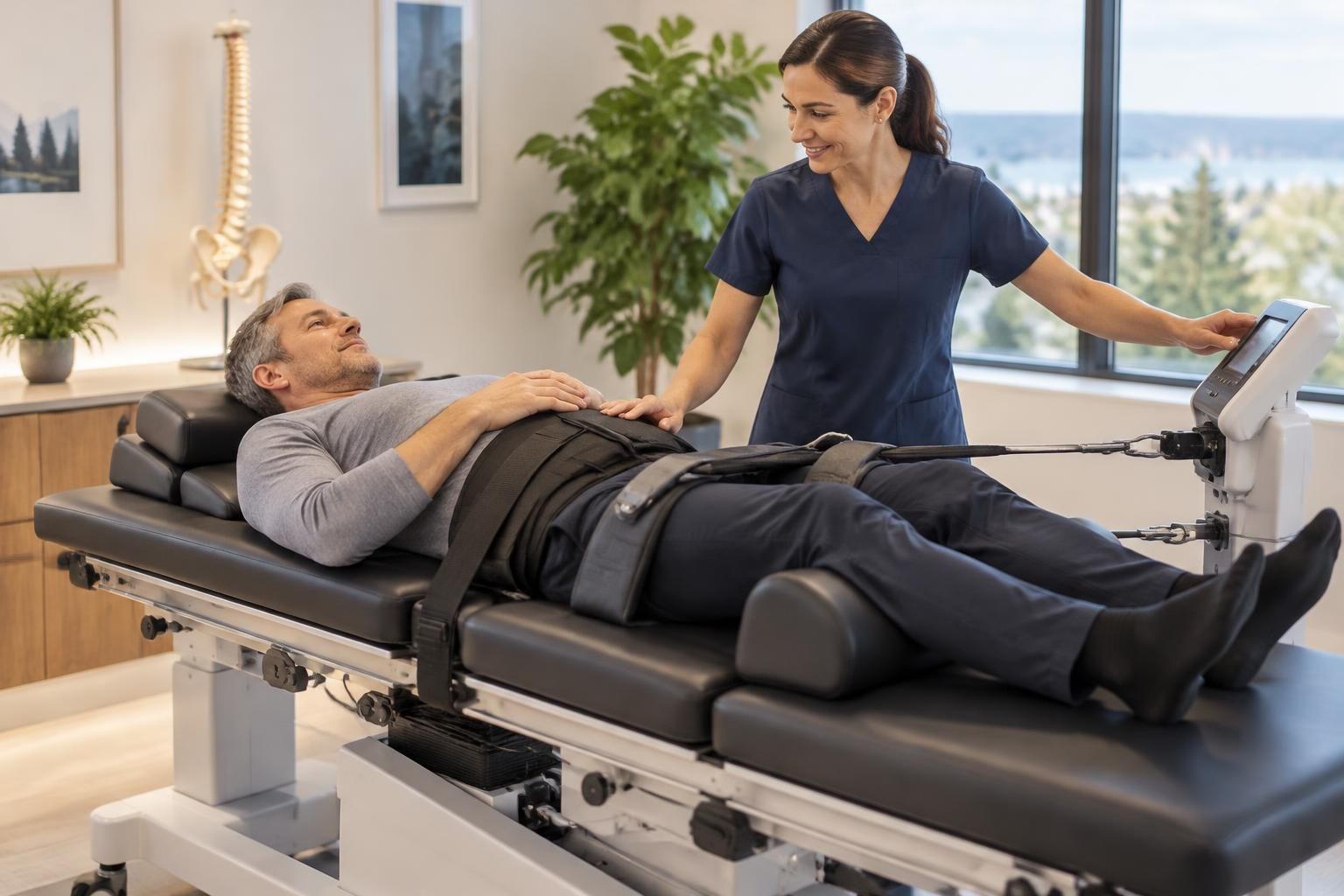
Targeted neurovertebral decompression is a form of motorized therapeutic traction that applies a gradual, controlled force to the lumbar spine. In LaSalle, it may be considered for some people whose low back pain or pain radiating down the leg suggests disc or nerve irritation, following an assessment; it is not suitable for every situation and does not guarantee relief.
The term “targeted” describes how the approach is adjusted according to symptoms and assessment, not certainty that a specific disc is causing the pain. A disc herniation seen on imaging is also not enough to determine treatment: the findings must be considered alongside the examination, functional abilities, and progression of symptoms.
In brief: understanding targeted neurovertebral decompression
Motorized traction: the table applies controlled lumbar traction, with intensity and progression adapted to the assessed profile.
A selective option: it may be discussed for certain symptoms consistent with disc or foraminal irritation, but it is not intended for all types of pain.
A variable response: results differ from person to person; no number of sessions is suitable for everyone.
Signs to watch for: worsening weakness, significant loss of sensation, or urinary or bowel changes require urgent assessment.
For someone who works sitting down in LaSalle, drives often, or alternates between the office and remote work, the return of pain in the buttock or leg may raise a legitimate question: is traction appropriate, or should another cause be explored first? The answer depends on the nature of the symptoms and how they progress, not solely on their intensity.
How neurovertebral decompression works in LaSalle
Neurovertebral decompression uses a motorized table and a trunk or pelvic support system to apply controlled traction. Depending on the device and treatment plan selected, the force is adjusted gradually to temporarily modify certain mechanical stresses on the lumbar region.
This intervention does not put a disc “back in place” and does not guarantee that a nerve root will be released. Its purpose is instead to provide a measured mechanical stimulus that some patients may tolerate better than manual traction or uncontrolled stretching. A session should be stopped or adjusted if symptoms clearly worsen.
Pain radiating down the leg may be consistent with irritation of a nerve root, sometimes associated with a disc herniation, protrusion, or narrowing of the passage where the nerve exits the spine. However, muscle or joint pain can also refer to the buttock or thigh. The pain pattern alone cannot determine the affected structure or reliably identify an L4, L5, or S1 root.
The mechanism of neurovertebral decompression can be explained through the movement of the table and the traction settings. To understand how a motorized session may be considered when pain radiates down the leg, a presentation of motorized lumbar decompression in LaSalle provides additional descriptive information, without replacing an individual assessment.
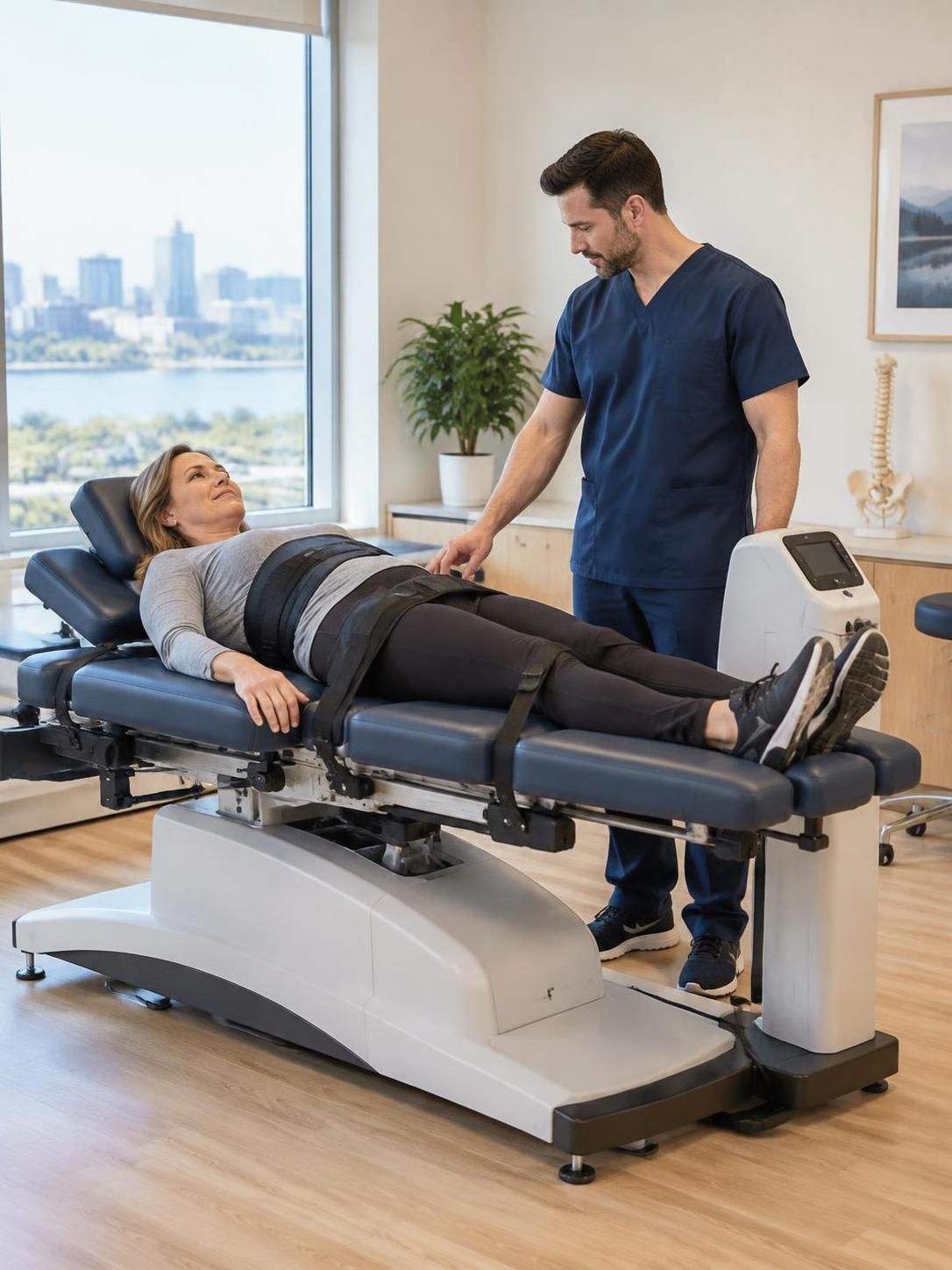
Who may benefit from this therapeutic traction?
An assessment aims to determine whether the person’s symptoms and abilities make this option reasonable. It considers, among other factors, the duration of episodes, movements that worsen or relieve pain, the presence of numbness or weakness, medical history, and examinations already completed.
Decompression may be discussed for some patients whose symptoms suggest a disc or foraminal origin. However, the presence of an abnormality on an X-ray or imaging does not prove that it explains the symptoms. The choice of spinal care is based on agreement among signs, examination findings, and relevant results, not on an isolated image.
Evidence on traction and decompression devices does not support promising uniform effectiveness. Some people may report improvement in pain or mobility; others notice little change or tolerate traction poorly. The response should therefore be reassessed over time using concrete measures, such as walking, sleep, and the ability to resume activities.
Recent fractures, certain infections, particular medical conditions, or significant neurological symptoms may make traction inappropriate or require medical advice first. A decompression clinic in LaSalle should clarify precautions, limitations, and alternatives before proposing a series of sessions.
TAGMED Clinic is located at 1140 Beaumont Avenue in Mount Royal, near Outremont and Côte-des-Neiges; this address is not in LaSalle. Depending on the assessment, approaches related to sciatica may include motorized decompression, specific osteopathy, or the precision percussor. The information on neurovertebral decompression at TAGMED can help provide a better understanding of this option and its clinical context.
Postures, driving, and activities: what may affect symptoms
Prolonged sitting, driving, repeated bending, or sudden exertion can worsen symptoms for some people. Others experience more stiffness after a period of inactivity and tolerate moderate walking better. In LaSalle, as elsewhere in the agglomeration, car travel or hours spent at a computer can therefore make pain more noticeable, without alone revealing its cause.
| Situation | Possible response | Cautious guidance |
|---|---|---|
| Prolonged sitting or driving | Stiffness or increased pain in some people | Change position and observe whether a break improves comfort. |
| Walking at a moderate pace | May be well tolerated or, conversely, worsen symptoms | Choose a comfortable duration and reduce effort if pain intensifies. |
| Bending or sudden exertion | May trigger radiating pain | Adapt the movement rather than pushing through increasing pain. |
| Coughing or sneezing | May briefly worsen pain of radicular origin | Report persistent worsening or worsening accompanied by loss of function. |
Postural adjustments or a support cushion may improve comfort for some people, but they do not treat a nerve root and are not necessarily suitable for all body types. The best position is often the one that allows regular variation without causing a lasting increase in symptoms.
Exercises can help maintain mobility and support a return to activities, provided they are adapted. Stop a movement that causes pain to radiate further down the leg or clearly increases numbness; new or progressive weakness calls for reassessment rather than more effort. Neck pain involves another region of the spine and should not automatically be equated with lumbar sciatica.
To explore movement and management options further, consult the guidance on possible treatments for sciatica. Physiotherapy, when accessible and appropriate, can help adapt activities and exercises; its benefits and limitations are detailed in this presentation of physiotherapy for sciatica in LaSalle.
Management options and when to seek care
Targeted decompression is only one possibility among several. When safe, maintaining or gradually resuming activities, movement advice, and adapted exercises can support function. Depending on the person’s profile, manual care or consultation with a regulated health professional may also be considered.
Medications should be discussed with a regulated health professional, particularly to consider other health conditions and treatments already being used. An injection may be offered in certain situations; specialist advice or surgery may be needed if significant compression, a neurological deficit, or the clinical course warrants it. Traction does not replace these options when they are indicated and cannot guarantee that surgery can be avoided.
A clinical assessment is indicated when pain persists or returns, radiates below the knee, disrupts sleep, or limits walking and daily tasks. Numbness, loss of sensation, weakness, or reduced function also warrants attention, especially if the change is recent or worsening.
Seek urgent care in the event of loss of bladder or bowel control, saddle anaesthesia — meaning loss of sensation around the genitals or anus — or significant or rapidly worsening weakness. Fever or feeling generally unwell, significant trauma, or pain in the context of cancer or infection also requires prompt medical assessment.
These signs cannot be assessed reliably remotely. If they are present, do not delay care to try traction, exercise, or another conservative treatment.
To distinguish situations that warrant a consultation from urgent signs, the guidance on when to seek care for sciatic pain can serve as an educational reference. It does not replace the advice of a professional who knows your situation.
Frequently asked questions about decompression in LaSalle
Is targeted neurovertebral decompression suitable for all pain that radiates down the leg?
No. Several conditions can cause radiating pain, and traction is not suitable for every cause or health condition. An assessment is needed to determine whether this option can be discussed.
Does a disc herniation on imaging mean decompression is needed?
No. An image must be interpreted in relation to symptoms and the clinical examination. The presence of a herniation is not enough to establish that it explains the pain or that traction is indicated.
How many sessions should be planned?
No number of sessions is suitable for everyone. Whether to continue an approach is reassessed based on tolerance, symptom progression, and functional goals.
When should an assessment be requested for recurrent low back pain?
A consultation is indicated if episodes persist or limit walking, sleep, or activities, or if numbness, loss of sensation, or weakness develops. Urinary or bowel changes, saddle anaesthesia, and rapidly worsening weakness require urgent assessment.
Can decompression help avoid surgery?
This is not guaranteed. It may be considered as a conservative option for some patients, but it does not replace specialist advice or surgery when the clinical condition warrants it.
If recurrent low back pain limits your mobility or work in LaSalle, an assessment can help clarify likely causes, signs to watch for, and whether a conservative approach is appropriate. To discuss options related to sciatica at the Mount Royal clinic, consult the information on managing sciatica in Montréal.
Sylvain Desforges, B.Sc., D.O., N.D., Doctor of Osteopathy
This content is educational and does not replace a personalized assessment.
