


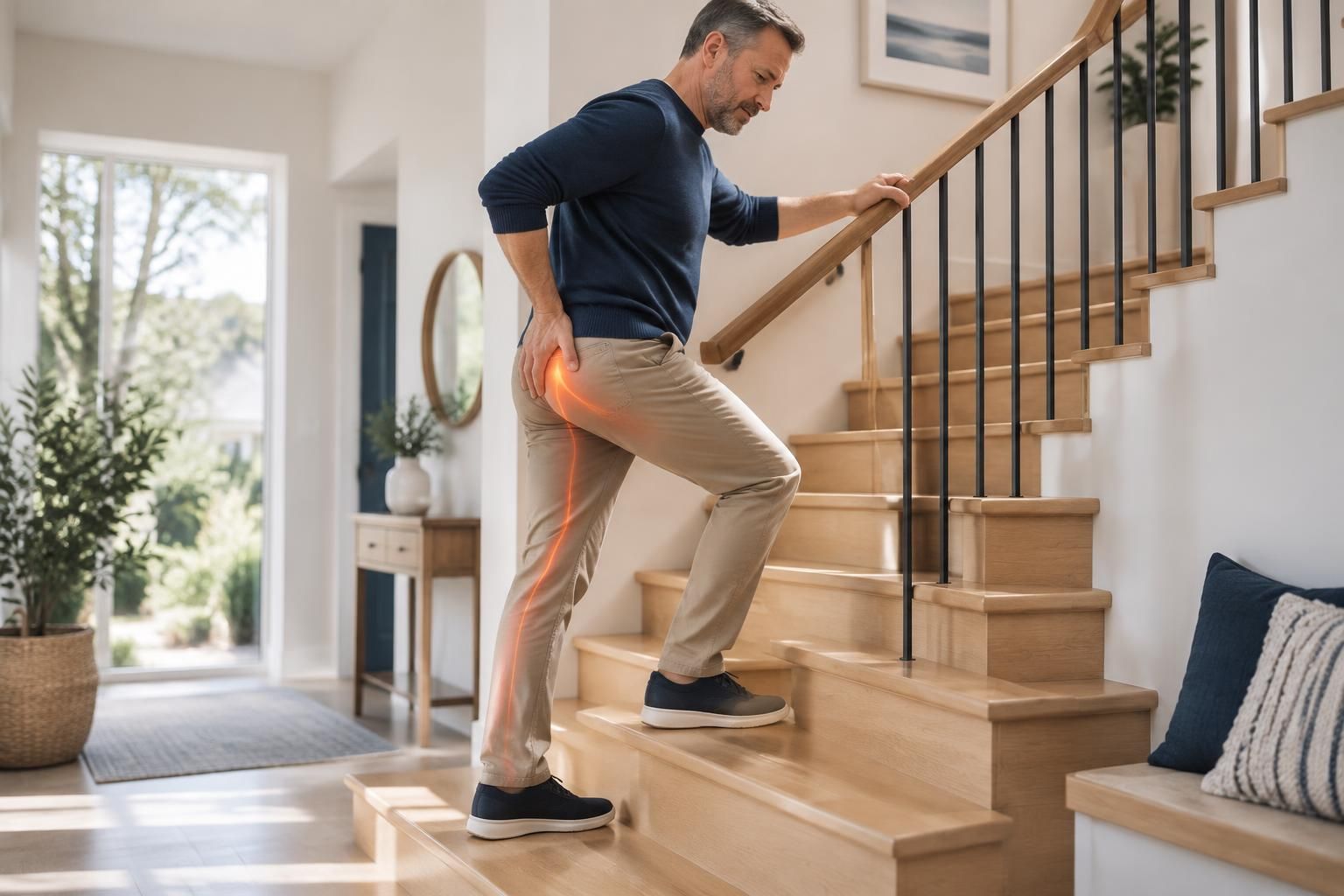
Going up or down stairs can worsen sciatic pain, but this response alone does not determine its cause. Step height, pace, fatigue, and how the pain travels down the leg all influence the effort involved. In Le Sud-Ouest, where stairs are part of many daily trips, a few adaptations may help preserve mobility without pushing through pain.
The key consideration is how symptoms progress: mild discomfort that settles quickly does not have the same significance as pain that travels further down the leg, worsening numbness, or weakness. The practical advice below is intended to make getting around more predictable, without replacing an assessment when symptoms persist or worsen.
To understand everyday movements that can change symptoms, also see these guidelines on positions to adapt with sciatica.


In brief: climbing stairs with sciatica
Assess the response. Pain that increases noticeably or extends further down the leg is a reason to stop the activity and reassess the situation.
Use the handrail. Stable support and a slow pace can make each step more controlled.
Adjust the frequency. Breaking up trips and planning a rest may be more tolerable than tackling several flights in a row.
Watch for neurological signs. New or worsening weakness warrants prompt assessment; some signs require urgent care.
Why going up or down stairs can trigger sciatic pain
Sciatica usually refers to pain related to irritation of a lumbar nerve root, sometimes accompanied by tingling, numbness, or weakness. It may be consistent with a disc herniation or spinal stenosis, among other causes, but pain in the buttock or leg does not automatically confirm nerve compression.
On stairs, every step requires weight transfer, hip flexion, and a push from the leg. Depending on the individual and the cause of symptoms, these movements can stress the lower back, hip muscles, or sensitive nerve structures. Going up often requires more pushing; going down requires movement control and may be uncomfortable for other people. There is therefore no universal rule about which direction is more painful.
The path of the pain provides useful information to describe, but is not enough to identify the nerve root involved. A clinical examination takes strength, sensation, reflexes, and the history of symptoms into account; imaging is considered according to the context rather than routinely.
For example, a person who feels pain in the buttock when climbing may need breaks and support, while another may mainly experience symptoms when going down. This contrast does not mean that one person is necessarily using the wrong movement: the response depends on their presentation and how it evolves.
Practical advice for using stairs more safely
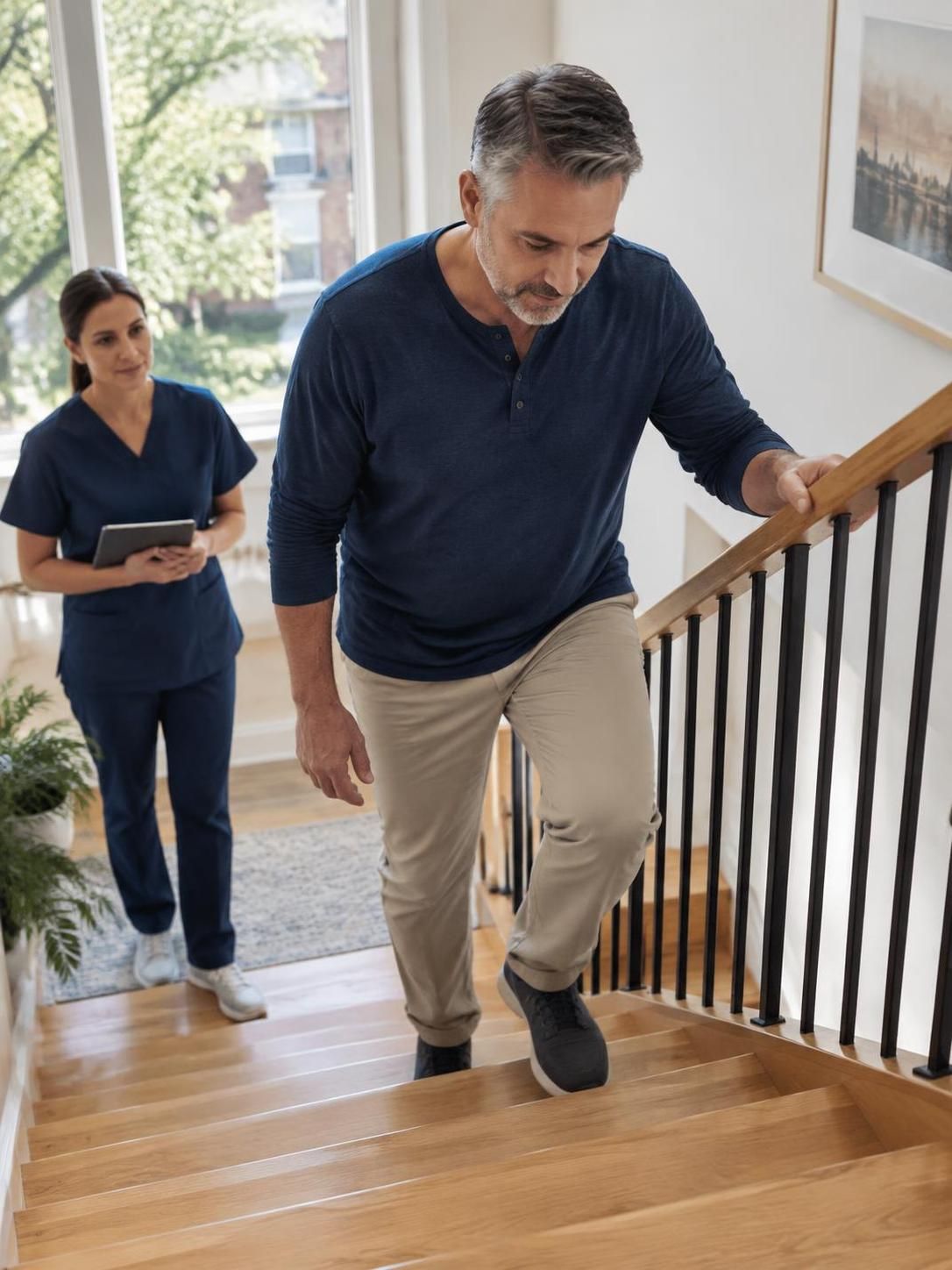
Before starting, make sure the handrail is secure and the steps are clear. Take your time, avoid carrying a bulky load, and keep one hand free for support. If the pain is intense or your balance is uncertain, do not force yourself to use the stairs without help.
A strategy that is often easier to control is to place both feet on each step rather than climbing quickly by alternating legs. Some people find it more comfortable to start with the less painful leg when going up and to go down carefully by placing the sensitive leg first; however, this guideline is not universal medical advice. If this approach worsens symptoms, stop and seek advice.
Going up stairs: take one step at a time, hold the handrail, and pause if your leg becomes tired or the pain worsens.
Going down stairs: slow down, watch the steps, and avoid suddenly twisting your torso while your foot is planted.
Carrying objects: reduce the load, distribute it if possible, and favour a trip with nothing in your hands when balance is less reliable.
At home or in a public place: if several flights are needed, plan stops rather than continuing despite clear worsening.
At home, a securely installed handrail and adequate lighting improve visibility and support. In Le Sud-Ouest, getting around may also involve stairs, sidewalks, and public transit: planning an unhurried route and limiting heavy bags can make daily mobility more manageable during a painful period.
A cane can sometimes help make walking safer, but its height and use need to be appropriate. If you need one because your leg gives way, or if you are worried about falling, seek an assessment rather than relying solely on a walking aid.
Activity, adapted exercises, and pain prevention
Prolonged bed rest is generally not a preferred strategy when movement is safe. Short walks and changes in position can help maintain tolerable activity, but the amount should be adjusted based on the response of symptoms. There is no need to “push through” pain that is worsening.
Appropriate exercises depend on the likely cause, the stage of pain, and the movements that relieve or aggravate it. Flexion, extension, or stretching may suit some people and irritate symptoms in others. Stop an exercise if pain travels further down the leg, numbness increases, or weakness appears; reassessment is then indicated.
Physiotherapy can help assess functional abilities, select a progression of activities, and work on mobility and strength according to individual needs. Manual therapy may be considered for some presentations, but it does not replace an active strategy and is not automatically suitable for all causes of radiating pain. For general guidance, exercises and precautions associated with sciatica can supplement a discussion with a professional.
Pain prevention relies more on gradual habits than on perfect posture: move regularly, break up prolonged periods of sitting, and resume activities gradually after a flare-up. If stairs remain difficult, note what happens when going up and down, how long the reaction lasts, and any symptoms involving sensation or strength; these details will help guide the assessment.
To illustrate everyday movements, this video search may provide general ideas; it does not replace advice tailored to your situation.
When to seek care for sciatica that worsens on stairs
A clinical assessment is indicated if pain persists or returns, travels below the knee, limits walking, or disrupts sleep. Persistent numbness, loss of sensation, weakness, or loss of function also warrant attention, even if symptoms fluctuate.
Urgent medical assessment is necessary in the event of loss of bladder or bowel control, numbness in the saddle area, significant or rapidly worsening weakness, fever, or poor general health. Significant trauma, a cancer or infection context, or rapid worsening also warrant urgent care. Do not attempt to determine the cause remotely.
For persistent symptoms, a professional can determine whether an examination is necessary and which options are appropriate. Treatment may include maintaining safe activity, guided exercises, medication based on the advice of an authorized professional, or, in some situations, an injection or specialist consultation.
Neurovertebral decompression is controlled, motorized lumbar traction that may be considered for some patients after assessment, particularly when the presentation suggests disc or foraminal involvement. It is not suitable for all cases of sciatica, its results vary, and no number of sessions applies to everyone. It does not put a disc back into place and never replaces an urgent assessment; appropriateness and contraindications must be discussed on a case-by-case basis.
TAGMED Clinic, located at 1140 Beaumont Avenue in Mont-Royal, near Outremont and Côte-des-Neiges, provides its information on neurovertebral decompression. To better understand common actions and when to seek help, the guidelines on what to do for sciatica are also a useful resource.
Frequently asked questions about sciatica and stairs
{“@context”:”https://schema.org”,”@type”:”FAQPage”,”mainEntity”:[{“@type”:”Question”,”name”:”Faut-il u00e9viter complu00e8tement les escaliers quand on a une sciatique ?”,”acceptedAnswer”:{“@type”:”Answer”,”text”:”Pas nu00e9cessairement. Si lu2019effort reste tolu00e9rable et que les symptu00f4mes ne su2019aggravent pas, un du00e9placement prudent peut u00eatre possible. Utilisez la rampe, ralentissez et fractionnez lu2019effort; interrompez-le si la douleur su2019u00e9tend ou si une faiblesse apparau00eet.”}},{“@type”:”Question”,”name”:”Est-il normal du2019avoir plus mal en descendant quu2019en montant ?”,”acceptedAnswer”:{“@type”:”Answer”,”text”:”La ru00e9action varie selon les personnes et la cause des symptu00f4mes. Descendre demande de contru00f4ler la flexion et lu2019appui; monter sollicite davantage la poussu00e9e. Cette diffu00e9rence ne permet pas, u00e0 elle seule, de poser un diagnostic.”}},{“@type”:”Question”,”name”:”Quand consulter si les escaliers deviennent difficiles ?”,”acceptedAnswer”:{“@type”:”Answer”,”text”:”Demandez une u00e9valuation si la douleur persiste ou ru00e9cidive, limite la marche, perturbe le sommeil ou su2019accompagne du2019engourdissement ou de faiblesse. Une perte de contru00f4le urinaire ou intestinal, une anesthu00e9sie de la selle ou une faiblesse rapidement progressive exige une u00e9valuation urgente.”}},{“@type”:”Question”,”name”:”La du00e9compression neurovertu00e9brale peut-elle aider u00e0 monter les escaliers ?”,”acceptedAnswer”:{“@type”:”Answer”,”text”:”Elle peut u00eatre envisagu00e9e chez certains patients apru00e8s une u00e9valuation, mais ne constitue pas une solution universelle et ses ru00e9sultats varient. La prioritu00e9 est de clarifier les symptu00f4mes et du2019u00e9carter les signes qui nu00e9cessitent une prise en charge urgente.”}}]}Should stairs be avoided completely when you have sciatica?
Not necessarily. If the effort remains tolerable and symptoms do not worsen, careful use of stairs may be possible. Use the handrail, slow down, and break up the effort; stop if the pain spreads or weakness appears.
Is it normal for pain to be worse when going down than up?
The response varies depending on the person and the cause of symptoms. Going down requires controlling flexion and weight-bearing; going up requires more pushing. This difference alone cannot establish a diagnosis.
When should you seek care if stairs become difficult?
Seek an assessment if pain persists or recurs, limits walking, disrupts sleep, or is accompanied by numbness or weakness. Loss of bladder or bowel control, saddle anaesthesia, or rapidly worsening weakness requires urgent assessment.
Can neurovertebral decompression help with climbing stairs?
It may be considered for some patients after an assessment, but it is not a universal solution and results vary. The priority is to clarify symptoms and rule out signs that require urgent care.
If sciatic pain is making it difficult to get around in Le Sud-Ouest, an assessment can help clarify the likely cause, signs to watch for, and whether a conservative approach is appropriate. In Mont-Royal, you can explore assessment and management options for sciatica.
View the clinic’s contact information
Sylvain Desforges, B.Sc., D.O., N.D., osteopath and naturopath
This content is educational and does not replace a personalized assessment or medical advice.
