


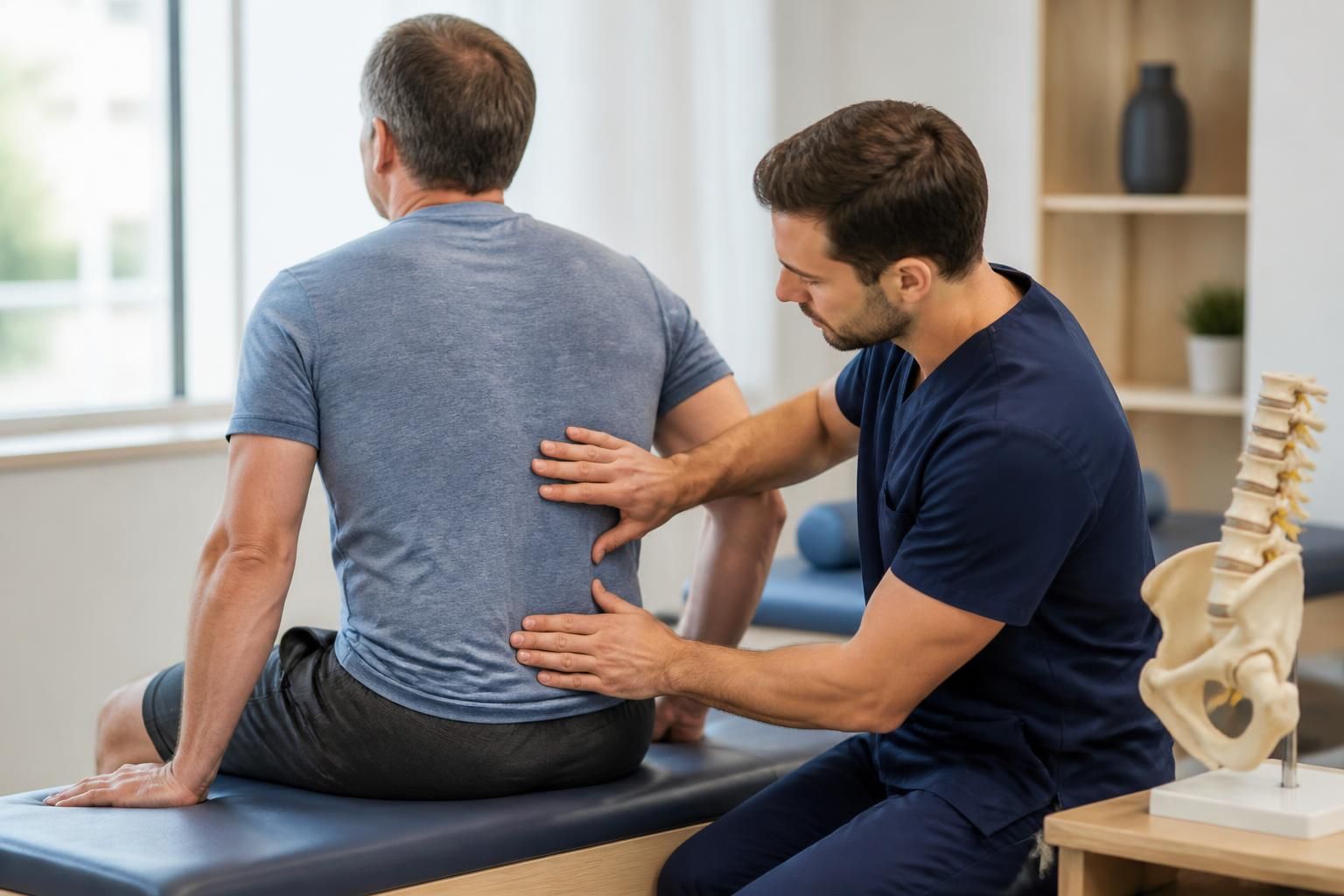
Sciatica, often described as shooting pain radiating from the lower back down the leg, is a common condition in the LaSalle area. Physiotherapy is frequently recommended as a preferred conservative treatment, aiming to reduce pain, improve mobility and prevent recurrences. However, despite its recognized benefits, this approach has limitations and requires precise adaptation to the underlying causes and the patient’s stage of progression.
In a context where understanding clinical specificities guides treatment choices, it is essential to consider the diversity of symptoms and mechanical causes of sciatica. Optimal care relies on a thorough assessment, making it possible to avoid movements that could worsen nerve irritation and to incorporate the most appropriate rehabilitation strategies. In LaSalle, patients benefit from tailored approaches, often combined with neurovertebral decompression, for comprehensive and progressive care.


Recognized benefits of physiotherapy in managing sciatica in LaSalle
Physiotherapy is often recommended as a first-line option for managing sciatica, including in the LaSalle area, because of its positive effects on pain reduction and functional improvement. This therapeutic approach is based on several complementary mechanisms intended to relieve irritation of the sciatic nerve and restore harmonious movement of the lumbar spine.
Among its notable benefits, physiotherapy may help reduce local inflammation and muscle tension. Using manual techniques such as gentle joint mobilization and soft-tissue massage, it helps reduce reflexive guarding in the lumbar and gluteal muscles, which are often contracted in response to pain. This muscle relaxation promotes better blood and lymphatic circulation, which may accelerate the resolution of inflammatory processes.
Tailored exercise programs are another pillar of physiotherapy for sciatica. In LaSalle, physiotherapists often prescribe a combination of stretching, core-strengthening and neural mobilization exercises, personalized according to the stage of progression and the source of the symptom. For example, targeted stretching of the piriformis muscle may be beneficial when it places pressure on the nerve, while strengthening the deep abdominal muscles helps stabilize the lower back and reduce disc loading.
The role of physiotherapy goes beyond simply managing symptoms. It also aims to correct postural imbalances and poor mechanical habits that may cause or promote the recurrence of sciatic pain. This comprehensive care often includes work on everyday ergonomics, whether in the workplace or at home, particularly for LaSalle residents whose activities involve extensive sitting or repetitive movement.
The psychological benefits associated with physiotherapy are also worth noting. By providing educational support, personalized advice and appropriately progressed exercises, patients gain confidence in their functional abilities. This psychological strengthening plays an important role in managing chronic pain and preventing harmful avoidance behaviours.
In summary, physiotherapy provides a holistic approach that includes pain reduction, mobility optimization, correction of mechanical factors and patient support. This approach is widely supported by clinical evidence, reinforcing its role as a preferred conservative treatment before considering more invasive interventions.

Limitations and precautions related to physiotherapy for sciatica
Despite its many benefits, physiotherapy has important limitations in the treatment of sciatica, particularly in LaSalle, where patients may present with substantial clinical variability. Recognizing these limitations is essential to adapt care and avoid worsening or unnecessarily prolonging symptoms.
The first limitation lies in the multifactorial nature of sciatica. For example, a large disc herniation or advanced foraminal stenosis may result in significant mechanical nerve compression that exercises or manual care alone may not be enough to relieve. In these cases, physiotherapy is instead a preparatory or complementary step alongside other treatments, such as neurovertebral decompression or specialist consultation. When significant compression is suspected, an accurate diagnosis is crucial before starting a rehabilitation program.
In the acute phase, certain exercises or physiotherapy techniques can also worsen pain if performed without proper judgment. In particular, loaded lumbar flexion, sudden movements and forced stretches should be avoided, as they may increase pressure on the nerve. Care in LaSalle always incorporates a precise functional assessment to determine which movements should be prioritized or paused according to individual tolerance.
Another challenge is patient adherence and persistence. Physiotherapy often requires several sessions and a commitment to perform exercises at home, which may be difficult for some people. Treatment is a gradual process that does not guarantee immediate pain resolution, which may lead to discouragement or a premature search for less conservative solutions.
In addition, physiotherapy does not replace prompt medical assessment in the presence of concerning neurological signs, such as progressive muscle weakness, urinary problems or perineal numbness. These manifestations require urgent consultation, for which physiotherapy cannot be a substitute.
Finally, certain local contraindications, such as an active infection, a recent vertebral fracture or a tumour, require stopping or substantially modifying physiotherapy treatment. LaSalle professionals carefully select patients before establishing a program to maximize safety and effectiveness.
To fully understand the scope of these limitations and ensure an appropriate approach, patients and those seeking information are advised to consult specialized resources, such as sites offering an overview of physiotherapy for sciatica, which clearly explain which cases may benefit and which require a different referral pathway.

Specific exercises and precautions during sciatica rehabilitation in LaSalle
A central aspect of physiotherapy is guiding rehabilitation through exercises tailored to the specific cause and stage of progression of sciatica. Several exercises are regularly recommended in LaSalle clinics, while respecting individual limits and under professional supervision.
Commonly prescribed exercises include piriformis stretching, which may help reduce compression on the nerve root when it is affected by contraction of this muscle. It is performed lying down, by placing the ankle on the painful side over the opposite knee, then gently pulling the thigh toward the chest without triggering leg pain. This movement should be repeated several times a day, with particular attention to tolerance.
Puppy pose, an all-fours position in which the hands reach far forward while keeping the hips above the knees, promotes gentle decompression of the lumbar spine. This posture stretches the posterior chain and often provides relief without intensifying pain.
“Slider” neural mobilization provides subtle mobilization of the sciatic nerve without abrupt stretching. While seated in a chair, this movement involves alternating flexion and extension of the leg in coordination with head movements to modulate neural tension. This technique helps restore nerve mobility in peripheral tissues.
Progressive strengthening of the deep abdominal core is also an essential component, helping stabilize the lumbar spine and decrease the load on the intervertebral discs. This exercise is performed with a gentle contraction of the lower abdomen, without holding the breath, and is often introduced as early as the subacute phase.
It is crucial to stop certain exercises, especially in the acute phase, such as loaded lumbar flexion, crunches or any exercise that causes pain radiating into the leg. LaSalle patients are made aware of these precautions and invited to report any increase in symptoms to their physiotherapist.
- Gentle stretches adapted to the cause of sciatica
- Progressive strengthening of lumbar stabilizing muscles
- Controlled nerve mobilization to restore gliding
- Avoid exercises that cause increased radicular pain
- Careful monitoring during the acute phase to avoid exacerbations
Performing these exercises in a supervised setting provides optimal benefit and limits risks, thereby reinforcing the essential role of the physiotherapist in personalized care.

Progression, influencing factors and the importance of restoring mobility after sciatica
Management of sciatica in LaSalle incorporates a detailed understanding of the factors that influence symptom progression and treatment effectiveness, particularly those related to patients’ mobility and lifestyle.
Prolonged rest in the context of sciatica is now discouraged. Although strict bed rest was previously commonly recommended for radicular low back pain, current knowledge highlights the risks associated with prolonged immobility: stiffness, muscular deconditioning and worsening pain. In contrast, moderate, controlled movement tailored to tolerance is beneficial for circulation, nerve mobility and overall recovery.
In LaSalle, patients are encouraged to gradually incorporate functional activities, such as walking, without exceeding their pain limit. Alternating between sitting and standing during the day, adapting the workstation and making ergonomic adjustments at home help reduce mechanical stress on the sciatic nerve.
Different factors can worsen or relieve symptoms: prolonged sitting, remote work, certain driving postures, and going up and down stairs are frequently mentioned. Understanding these aspects allows patients to adapt their environment and habits to better manage the condition.
In some cases, motorized neurovertebral decompression is considered as a complement to physiotherapy. This technique involves progressive, controlled spinal traction intended to temporarily reduce pressure on nerve roots, particularly when mechanical conditions such as disc protrusion or foraminal stenosis are present. For some patients in LaSalle, this addition may improve tolerance to movement and functional outcomes, but it is not indicated for all cases of sciatica.
| Factors affecting sciatic pain | Common effect on symptoms |
|---|---|
| Prolonged sitting | Often worsens pain by increasing disc pressure |
| Moderate walking | Often relieving; promotes nerve and muscle circulation |
| Intense physical or sports activities | May cause a flare-up in the acute phase |
| Ergonomic adaptations (posture, lumbar support) | Reduce compression and relieve symptoms |
| Prolonged rest | May cause stiffness and deconditioning, delaying recovery |
Results vary from one patient to another, and an individual understanding of these factors is essential to optimize rehabilitation. Regular follow-up at an appropriate clinic, such as those offering convenient access to both physiotherapy and neurovertebral decompression near LaSalle, helps adjust care according to changes in clinical signs.
When to consult a professional for persistent or worsening sciatica in LaSalle
It is important to know the signs indicating the need to consult a health professional when sciatica persists or progresses unfavourably, particularly in the LaSalle area, where access to specialized care is often easier.
Consult a physiotherapist or physician as soon as:
- Pain persists for several days without improvement and affects sleep.
- Pain consistently travels below the knee and limits walking.
- Numbness, tingling or muscle weakness develops in the leg.
Seek urgent medical attention in the following situations:
- Loss of bladder or bowel control.
- Numbness in the perineal (“saddle”) area.
- Significant or rapidly progressing muscle weakness.
- General signs such as unexplained fever or deterioration in general health.
In these cases, prompt diagnosis and specific treatment are imperative. Physiotherapy does not replace these urgent assessments but is part of a complementary care pathway once critical situations have been ruled out.
Sciatica treatment options in LaSalle: physiotherapy, neurovertebral decompression and alternatives
In the management of sciatica in LaSalle, physiotherapy plays a central role, often incorporated into a comprehensive treatment plan that may include other modalities according to the diagnosis and the patient’s response.
Physiotherapy offers conservative treatment based on a thorough assessment, manual techniques, functional rehabilitation and instruction in appropriate exercises. In LaSalle, specialized clinics tailor these programs to each person to avoid aggravation and improve mobility, while taking the underlying cause into account.
Motorized neurovertebral decompression, for its part, is a form of progressive spinal traction using specialized equipment. It aims to temporarily reduce the pressure exerted on the discs and nerve roots. This technique may be considered for some patients with a disc herniation or moderate stenosis, as a complement to physiotherapy. However, it is not suitable for every case, particularly when specific contraindications or urgent neurological symptoms are present.
In parallel, complementary approaches such as functional osteopathy or precision percussive therapy may be offered in LaSalle to help relieve muscle tension and improve body mechanics. These methods are often integrated into a multidisciplinary plan and adapted according to clinical feedback.
It is important to note that medication options or injections are decided by medical specialists and do not replace the role of conservative interventions in the community. Surgery is reserved for severe cases involving persistent neurological deficits or significant compression not relieved by conservative care.
To better understand the various care modalities, consult detailed resources on the comparison between physiotherapy and neurovertebral decompression offering a clear overview of their respective indications, benefits and limitations.


What are the specific benefits of physiotherapy for sciatica?
Physiotherapy helps reduce pain, improve mobility, decrease muscle tension and correct postural imbalances, which promotes better recovery.
When is physiotherapy not enough to treat sciatica?
It may be limited in cases of significant nerve compression, severe neurological signs or medical contraindications that require specialized assessment and treatment.
Which exercises are recommended to relieve sciatica?
Gentle piriformis stretches, lumbar decompression postures and neural mobilizations combined with abdominal core strengthening are often recommended.
Why should prolonged rest be avoided with sciatica?
Prolonged rest can worsen stiffness and muscle deconditioning, thereby delaying recovery; gentle mobilization is preferred as soon as it is tolerated.
In what situations is urgent consultation necessary?
Rapid weakness, loss of bladder or bowel control, and perineal numbness require immediate medical assessment.
If sciatica-related pain limits your mobility or disrupts your daily life in LaSalle, a specialized assessment may help identify the likely cause and the options best suited to your situation. Personalized follow-up combining physiotherapy and other complementary approaches may be considered to relieve your symptoms safely.
Book an appointment for sciatica treatment
Dr. Sylvain Desforges, B.Sc., D.O., N.D., osteopath
This content is for educational purposes and does not replace a personalized assessment with a health professional.
