





Neurogenic vs vascular claudication: why walking causes leg pain
Leg pain, heaviness, numbness or weakness during walking may come from lumbar spinal stenosis or reduced arterial blood flow. The pattern offers clues, but symptoms alone do not safely establish the cause.
Neurogenic claudication arises when lumbar stenosis affects neural structures during standing or walking. Vascular claudication occurs when exercising muscles do not receive enough arterial blood. Both conditions can coexist, especially in older adults with cardiovascular and degenerative risk factors.
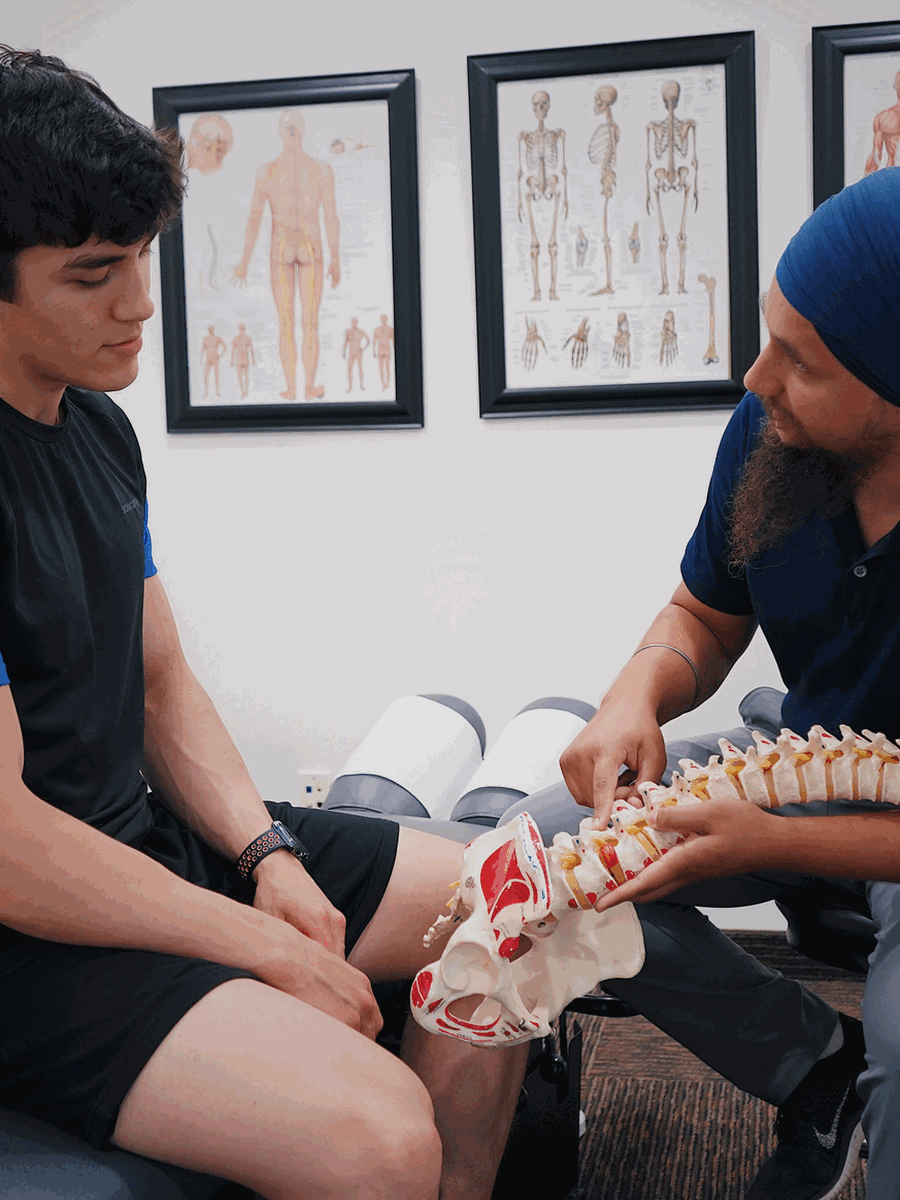
Assessment and differential diagnosis
Assessment compares the effect of standing, sitting, lumbar flexion, cycling and walking. It includes neurological examination, hip evaluation, peripheral pulses, skin temperature and cardiovascular risk review. An ankle-brachial index may assess arterial disease, while lumbar MRI is considered when spinal stenosis findings may change management.
| Clinical pattern | Possible interpretation | Why it matters |
|---|---|---|
| Symptoms above the knees, triggered by standing and relieved by sitting | Neurogenic pattern more likely | A symptom constellation is more useful than one feature. |
| Calf symptoms relieved by stopping while remaining upright | Vascular pattern more likely | Arterial evaluation may be necessary. |
| Mixed or atypical presentation | Investigate both pathways | Spinal and vascular disease can coexist. |
| Rest pain, ulcers or sudden limb change | Urgent vascular assessment | Limb viability may be threatened. |


Treatment and decision-making
Lumbar stenosis may be managed with education, activity pacing, exercise, medication, selected injections or surgery according to function and neurological status. Peripheral arterial disease requires cardiovascular risk management, supervised exercise and, in selected cases, vascular medication or revascularization. Treating only the spine will not correct an arterial limitation.
Questions before choosing care
What is the leading diagnosis?
Ask which findings support it and which alternatives remain.
What test would change care?
Avoid testing that cannot alter the next step.
What result matters?
Track function, neurological safety and meaningful activity.
When should the plan change?
Define referral, stopping and escalation criteria.

Relevant specialized resources
Some resources may share ownership or editorial direction; this relationship is disclosed and the links are included for contextual relevance.
Clinique TAGMED — spinal stenosis information
Clinical information about selected non-surgical spinal care.
Frequently asked questions
Does leaning on a shopping cart prove spinal stenosis?
No. It is one useful clue within a broader pattern.
Can vascular pain improve with sitting?
It may improve simply by stopping activity, regardless of posture.
Can both conditions occur together?
Yes.
What is an ankle-brachial index?
A comparison of ankle and arm blood pressures used to screen for peripheral arterial disease.
Does MRI diagnose vascular claudication?
No.
Does a normal pulse exclude vascular disease?
Not always.
Can cycling distinguish the conditions?
Posture and exercise response may add clues but do not establish the diagnosis alone.
When is spine surgery considered?
When severe functional limitation or neurological compromise correlates with treatable stenosis.
When is vascular surgery considered?
When symptoms, anatomy and limb risk justify revascularization.
Does The Spine Page diagnose claudication?
No.
Sources consulted
- Nadeau et al. — Differentiating neurogenic from vascular claudication
- Houle et al. — Treadmill walking in neurogenic and vascular claudication
- North American Spine Society — Degenerative Lumbar Spinal Stenosis Guideline
Last editorial review: July 2026. General educational information only.
Dr. Sylvain Desforges, B.Sc., D.O., N.D., osteopath — The Spine Page
Continue exploring spine health
Use the condition and treatment hubs to compare related guides.
The Spine Page — The best treatments for your spinal problems — www.thespinepage.com