

Vertebra with features of two neighbouring spinal regions, particularly at the lumbosacral junction.
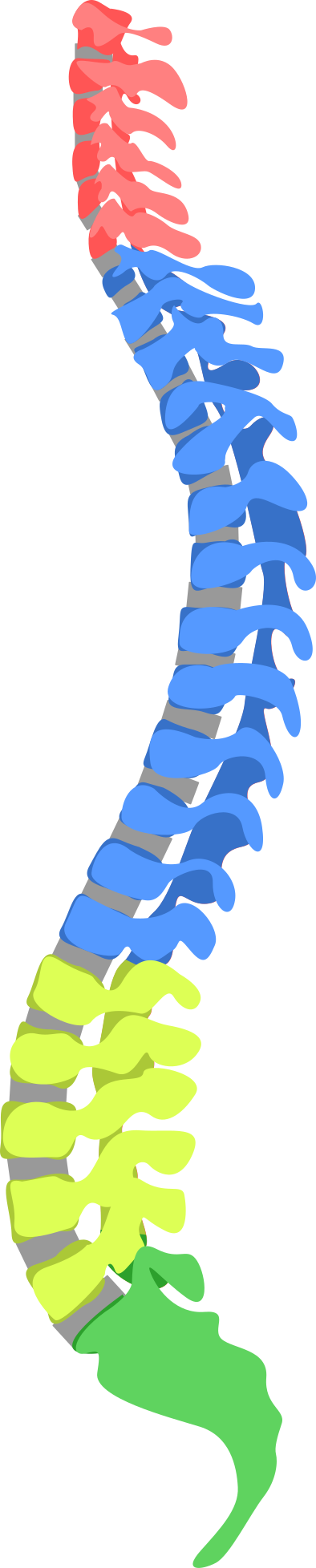
mikeingram1; recoloration : MJL — CC0 1.0. Image source.

Understanding the mechanism
A transitional vertebra has features intermediate between two spinal regions. At the lumbosacral junction, this may involve sacralization of the lowest lumbar vertebra or lumbarization of the first sacral segment. It is a developmental variation, not a vertebra displaced by lifting or exercise. Identifying it is particularly important when numbering spinal levels for imaging and procedures.
Symptoms and warning signs
Many people have no symptoms attributable to this anatomy. Some develop pain through associated mechanisms at an adjacent segment or pseudo-joint; Bertolotti syndrome describes cases in which the pain is attributed to the transitional anatomy. New symptoms still require consideration of ordinary spinal and non-spinal causes rather than assuming the variant explains everything.
Diagnosis and investigations
Radiographs and CT describe bone, while MRI evaluates discs and neural structures. Numbering can be ambiguous on an image limited to the lower spine. Clinicians need clear communication of level identification, sometimes using more extensive imaging, before a procedure. Different labels in separate reports may reflect counting methods rather than a newly developed spinal disease.
Treatment and outlook
No treatment is needed for an asymptomatic variant. When symptoms occur, care targets the clinically identified cause. Exercise, activity modification or specialist review may be considered according to the actual problem. Invasive treatment is reserved for documented indications. Simply having a transitional vertebra does not justify surgery or a pre-set course of repeated physical treatments.
The role of TAGMED care
At TAGMED, this information should be included in the clinical record and treatment precautions. Decompression cannot change vertebral number or a congenital fusion. Any physical modality should address associated symptoms without promising anatomical normalization. New neurological loss needs urgent assessment; new urinary retention, loss of bladder or bowel control, or saddle numbness requires immediate emergency care regardless of the known variant or previous imaging.
Practical follow-up
Keeping imaging reports supports communication when another clinician takes over care. Clearly identified anatomy can prevent contradictory interpretations. Without symptoms or another problem, the variation does not by itself require general restrictions on sport, work or ordinary daily movement.
Frequently asked questions
Is the variation dangerous by itself?
Often not. Its importance depends on symptoms and consequences, especially when planning a procedure.
Does it mean an extra vertebra?
The apparent lumbar count can vary with segmentation and the way levels are numbered.
Is it the same as Bertolotti syndrome?
No. That syndrome attributes pain to the anatomy; the variant alone may be silent.
Should the surgeon or radiologist know?
Yes. Accurate level numbering matters before a targeted procedure.
Can an active life continue?
Without another problem, activity depends on symptoms and capacity rather than the variant alone.
Conceptual diagram: the steps depend on clinical findings and do not provide an individual diagnosis.
Medical references
- American Journal of Neuroradiology. Lumbosacral Transitional Vertebrae: Classification, Imaging Findings, and Clinical Relevance.
- International Journal of Spine Surgery. A Review of Symptomatic Lumbosacral Transitional Vertebrae: Bertolotti's Syndrome.
References document the topic; their inclusion does not imply endorsement of TAGMED services by those organizations.
Educational information from The Spine Page. This entry does not replace an individual assessment. Documentary version: October 12, 2026. Sylvain Desforges, B.Sc., D.O., N.D., osteopath and naturopath.
TAGMED clinic contact details
For non-urgent consultations and information about available services.
Clinique TAGMED — Terrebonne
1150, rue Lévis, Suite 200
Terrebonne (Québec) J6W 5S6
450‑704‑4447
Clinique TAGMED — Montréal
1140, avenue Beaumont
Mont-Royal (Québec) H3P 3E5
1‑877‑672‑9060