

Sense of body position and movement, informed by signals from muscles, tendons and joints.
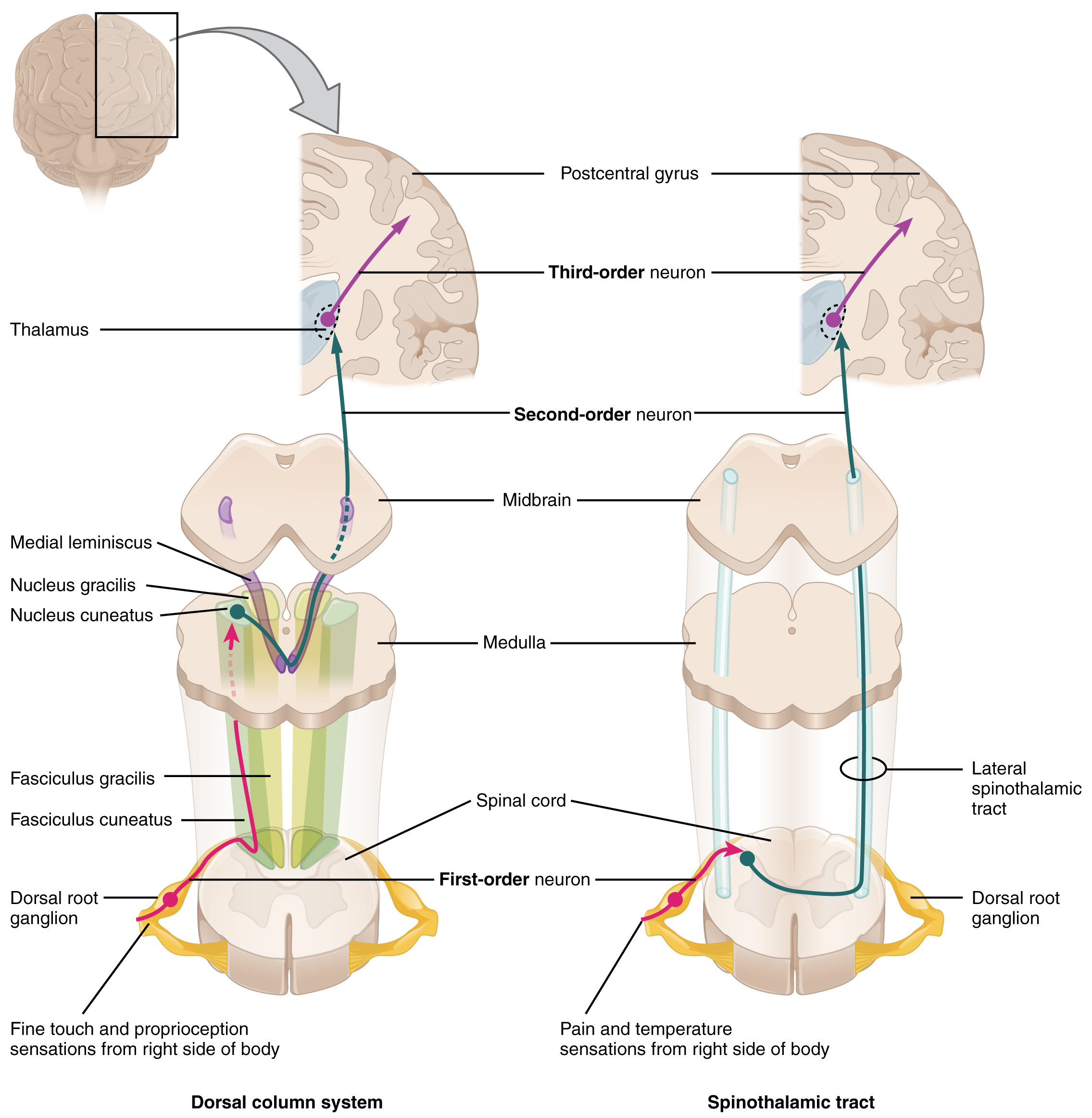
OpenStax College — CC BY 3.0. Image source.

Understanding the approach
Proprioception is the sense of body position and movement informed partly by signals from muscles, tendons and joints. The brain combines them with vision and vestibular information. It allows a movement to be adjusted without continuously watching the limb involved.
Indications and assessment
A proprioceptive difficulty may contribute to clumsiness or impaired balance, but these findings have many causes. Assessment can examine position reproduction, balance and coordination. New walking problems or sensory loss sometimes require neurological evaluation rather than simply more exercise.
Benefits, limitations and precautions
Sensorimotor exercises use adapted tasks that become progressively more demanding. Their value depends on the deficit actually identified; an unstable surface is not essential for everyone. Safety comes first when falls are a concern, and closing the eyes should not be imposed without precautions.
Place in the care pathway
Within TAGMED care, goals may involve movement control or confidence in activity. Passive stimulation does not establish lasting normalization of proprioception. Transfer to everyday tasks is more meaningful than an isolated performance score on a device.
Goals should be practical: walking farther, returning to a chosen activity or reducing symptoms that interfere with sleep. Improvement immediately after a session does not establish lasting benefit. Follow-up compares function with the starting point, records adverse effects and considers progress between appointments. An inadequate response should prompt a review of the clinical explanation or proposed approach, rather than an automatic extension of the same treatment.
Before starting, describe the outcome you want, treatments already tried and difficulties encountered. Ask how the response will be measured and when another option would be preferable. Available reports complement the discussion without replacing your current experience, priorities or preferences.
Frequently asked questions
Is it the same as balance?
No. Proprioception contributes alongside vision, vestibular information and motor capacity.
Does pain mean proprioception is impaired?
Not necessarily. Specific assessment can clarify the situation.
Is expensive equipment necessary?
No. Some simple tasks allow progressive practice.
Are eyes-closed exercises always suitable?
No. They can increase fall risk.
What improvement matters?
More accurate movement or better control of an activity that transfers to daily life.
Conceptual diagram of clinical reasoning; not an anatomical drawing to scale.
Role of TAGMED care
TAGMED offers manual care and osteopathy, as well as modalities such as motorized spinal decompression, laser and shockwave when a relevant indication exists. Selection cannot be based solely on a symptom label: it depends on assessment, contraindications, evidence for each modality and your goals. Maintaining or gradually resuming activity and monitoring function remain central considerations.
Medical references
- National Library of Medicine. Proprioception — MeSH D011434.
- AAOS — OrthoInfo. Spine Conditioning Program.
References document the topic; their inclusion does not imply endorsement of TAGMED services by those organizations.
Educational information from The Spine Page. This entry does not replace an individual assessment. Documentary version: October 12, 2026. Sylvain Desforges, B.Sc., D.O., N.D., osteopath and naturopath.
TAGMED clinic contact details
For non-urgent consultations and information about available services.
Clinique TAGMED — Terrebonne
1150, rue Lévis, Suite 200
Terrebonne (Québec) J6W 5S6
450‑704‑4447
Clinique TAGMED — Montréal
1140, avenue Beaumont
Mont-Royal (Québec) H3P 3E5
1‑877‑672‑9060