

Leg pain, heaviness or weakness triggered by walking or standing, often relieved by sitting or leaning forward.
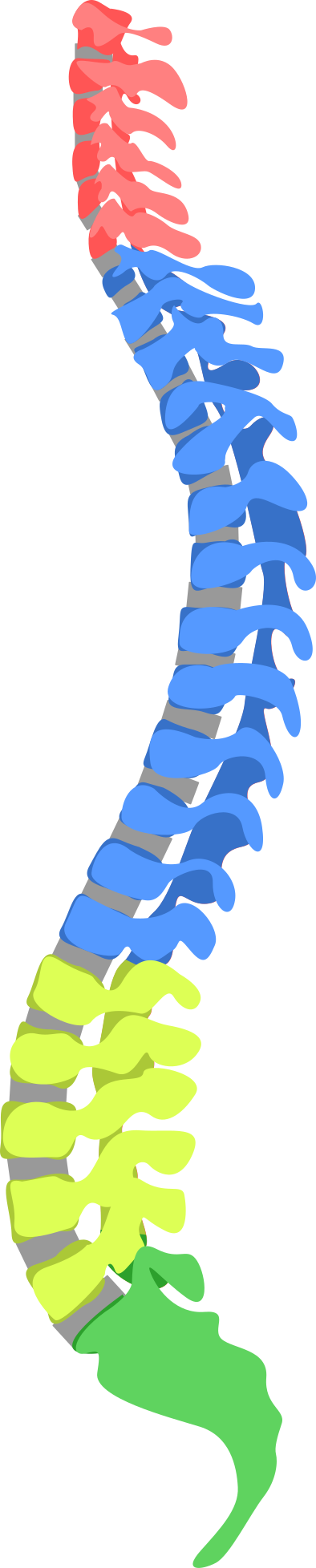
mikeingram1; recoloration : MJL — CC0 1.0. Image source.

Understanding the mechanism
Neurogenic claudication is walking limitation related to impaired tolerance of lumbar neural structures, commonly in spinal canal stenosis. Spinal position affects the available space and symptom response. It differs from vascular claudication, in which muscle blood supply is insufficient during exertion, although both problems can coexist and contribute to the same person's restricted walking.
Symptoms and warning signs
The legs may become painful, heavy, numb or weak during standing or walking. Sitting or leaning forward can ease symptoms, and some people walk more easily with support. That pattern is suggestive rather than definitive. Progressive weakness, saddle numbness or new bladder dysfunction needs urgent medical assessment instead of simply reducing exercise or increasing passive treatment.
Diagnosis and investigations
Assessment records walking distance, the effect of posture and recovery time. Neurological examination, peripheral pulses and hip assessment look for associated or alternative causes. MRI can demonstrate stenosis, but the degree of anatomical narrowing does not precisely predict disability. An ankle–brachial index can help investigate a vascular contribution when the history or examination raises concern.
Treatment and outlook
Care aims to improve endurance and maintain participation in daily life. Individualized exercise, shorter bouts of activity and walking aids may be useful. Specialist consultation can lead to surgery when disability remains substantial and the clinical and imaging findings agree. The decision considers general health, realistic functional goals and procedural risks rather than the scan alone.
The role of TAGMED care
At TAGMED, any conservative plan should begin with measurable walking goals and regular reassessment. Traction cannot remove bone spurs or thickened ligaments responsible for fixed stenosis. Motorized spinal decompression must therefore not be presented as permanently widening the canal. Findings suggesting vascular disease or worsening neurological function require appropriate referral rather than persistence with an ineffective treatment course.
Practical follow-up
A simple record can note walking time or distance before stopping and the support used. Comparing similar conditions makes follow-up more interpretable than comparing isolated pain scores obtained in different circumstances. Safety and any new neurological changes remain separate priorities.
Frequently asked questions
Why can leaning forward help?
It can change lumbar loading and available space, but the response is not diagnostic by itself.
Is this always age-related?
Degenerative change is common, but developmental anatomy and other causes can also contribute.
Should walking be stopped entirely?
It can often be modified and divided into shorter sessions according to safety and tolerance.
Does MRI predict walking distance?
No. Actual function and associated health conditions also influence walking ability.
When is surgery discussed?
When symptoms match imaging and significant limitation persists despite suitable conservative management.
Conceptual diagram: the steps depend on clinical findings and do not provide an individual diagnosis.
Medical references
- American Academy of Orthopaedic Surgeons. Lumbar Spinal Stenosis.
- National Heart, Lung, and Blood Institute. Peripheral Artery Disease: Diagnosis.
- NICE. Low back pain and sciatica in over 16s: assessment and management (NG59).
References document the topic; their inclusion does not imply endorsement of TAGMED services by those organizations.
Educational information from The Spine Page. This entry does not replace an individual assessment. Documentary version: October 12, 2026. Sylvain Desforges, B.Sc., D.O., N.D., osteopath and naturopath.
TAGMED clinic contact details
For non-urgent consultations and information about available services.
Clinique TAGMED — Terrebonne
1150, rue Lévis, Suite 200
Terrebonne (Québec) J6W 5S6
450‑704‑4447
Clinique TAGMED — Montréal
1140, avenue Beaumont
Mont-Royal (Québec) H3P 3E5
1‑877‑672‑9060