

Intradiscal pressure is pressure measured within an intervertebral disc. It varies with loading, position, muscle activity and disc condition. This biomechanical parameter does not directly measure pain, establish an individual's injury risk or determine whether a treatment will be effective.
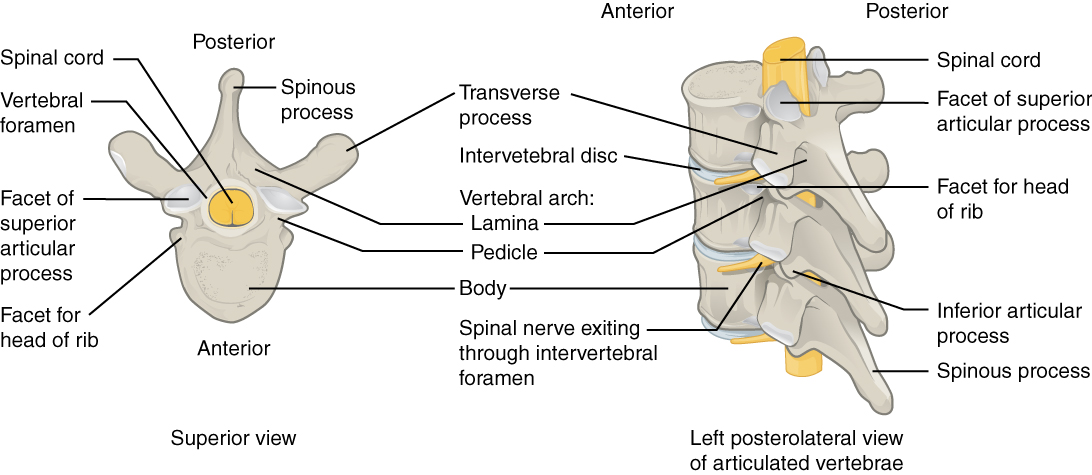
OpenStax College — CC BY 3.0. Image source.

Function and mechanism
A disc shares forces through its nucleus, annulus and neighbouring structures. Internal pressure contributes to that function, but its distribution can change with degeneration. Measurements depend on spinal level, sensor position and experimental conditions. A value obtained in one investigation is not a universal number that applies to every disc or person.
Assessment and interpretation
Direct measurements are invasive and are not part of the ordinary assessment of back pain. Some historical studies involved very few people; Wilke's 1999 study used one volunteer. Posture-pressure tables therefore need careful interpretation. They should not turn each position into an absolute danger ranking or a universal instruction to avoid sitting.
Role of TAGMED care
At TAGMED, task modification can aim to improve comfort and tolerance without claiming to measure pressure by touch or photography. Motorized decompression does not guarantee negative pressure in every disc or return of a herniation to its original location. Treatment value should be judged through clinical outcomes.
Follow-up and warning signs
Follow-up compares activities, strength and symptoms. Assumptions about pressure cannot justify delaying assessment of progressive weakness. New urinary retention or saddle numbness requires immediate emergency care rather than further decompression sessions or waiting to see whether the pain settles.
Frequently asked questions
Are pressure and force identical?
No. Pressure expresses force distributed over an area.
Does lower pressure always mean better health?
No. Normal function involves loading and appropriate distribution of forces.
Can ordinary MRI measure this pressure?
Routine clinical MRI does not directly measure intradiscal pressure.
Is sitting invariably worse than standing?
No. Support, posture, muscle activity and circumstances influence the comparison.
Does pain relief confirm disc repair?
No. Less pain does not measure pressure or establish structural healing.
Pressure is a mechanical variable rather than a pain measurement or a therapeutic guarantee.
Medical references
- Spine — Wilke and colleagues. New in vivo measurements of pressures in the intervertebral disc in daily life.
- Journal of the Mechanical Behavior of Biomedical Materials. Axial Creep Loading and Unloaded Recovery of the Human Intervertebral Disc and the Effect of Degeneration.
- American Academy of Orthopaedic Surgeons. Spine Basics.
References document the topic; their inclusion does not imply endorsement of TAGMED services by those organizations.
Educational information from The Spine Page. This entry does not replace an individual assessment. Documentary version: October 12, 2026. Sylvain Desforges, B.Sc., D.O., N.D., osteopath and naturopath.
TAGMED clinic contact details
For non-urgent consultations and information about available services.
Clinique TAGMED — Terrebonne
1150, rue Lévis, Suite 200
Terrebonne (Québec) J6W 5S6
450‑704‑4447
Clinique TAGMED — Montréal
1140, avenue Beaumont
Mont-Royal (Québec) H3P 3E5
1‑877‑672‑9060