

Pain pattern attributed to spinal facet joints, whose confirmation may require clinical assessment and targeted diagnostic procedures.
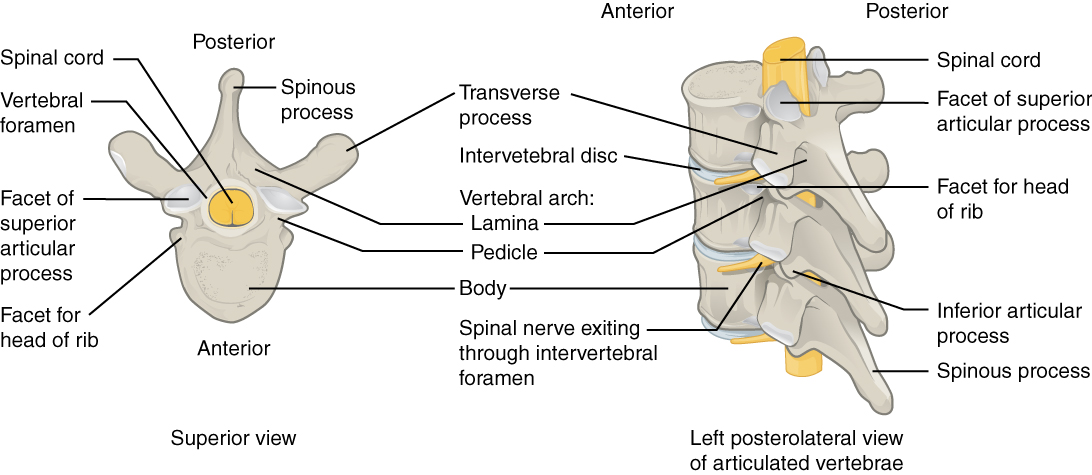
OpenStax College — CC BY 3.0. Image source.

Understanding the mechanism
Facet joint syndrome refers to pain attributed to the small posterior joints connecting adjacent vertebrae. Their capsule and nerve supply can contribute to neck or lower-back pain. Visible arthritis, however, does not prove that a facet joint is painful. The diagnosis remains a clinical attribution to assess alongside other possible sources rather than a conclusion supplied by a scan.
Symptoms and warning signs
Pain is often local or referred nearby and may increase with some extension or rotation movements. No painful movement is uniquely diagnostic. Radiating pain with neurological loss suggests another associated disorder rather than isolated facet pain. Fever, substantial trauma or progressive neurological findings need medical assessment and should not be described simply as a locked or blocked spinal joint.
Diagnosis and investigations
Examination explores movement limitations and alternative disc, muscular, sacroiliac or hip explanations. Imaging describes structure without reliably identifying the painful tissue by itself. In selected specialist pathways, medial branch blocks are used as prognostic tests before radiofrequency treatment. Their response needs careful interpretation; a block is not an infallible test and procedural details affect its meaning.
Treatment and outlook
Initial management may include graded activity, strengthening and load modification. Manual techniques are a possible component of an active programme rather than its entire purpose. Medial branch radiofrequency treatment can be discussed by a specialist for selected patients after appropriate diagnostic assessment. Injections and interventional procedures must not be portrayed as ordinary services provided by TAGMED.
The role of TAGMED care
At TAGMED, assessment can explore joint contributions and functional capacity without claiming to reposition a facet. Spinal decompression is not a routine treatment for facet syndrome. Laser, percussion or other modalities should not be chosen solely because arthritis is visible. The plan needs explicit goals and should be revised when the clinical course does not support the initial explanation.
Practical follow-up
Before continuing a programme, identify the activity that should become easier so reassessment remains meaningful. Less tenderness on palpation alone does not establish durable benefit when important daily tasks remain as restricted as they were at the start of care.
Frequently asked questions
Is an extension test sufficient?
No. Several spinal tissues can be painful during that movement.
Does CT confirm facet pain?
It shows anatomy and degeneration but cannot alone establish the painful source.
Is the joint out of place?
The phrase locked joint does not demonstrate a dislocation or displaced bone.
Does radiofrequency cure arthritis?
It targets selected pain pathways rather than rebuilding the joint.
When should the diagnosis be reconsidered?
When function fails to improve or new symptoms emerge during follow-up.
Conceptual diagram: the steps depend on clinical findings and do not provide an individual diagnosis.
Medical references
- Multispecialty international working group. Consensus practice guidelines on interventions for lumbar facet joint pain.
- NICE. Low back pain and sciatica in over 16s: assessment and management (NG59).
- NIAMS. Osteoarthritis.
References document the topic; their inclusion does not imply endorsement of TAGMED services by those organizations.
Educational information from The Spine Page. This entry does not replace an individual assessment. Documentary version: October 12, 2026. Sylvain Desforges, B.Sc., D.O., N.D., osteopath and naturopath.
TAGMED clinic contact details
For non-urgent consultations and information about available services.
Clinique TAGMED — Terrebonne
1150, rue Lévis, Suite 200
Terrebonne (Québec) J6W 5S6
450‑704‑4447
Clinique TAGMED — Montréal
1140, avenue Beaumont
Mont-Royal (Québec) H3P 3E5
1‑877‑672‑9060