

Adaptation of tasks, tools and environments to human capabilities to improve comfort, safety and activity performance.
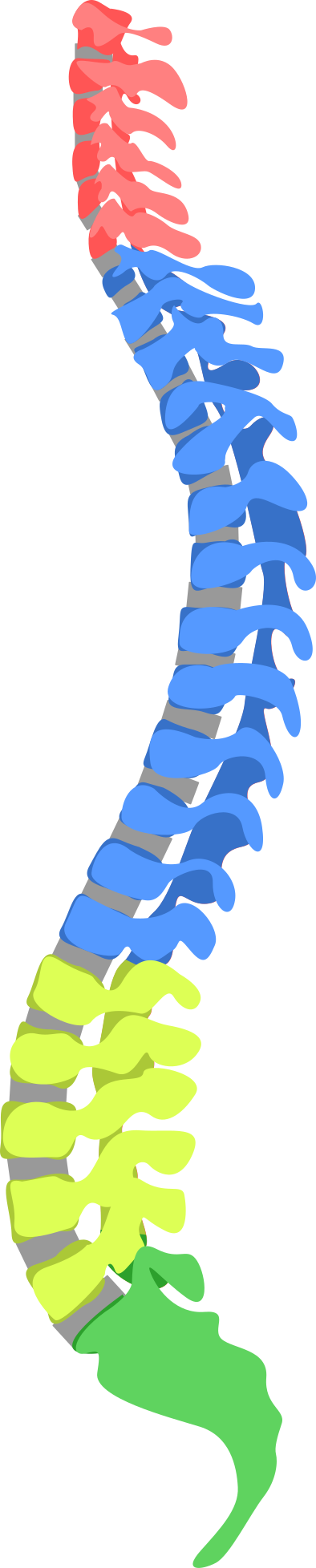
mikeingram1; recoloration : MJL — CC0 1.0. Image source.

Understanding the approach
Ergonomics adapts tasks, equipment and environments to human capabilities. For spinal health it considers time spent in positions, exertion, repetition and work organization. It is not limited to purchasing a chair or maintaining a supposedly perfect posture.
Indications and assessment
Assessment begins with an actual situation: a distant screen, difficult tool access, floor-level work or repeated lifting. Workstation dimensions, opportunities to change position and breaks matter. Pain may also reflect sleep, health and factors beyond furniture design.
Benefits, limitations and precautions
A useful adjustment makes work less demanding and allows more variation. Standing throughout the day is not necessarily better than continuous sitting. An adjustable desk is a tool, not a universal treatment. Changes should be evaluated during normal tasks rather than solely from a photograph.
Place in the care pathway
At TAGMED, advice can focus on activities that trigger or maintain symptoms. It complements care and physical progression. For complex workplace demands, a specialist ergonomic assessment may be more relevant than a general list of positions to avoid.
Goals should be practical: walking farther, returning to a chosen activity or reducing symptoms that interfere with sleep. Improvement immediately after a session does not establish lasting benefit. Follow-up compares function with the starting point, records adverse effects and considers progress between appointments. An inadequate response should prompt a review of the clinical explanation or proposed approach, rather than an automatic extension of the same treatment.
Before starting, describe the outcome you want, treatments already tried and difficulties encountered. Ask how the response will be measured and when another option would be preferable. Available reports complement the discussion without replacing your current experience, priorities or preferences.
Frequently asked questions
Is there one ideal posture?
No. Comfort, variation and matching the task are central.
Will a standing desk cure back pain?
No. It may support alternation without guaranteeing relief.
Should all bending be avoided?
Not automatically. Load, repetition and individual capacity matter.
Must breaks be long?
Regular changes of task or position can already be useful.
How is an adjustment assessed?
Compare comfort and work capacity during the same activities over several days.
Conceptual diagram of clinical reasoning; not an anatomical drawing to scale.
Role of TAGMED care
TAGMED offers manual care and osteopathy, as well as modalities such as motorized spinal decompression, laser and shockwave when a relevant indication exists. Selection cannot be based solely on a symptom label: it depends on assessment, contraindications, evidence for each modality and your goals. Maintaining or gradually resuming activity and monitoring function remain central considerations.
Medical references
- Canadian Centre for Occupational Health and Safety. Working in a Sitting Position — Overview.
- AAOS — OrthoInfo. Spine Conditioning Program.
References document the topic; their inclusion does not imply endorsement of TAGMED services by those organizations.
Educational information from The Spine Page. This entry does not replace an individual assessment. Documentary version: October 12, 2026. Sylvain Desforges, B.Sc., D.O., N.D., osteopath and naturopath.
TAGMED clinic contact details
For non-urgent consultations and information about available services.
Clinique TAGMED — Terrebonne
1150, rue Lévis, Suite 200
Terrebonne (Québec) J6W 5S6
450‑704‑4447
Clinique TAGMED — Montréal
1140, avenue Beaumont
Mont-Royal (Québec) H3P 3E5
1‑877‑672‑9060