

Reduced water content in a disc, often visible as a change in MRI signal.
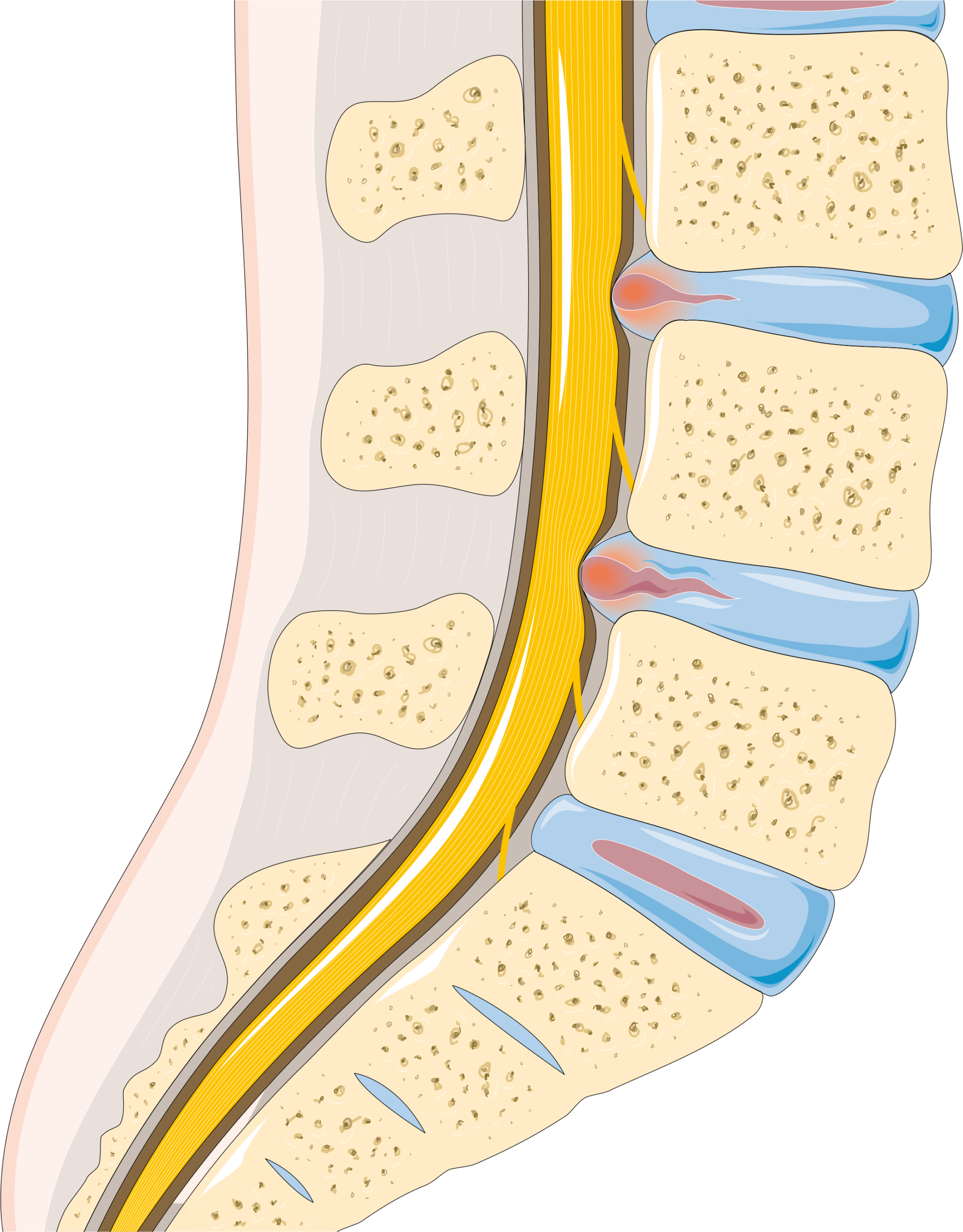
Laboratoires Servier / SMART-Servier Medical Art — CC BY-SA 3.0. Image source.

Understanding this term
Disc desiccation describes reduced water content and altered matrix properties, often seen as lower signal on T2-weighted MRI. It commonly accompanies disc aging. The term does not automatically indicate whole-body dehydration or an urgent need to drink more water.
Symptoms and assessment
A less hydrated disc may still function adequately without pain. Assessment checks for accompanying height loss, herniation or stenosis and, above all, whether findings match the presentation. Signal alone cannot predict an individual’s course or determine how many treatments are needed.
Assessment considers symptom onset, distribution, restricted activities and medical history. Imaging findings must be compared with the clinical examination: a visible abnormality does not, on its own, establish the source of pain.
Management and outlook
General health measures and exercise can support independence. Oral hydration, laser or traction should not be equated with proven disc rejuvenation. Activity progression is based on symptoms and capacity, rather than a requirement to make the disc appear bright on MRI.
For a mechanical problem without concerning findings, care aims for a gradual return to activity, individually selected exercises and measurable functional goals. Manual care may complement this approach when the examination supports it. Progress is judged through walking, sleep and daily tasks, as well as symptoms, rather than through an image alone.
Motorized spinal decompression is a form of traction. It cannot guarantee disc repair or disappearance of a herniation. NICE does not recommend traction for low back pain with or without sciatica; any proposed care should therefore explain uncertainty, alternatives and the criteria for reassessment.
When to seek prompt assessment
New or progressive weakness, newly impaired walking, loss of sensation around the saddle region, or new bladder or bowel control problems require urgent medical assessment.
Frequently asked questions
Does drinking more automatically rehydrate the disc?
No. Its matrix and tissue exchanges are not determined simply by water intake.
Is a dark disc always painful?
No. Desiccation may be an asymptomatic finding.
Can imaging establish the diagnosis alone?
No. Findings must fit the clinical history and examination before they guide treatment.
Should all activity stop?
Usually not: loading is adjusted and gradually increased according to tolerance and the diagnosis.
How should progress be monitored?
Track functional abilities, neurological symptoms and resumed activities so care can be adjusted.
Concept diagram showing key relationships; this is not a scan or an anatomical drawing to scale.
Role of TAGMED care
TAGMED offers motorized spinal decompression, a form of traction. Initial assessment considers whether symptoms, neurological findings and imaging, when indicated, agree. The value of this approach remains uncertain depending on the condition; NICE recommends against offering traction for low back pain with or without sciatica. It does not guarantee disc resorption, disc repair or correction of stenosis. Alternatives, contraindications, functional goals and stopping criteria should be discussed before any trial.
Medical references
- NASS / ASSR / ASNR; The Spine Journal. Lumbar disc nomenclature: version 2.0 (Fardon et al., 2014).
- NIAMS, National Institutes of Health. Back Pain: Diagnosis, Treatment, and Steps to Take.
- National Institute for Health and Care Excellence. NG59 — Low back pain and sciatica in over 16s: recommendations.
References document the topic; their inclusion does not imply endorsement of TAGMED services by those organizations.
Educational information from The Spine Page. This entry does not replace an individual assessment. Documentary version: October 12, 2026. Sylvain Desforges, B.Sc., D.O., N.D., osteopath and naturopath.
TAGMED clinic contact details
For non-urgent consultations and information about available services.
Clinique TAGMED — Terrebonne
1150, rue Lévis, Suite 200
Terrebonne (Québec) J6W 5S6
450‑704‑4447
Clinique TAGMED — Montréal
1140, avenue Beaumont
Mont-Royal (Québec) H3P 3E5
1‑877‑672‑9060