

Axial loading is force directed along a structure's main axis. In spinal discussions, it often refers to a compressive component transmitted along the column. Its effects depend on magnitude, duration, alignment and the properties of the tissues receiving the load.
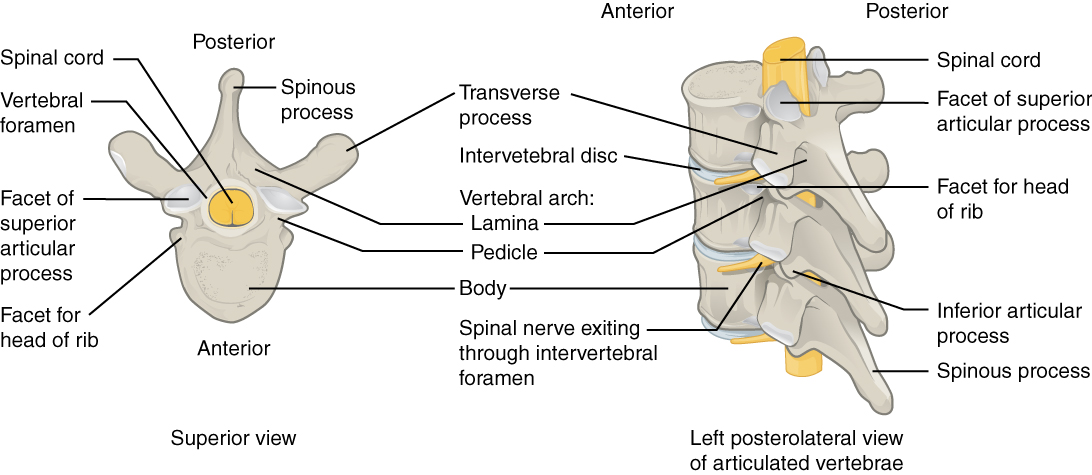
OpenStax College — CC BY 3.0. Image source.

Function and mechanism
Body weight, carried objects and muscle contractions contribute to forces acting on the spine. Loading is not always purely axial: bending and shear may occur simultaneously. Compressive force is also different from pressure inside a disc, which depends on how that force is distributed within the structure.
Assessment and interpretation
Mechanical studies allow comparison of specified conditions, but their values are not universal injury thresholds. Age, bone fragility, activity and previous conditions affect tolerance. Pain during a loading test cannot independently diagnose a herniation, fracture or instability. Its meaning depends on the history, examination and whether further investigation would change management.
Role of TAGMED care
At TAGMED, adjustments may address weight, exposure time, support and recovery. Temporarily reducing a particular load does not mean eliminating all activity. Traction should not be described as cancelling every spinal force or automatically regenerating discs. Any proposed change needs a clear functional purpose and monitoring of its effects.
Follow-up and warning signs
Follow-up records what is carried and for how long. Sudden pain after a fall, substantial trauma or minimal effort in someone with fragile bone needs assessment before resuming loading or attempting a forceful mechanical intervention.
Frequently asked questions
Does axial loading always mean compression?
Axial force can be compressive or tensile; the context should specify its direction.
Is carrying an object inherently harmful?
No. Loading must be related to capacity, the task and necessary precautions.
Does external weight represent the whole force?
No. Muscle activity and position also contribute to internal forces.
Does a support belt remove axial loading?
No. It does not eliminate body weight or every spinal constraint.
How should loading progress?
Adjust a useful parameter gradually while observing tolerance and recovery rather than one isolated number.
General mechanical diagram; real spinal loading commonly combines several force components.
Medical references
- American Academy of Orthopaedic Surgeons. Spine Basics.
- Journal of the Mechanical Behavior of Biomedical Materials. Axial Creep Loading and Unloaded Recovery of the Human Intervertebral Disc and the Effect of Degeneration.
- Spine — Wilke and colleagues. New in vivo measurements of pressures in the intervertebral disc in daily life.
References document the topic; their inclusion does not imply endorsement of TAGMED services by those organizations.
Educational information from The Spine Page. This entry does not replace an individual assessment. Documentary version: October 12, 2026. Sylvain Desforges, B.Sc., D.O., N.D., osteopath and naturopath.
TAGMED clinic contact details
For non-urgent consultations and information about available services.
Clinique TAGMED — Terrebonne
1150, rue Lévis, Suite 200
Terrebonne (Québec) J6W 5S6
450‑704‑4447
Clinique TAGMED — Montréal
1140, avenue Beaumont
Mont-Royal (Québec) H3P 3E5
1‑877‑672‑9060