



In Ville-Marie, targeted exercises may help improve movement tolerance and support a gradual return to certain activities when pain suggests sciatica. However, their value does not lie in a series of stretches to be reproduced at all costs: the choice of movements depends on the symptoms, how they evolve, and how the body responds to them.
Pain that starts in the lower back or buttock and travels down the leg may be linked to irritation of a nerve root, but its path alone is not enough to determine the cause. A cautious approach therefore combines measured movement, observation of signs, and clinical assessment when needed, without replacing urgent care when a warning symptom appears.
To explore simple accessories that may accompany a home practice, the searches below are equipment options, not medical recommendations. No accessory is needed to begin moving gently.


In brief: what targeted exercises may offer
- They may support mobility and help with resuming certain tasks, if the movement remains well tolerated.
- Stretching is not suitable for everyone: mild tension is not the same signal as pain that progresses down the leg.
- Muscle strengthening is built gradually, according to the stage of symptoms and each person’s abilities.
- New or rapidly worsening weakness, loss of bladder or bowel control, or saddle numbness requires urgent assessment.
Targeted exercises for sciatica: understanding their role without promising results
The term “sciatica” commonly refers to pain that follows part of the sciatic nerve’s path, from the lower back or buttock toward the thigh, calf, or foot. In some cases, a lumbar nerve root is irritated or compressed, for example in the presence of a disc herniation or foraminal narrowing. However, buttock pain or discomfort in the leg may also have other causes, and reviewing symptoms alone cannot confirm a diagnosis.
Exercises can contribute to rehabilitation by maintaining movement, strength, and confidence in daily activities. They do not necessarily “unblock” the nerve or put a disc back in place. Their practical goal is instead to find tolerable movements, then gradually rebuild functional capacity without causing a lasting increase in symptoms.
The outcome depends on the individual’s profile. Bending the back may be comfortable for one person and increase pain for another; an extension posture sometimes suggested for certain disc problems may also be poorly tolerated. The response observed during movement, in the following hours, and the next day provides useful clues, but does not replace a professional assessment.
A distinction also matters between radicular pain, often associated with nerve root irritation, and referred pain originating from tissues in the back or hip. Femoral neuralgia more specifically affects the front of the thigh, while some piriformis or gluteal muscle pain may resemble sciatica. Tingling, numbness, or weakness may accompany nerve involvement; their onset or worsening deserves particular attention.
In Ville-Marie, prolonged sitting at the office, remote work, or commuting can make certain movements more difficult, but they do not alone explain the cause of symptoms. It is generally more helpful to identify the postures and activities that actually change the pain than to seek a perfect posture. A professional can compare these observations with the clinical history and physical examination.
Exercises are therefore one possible component of a broader strategy, not a test of willpower. To learn more about the causes and stages of an assessment, consult this resource on the possible causes and diagnosis of sciatica. The priority remains choosing an activity compatible with the person’s symptoms and functional goals.

How to assess whether a movement is well tolerated
Before trying an exercise, observe your symptoms at rest and during a simple activity, such as standing up from a chair or walking for a few minutes. This comparison does not establish a diagnosis, but it helps identify changes. Mild and temporary discomfort may sometimes be acceptable; pain that intensifies, travels farther down the leg, or is accompanied by increased numbness is instead a signal to stop the movement and seek advice.
The traffic-light rule can serve as a simple guide without becoming a guarantee of safety. Green corresponds to a comfortable movement or mild sensation that disappears quickly. Orange indicates that you should reduce the range, slow down, or take a break. Red means the pain persists or increases, function worsens, or a new neurological symptom appears: the exercise should then be stopped.
A common difficulty is confusing stretching with significant tensioning. With nerve mobilization, the goal is not to pull strongly on the back of the leg or hold a position at the end of the range. Alternating the position of the foot and knee gently, for example, may be better tolerated than a prolonged stretch, but it is not automatically suitable for everyone.
Lumbar extension movements, sometimes associated with the McKenzie method, illustrate why the individual response matters. For some people, a repeated movement may reduce leg pain or bring it closer to the back; for others, it may worsen it. It is not prudent to reproduce a series found online if symptoms worsen or if the direction of movement has not been assessed.
The same caution applies to piriformis stretches, trunk rotations, and ball massage. Firm pressure in the buttock may irritate an already sensitive area, and intense stretching does not prove that a muscle is compressing the sciatic nerve. The general recommendations available on exercises to prioritize or avoid based on tolerance may help formulate questions, but they do not replace advice tailored to your situation.
Avoid imposing a fixed number of repetitions or a universal trial duration on yourself. Choosing a few simple movements, testing them separately, and noting their effects can make discussion with a professional easier. A brief journal can indicate the movement performed, its duration, the painful area, and the time needed to return to the usual level. This information is often more useful than a long list of exercises done despite worsening symptoms.
Pain should not be “pushed through” to prove that the exercise is working. If it travels farther toward the foot, if tingling progresses, or if the leg seems weaker, stop the activity in question. The most useful guide is the overall trend in symptoms and function, not performance during a single session.
Stretching, mobility, and strengthening: choosing a reasonable progression
A program may bring together several types of movement, but it is not necessary to begin all of them at the same time. Gentle mobilizations aim to maintain a comfortable range of motion; strength exercises progressively engage the muscles of the trunk, hips, and legs; general activities, such as walking, contribute to returning to a routine. The combination and pace vary according to symptoms, fitness level, and goals.
To begin, a short walk on level ground can serve as a test if it does not cause limping or persistent worsening. Activity can be broken into short periods rather than immediately aiming for a long outing. On the streets of Ville-Marie, stairs, busy sidewalks, and changes in pace can complicate the trial: a quieter route or indoor space may sometimes make it easier to observe the body’s response.
Muscle-strengthening exercises may be introduced when basic movements are tolerated. A modified glute bridge, a controlled movement on all fours, or a trunk stabilization exercise are sometimes used in rehabilitation, but form and range need to be adjusted. If an exercise requires holding your breath, causes radiating pain, or makes the leg less functional, it should be adapted or stopped rather than increasing repetitions.
Gluteal or hamstring stretches may be tried gently when the sensation remains localized and fades after the movement. Moderate tension does not need to be held for a long time to be useful. Nerve mobilizations, in contrast, are generally performed without jerking and without seeking a strong stretching sensation; they should be stopped if nerve symptoms increase.
A table can help distinguish the purposes of movements without turning these examples into a prescription. Responses are individual, and an exercise that seems simple may be inappropriate depending on the cause or stage of pain.
| Type of movement | Possible goal | Safety consideration |
|---|---|---|
| Short walk | Maintain activity and general mobility | Reduce the duration if pain spreads or walking becomes difficult |
| Gentle mobilization | Explore a comfortable range of motion | Avoid sudden movements and strong tensioning |
| Progressive strengthening | Regain capacity in the hips and trunk | Adjust the effort if pain travels down the leg or persists afterward |
| Gentle stretching | Improve comfort or flexibility for some people | Do not hold a position that increases numbness or pain |
A useful progression does not mean increasing duration or difficulty every day. Rather, it involves identifying a tolerable activity, repeating it with reasonable consistency, and adjusting according to how things evolve. Resources such as this general guide to exercises associated with sciatica offer ideas, but advice should be adjusted if you have a medical history or new weakness.
For preventing recurrences, the goal is not to avoid every movement likely to trigger a sensation. Instead, it is to rebuild useful capacity: walking, working, bending, or lifting objects as needed, with a progression that respects current limits. Consistency and adjustment matter more than a “perfect” exercise.
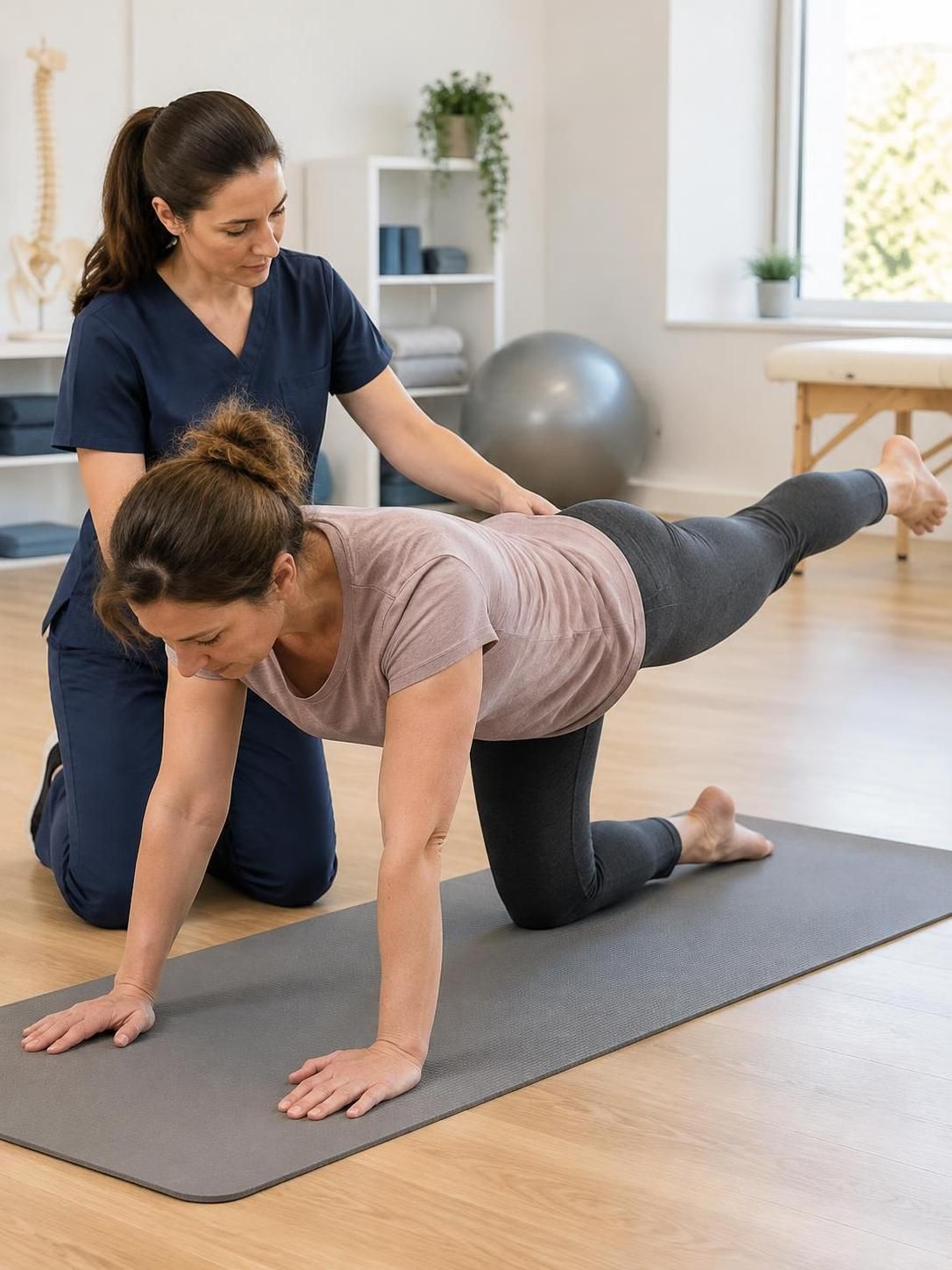
Daily rehabilitation in Ville-Marie and preventing recurrences
Returning to activities often happens through ordinary movements, not only during exercises. A day of remote work may involve several hours of sitting, while commuting by public transit requires standing, climbing stairs, or walking at a variable pace. If a position worsens symptoms, changing positions regularly or dividing tasks up may make the day more manageable without claiming to correct the cause.
There is no ideal sitting posture that eliminates sciatica. Adjusting chair height, bringing frequently used objects closer, or taking short standing breaks may reduce discomfort for some people. Others feel better after walking for a few minutes or lying down briefly; these responses should be considered individual observations, not proof of the source of pain.
When an activity such as walking is tolerated, starting with a short, repeatable route makes assessment easier. If pain becomes more intense with each outing, spreads farther into the leg, or causes limping, reduce the effort and seek an assessment rather than persisting. Cycling or a pool-based activity may be better tolerated by some people, but they are not universal solutions either.
Muscle strengthening may support a return to tasks such as standing up from a chair, carrying light bags, or climbing stairs. A reasonable progression begins with a manageable load or range, then evolves according to the body’s response. This process can take time; fluctuating improvement does not necessarily mean all progress has been lost, but continued deterioration deserves reassessment.
To limit recurrences, maintaining regular and varied physical activity may be more relevant than following a single stretching ritual. Strength, endurance, sleep, and work demands can all influence the ability to remain active. It is not necessary to wait until every sensation has completely disappeared before gradually resuming certain activities, provided they are safe and neurological signs are not worsening.
Manual care or specific osteopathy may be considered depending on the assessment and preferences, as components of care, but they do not replace exercises or medical advice when it is needed. Exercises alone are not always sufficient to explain or treat symptoms; they should be part of an adapted strategy. Resources from SOS Sciatica on exercises and movement management can complement this reflection.
An assessment can also help determine whether goals should first focus on pain relief, mobility, or returning to work. In Ville-Marie, this may mean planning a gradual return to commuting or temporarily modifying certain tasks, rather than trying to make every sensation disappear before resuming daily life. The next step is to recognize situations in which self-management is no longer enough.
When to seek care and which management options to consider
A clinical assessment is indicated if pain persists, returns regularly, or travels below the knee, especially when it limits walking, disrupts sleep, or prevents usual activities. Numbness, loss of sensation, weakness, or loss of function also warrants professional attention. The examination may help distinguish possible causes and determine whether imaging is useful; it is not needed in every situation.
Seek emergency medical care without delay in the event of loss of bladder or bowel control, numbness in the saddle area, or significant or rapidly progressive weakness. Fever or a decline in general condition, significant trauma, pain in the context of cancer or infection, or rapid worsening also require urgent medical assessment. These signs cannot be reliably sorted remotely.
When the situation allows, management may include maintaining or gradually resuming activities, adapted exercises and, depending on the case, physiotherapy or manual care. Medications can be discussed with an authorized professional, taking contraindications and other treatments into account. An injection or specialist opinion may be considered in certain situations; surgery may be discussed, particularly when compression and the clinical course justify it.
Motorized neurovertebral decompression is a form of controlled traction that may be considered for certain patients after an assessment. It aims to temporarily modify certain mechanical stresses applied to the discs and nerve roots. It may be considered for profiles compatible with a disc herniation or protrusion, disc narrowing, or foraminal stenosis, but it is not indicated for all sciatic pain.
Results vary, and no number of sessions is appropriate for everyone. This approach does not put a disc “back in place,” does not guarantee avoidance of surgery, and never replaces urgent assessment. Contraindications or signs requiring medical referral may rule out its use; the professional must take the health history and examination into account.
Decompression differs from exercises, which gradually develop functional capacity, and from manual care, which uses other techniques. It should also not be confused with an injection or surgical intervention, whose indications and goals are distinct. For some patients, a conservative plan may combine several approaches; the choice depends on the likely cause, symptoms, preferences, and response to treatment.
TAGMED Clinic, located at 1140 Beaumont Avenue in Mount Royal, near Outremont and Côte-des-Neiges, presents approaches that may include, depending on the assessment, motorized neurovertebral decompression, specific osteopathy, or a precision percussor. These options are not suitable for everyone, and their relevance must be assessed individually. Information on the approaches offered for sciatica in Montréal may help prepare a plan without prejudging the outcome.
A consultation is particularly useful when you are unsure which movements to continue, symptoms persist despite cautious adjustments, or weakness and numbness are changing. A personalized assessment can clarify the signs to monitor and appropriate options, rather than multiplying exercises found at random.
Frequently asked questions about exercises and sciatica
Should you stop exercising if pain is present?
Not necessarily, but pain that increases persistently or travels farther down the leg requires stopping the movement in question and seeking advice. Intensity, duration, and associated symptoms matter as much as the presence of discomfort.
Do piriformis stretches always relieve sciatica?
No. They may be comfortable for some people, but they are not suitable for all profiles and do not prove that the piriformis is the cause of symptoms. Avoid pressure or a range that increases pain or numbness.
When should you seek care for pain that travels down the leg?
Persistent or recurring pain, discomfort below the knee, limited walking, disrupted sleep, numbness, or weakness warrants an assessment. Loss of bladder or bowel control, saddle numbness, or rapidly progressive weakness requires urgent assessment.
Is walking recommended with sciatica?
It may be a useful activity for returning to movement if it remains tolerable and does not cause lasting worsening. Start with a duration suited to your capacity and have the situation reassessed if you limp or symptoms progress.
If pain travelling down your leg is making it harder to commute or work in Ville-Marie, an assessment may help clarify the likely cause, signs to watch for, and the relevance of a conservative approach. To learn about management options and assessment procedures in Mount Royal, consult the clinic page.
Sylvain Desforges, B.Sc., D.O., N.D., Doctor of Osteopathy
This content is educational and does not replace a personalized assessment or medical advice tailored to your situation.
