


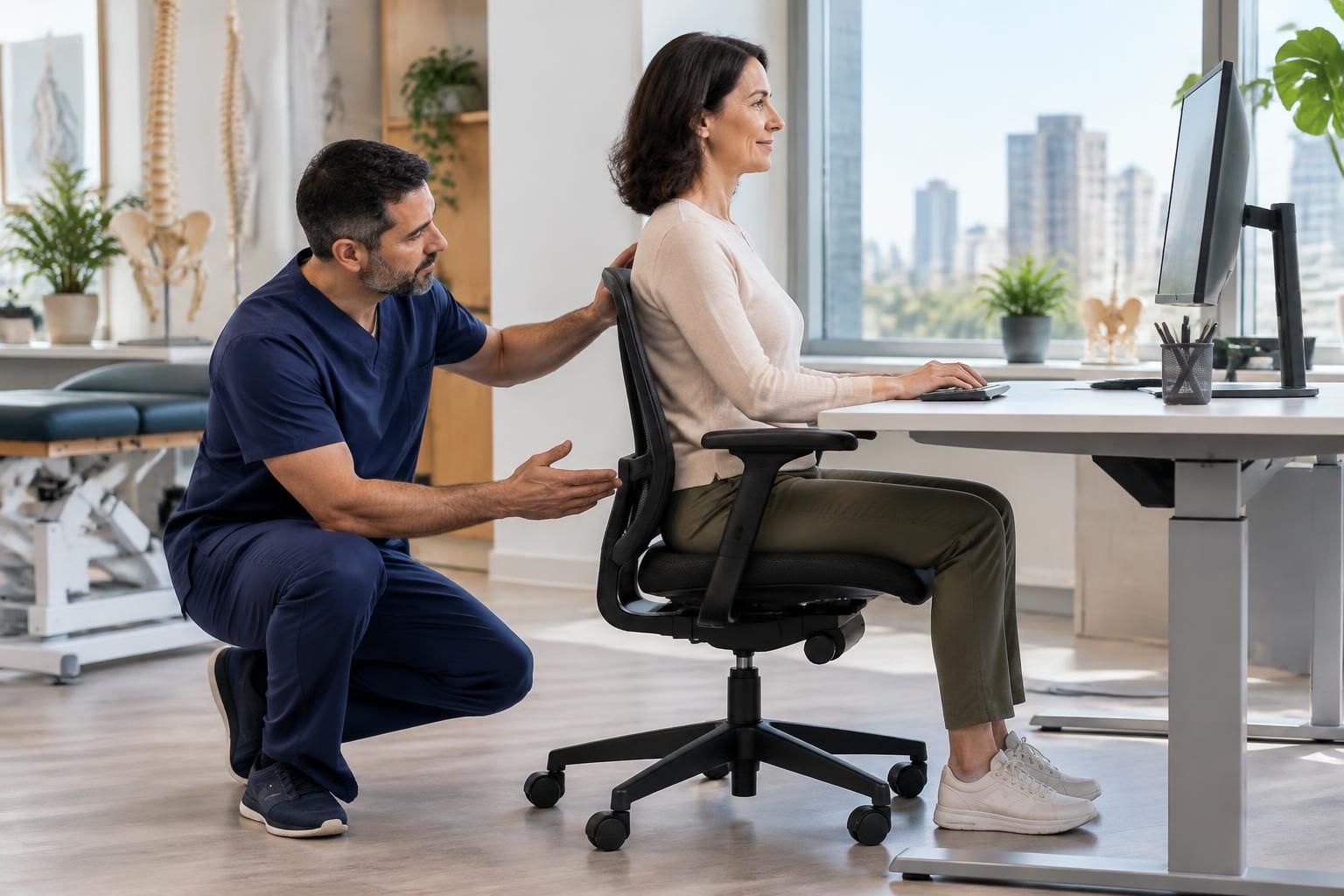
In Park Extension, where public transit commutes, hours of seated work, and daily tasks follow one another, a comfortable posture and regular position changes may help limit strain on the lower back. However, they do not guarantee the prevention of sciatica: pain that travels into the buttock or leg can have several causes, and no single posture suits everyone.
The most useful guide is not to keep your back perfectly straight all day, but to move without sudden motions, adapt your environment, and notice what changes your symptoms. An assessment is indicated if pain persists, travels below the knee, or is accompanied by numbness or weakness.
In brief: posture, mobility, and sciatica prevention
- Vary your positions: sitting or standing for a long time can increase discomfort, but tolerance varies from person to person.
- Adapt your movements: bring objects close before lifting them, and avoid bending while twisting your trunk at the same time.
- Maintain your mobility: gradual activity is often preferable to prolonged rest if it does not worsen symptoms.
- Do not conclude that you have sciatica based on posture alone: symptom history and a clinical examination guide the assessment.
When setting up a workstation, a lumbar cushion or footrest may be helpful if the accessory genuinely improves your comfort. It does not replace breaks or a setup suited to your body shape.


What posture can—and cannot—prevent
The term “sciatica” generally refers to pain related to irritation of a nerve root in the lower back, which may spread into the buttock and leg. A herniated disc or narrowing around a nerve root may be the cause, but leg pain is not automatically sciatica.
A prolonged posture or poorly tolerated exertion may contribute to triggering or worsening symptoms in some people. This does not mean that poor posture is the sole cause of the problem, or that a back must remain still and perfectly aligned to be healthy. Tissues adapt to loads; their tolerance also depends on activity, sleep, stress, and how symptoms evolve.
An “ideal” posture is therefore not a position to maintain all day. When working from home or at a screen, instead aim for reasonable comfort: feet supported, a screen height that avoids tilting your head, supported forearms, and use of the backrest as needed. In Park Extension, a person who alternates between computer work, walking to public transit, and tasks at home will benefit from varying demands rather than seeking perfect stillness.
Advice on sciatica prevention and physical activity can provide general guidance. However, it cannot determine the cause of a specific pain; if symptoms persist, the clinical context should take precedence over a universal posture rule.
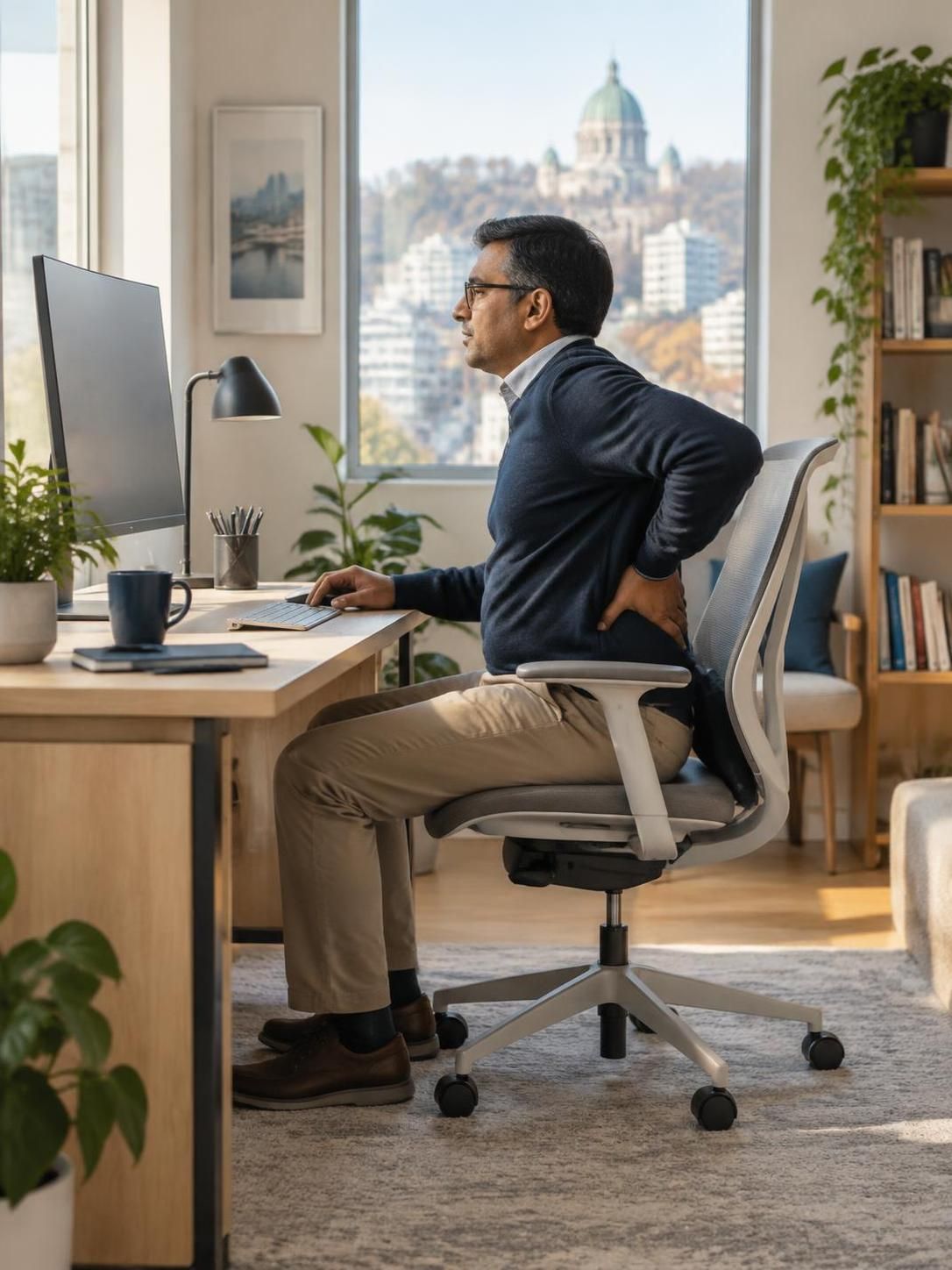
Habits to adjust at the office, in the car, and at home
Prolonged sitting is often uncomfortable when it offers no opportunity to move. Rather than forcing yourself into a rigid posture, alternate positions and take short breaks to stand up or walk. If pain increases while sitting, try adjusting the seat height, bringing the keyboard closer, and sitting in a way that does not require you to stretch toward the screen.
In the car, moving the seat closer to the pedals and avoiding driving with your legs extended may make the position more comfortable. During a long trip, plan opportunities to stretch your legs, according to what is possible and your tolerance. To get in or out of the vehicle, turning without rushing may avoid a sudden twist, without this precaution constituting a treatment for sciatica.
To pick up an object, first move close to it and face it. Bend your knees if this is comfortable for you, keep the load close to your body, and avoid lifting something heavy while turning at the same time. In the kitchen or bathroom, stable support may help when you bend; to put on shoes, sitting down avoids having to balance on one leg.
| Situation | Adjustment to try | What to watch for |
|---|---|---|
| Screen-based work | Adjust the seat and screen, then change positions regularly. | Pain that becomes more intense or travels further down the leg. |
| Driving | Move the seat closer to the pedals and take breaks during long trips. | Numbness, weakness, or difficulty using the pedals. |
| Picking up an object | Move closer, face the object, and avoid twisting while under load. | Persistent worsening after the movement. |
| Standing | Shift your weight and walk briefly if possible. | Increasing limitation in walking or balance. |
These adjustments are practical trials, not absolute rules. The everyday movements sometimes suggested to protect the back should be adapted to your comfort and abilities.
Physical activity and stretching: favour a tolerable progression
Prevention also involves regular, appropriate activity, which helps maintain mobility and the ability to carry out everyday tasks. Walking, for example, may suit some people; others may need to start with short periods or choose a less demanding activity. You do not need to seek out a dramatic exercise to take care of your back.
Stretching, yoga, or Pilates are not universal solutions. A movement may provide a feeling of relief for one person and further irritate symptoms in another. Start gently, without forcing the range of motion and without trying to “push through” pain that intensifies or spreads further down the leg.
If weakness appears, numbness progresses, or exercise clearly increases pain, stop the movement in question and seek advice. If symptoms persist, a professional can help select exercises based on the examination, progression, and activities that matter to you. The resource on exercises and mobility with sciatica can complement this guidance, without replacing a personalized assessment.
When to seek care for pain consistent with sciatica
A clinical assessment is appropriate when pain persists or returns, travels below the knee, disrupts sleep, or limits walking and usual activities. Tingling, loss of sensation, or weakness in the leg should also be reported. The path of the pain alone cannot reliably identify the affected nerve root or the cause.
Obtain urgent medical assessment if you lose bladder or bowel control, experience numbness in the saddle area, or have significant or rapidly progressive weakness. Fever or poor general health, major trauma, a history of cancer or infection, or rapid worsening also warrant urgent care.
These signs cannot establish a diagnosis remotely and should not be attributed to simple posture. If you are unsure whether the situation is urgent, contact a health-care service without delay.
In other situations, the clinician can examine strength, sensation, movement, and factors that worsen or relieve symptoms. Imaging is not automatically necessary; its relevance depends in particular on the examination and how the condition evolves.
Guidance on knowing when to seek care for sciatic pain
Management: options to choose according to your profile
When the situation allows, maintaining or gradually resuming activities can be part of management. Personalized advice, tailored exercises, and manual care may be considered according to the assessment. Medications require the advice of an authorized professional, particularly to account for contraindications and other health conditions.
An injection may be discussed in certain situations, while a specialist opinion or surgery may become relevant in the presence of significant compression, a neurological deficit, or a progression that warrants it. These options are not suitable for everyone, and both their benefits and limitations depend on the clinical picture.
Neurovertebral decompression is motorized, gradual, controlled traction. For certain patients selected after an assessment, it may be considered to temporarily modify the mechanical stresses applied to the spine and nerve roots, particularly for certain disc or foraminal profiles. Results vary; no number of sessions is suitable for everyone, and this approach does not put a disc “back in place,” does not guarantee avoidance of surgery, and never replaces an urgent assessment.
Contraindications and situations requiring medical referral must be reviewed before considering this approach. It differs from exercise, manual care, medication, injections, and surgery: no option is superior for all cases. In Mount Royal, near Outremont and Côte-des-Neiges, Clinique TAGMED offers approaches that may include, depending on the assessment, motorized decompression, specific osteopathy, or the precision percussor. The sciatica assessment and management options in Montréal can be discussed according to symptoms and functional goals.
Frequently asked questions about posture and sciatica
Does poor posture always cause sciatica?
No. Posture can affect comfort or symptoms, but pain radiating into the leg can have different causes. A clinical assessment is needed to interpret the signs.
Should you keep your back straight all day?
No. It is generally more realistic to vary positions and choose comfortable adjustments than to maintain a rigid posture. Needs differ from one person to another.
When should you seek care for pain that travels down the leg?
Seek care if pain persists, recurs, disrupts sleep, or limits walking, particularly if it is accompanied by numbness or weakness. Loss of bladder or bowel control or rapidly progressive weakness requires urgent assessment.
Can stretching prevent a recurrence?
It may suit some people, but it does not prevent all recurrences and is not universally appropriate. Choose tolerable movements and stop those that worsen symptoms.
If pain that travels down your leg prevents you from working, getting around, or sleeping comfortably, an assessment can clarify possible causes, signs to watch for, and the relevance of a conservative approach. Located in Mount Royal, Clinique TAGMED provides information about its approaches and assessment process.
Sylvain Desforges, B.Sc., D.O., N.D., osteopath and naturopath
This content is educational and does not replace a personalized assessment or medical advice.
