


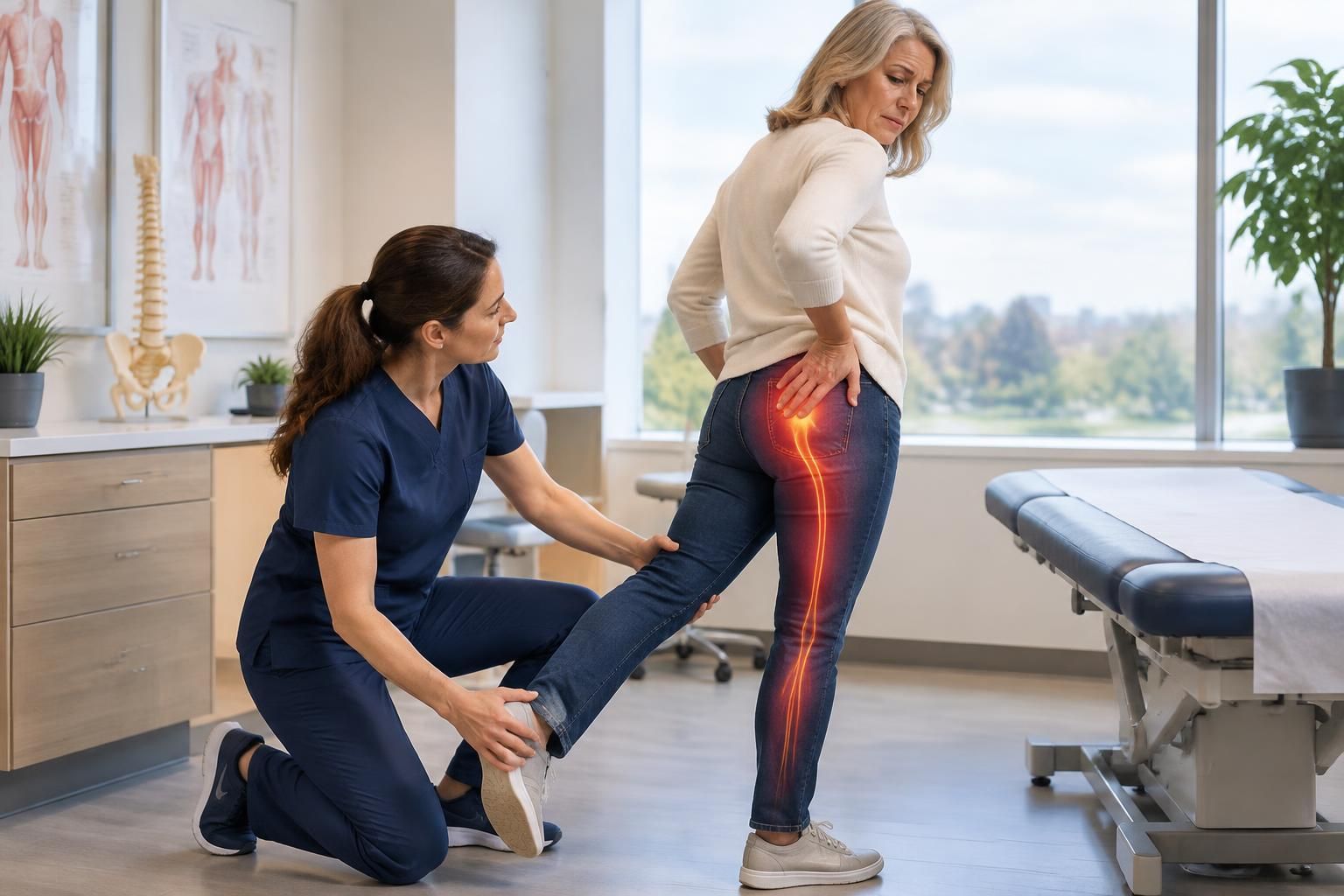
Pain in the buttock that travels down toward the thigh, calf, or foot may suggest sciatica, but its location alone is not enough to establish the cause. In Hochelaga-Maisonneuve, as elsewhere in Montréal, public transit commutes, long periods of sitting at work, or walking around can make symptoms more noticeable in daily life.
Treatment for sciatica depends on how the pain, sensation, and strength in the leg are progressing, as well as on the assessment findings. Irritation of a nerve root, pain originating in the buttock muscles, or a low back problem can appear similar; appropriate care therefore begins by distinguishing among these possibilities.




In brief: sciatic pain in Hochelaga-Maisonneuve
- Buttock pain is not automatically sciatica. The path of pain in the leg, sensations, and examination findings help guide the assessment.
- Sitting and commuting can change symptoms. It is helpful to observe what worsens or eases the pain without forcing a painful movement.
- Prolonged strict rest is generally not the only answer. Activity adapted to tolerance can help preserve mobility, with adjustments if symptoms increase.
- Some signs require urgent help. Loss of bladder or bowel control, saddle numbness, or rapidly progressive weakness should be assessed without delay.
Buttock pain: recognizing possible signs of sciatica
Sciatica usually refers to pain related to irritation of a lumbar nerve root, often L5 or S1. It can begin in the low back or buttock and extend into one leg, sometimes as far as the foot; burning, electric-shock sensations, tingling, or loss of sensation may also occur.
Pain may be more pronounced in the buttock than in the back, and some people have almost no low back pain. Conversely, pain limited to the buttock does not confirm nerve involvement: the muscles, pelvic joints, or hip may also be involved.
The pain pattern provides clues, but on its own does not identify the affected nerve root or the cause. An assessment considers the history of symptoms, mobility, sensation, and strength; imaging is considered when justified by the clinical context, rather than routinely for every type of pain.

Discomfort at the back of the leg can also be confused with femoral neuralgia, which is generally felt more at the front of the thigh, or with referred pain that does not originate directly from a nerve root. To compare certain symptoms and understand their limitations, see this resource on signs of sciatica to watch for in the area and this guide on sciatic pain and its possible causes.
Possible causes and factors that influence symptoms
A disc herniation or protrusion can irritate a nerve root; changes related to osteoarthritis or narrowing of a nerve passage may also contribute to symptoms. These findings must be considered in relation to the examination: an abnormality visible on imaging does not, on its own, prove that it explains the pain.
In daily life in Hochelaga-Maisonneuve, a long period at a desk, prolonged driving, or a seated bus ride can make certain positions uncomfortable. Other people notice worsening when walking, bending, or climbing stairs. Responses vary, and bending or extending the back does not have the same effect for everyone.
Gentle walking may be tolerated by some people, while others need to temporarily reduce the duration or frequency of their outings. Breaks to change position, a better-adjusted work-from-home setup, and a gradual return to tasks may be helpful, without guaranteeing immediate relief.
Exercises to relieve sciatica should not be chosen solely because they are popular online. If a movement clearly increases leg pain, causes symptoms to travel further down, worsens numbness, or reveals weakness, it should be stopped and advice should be sought. Prolonged complete rest can also increase stiffness in some people.
A physiotherapy clinic in Hochelaga-Maisonneuve may be an option to consider for an assessment and rehabilitation support, depending on available services and your situation. For local information on nearby care, you may consult the Diapason Santé clinic in Hochelaga-Maisonneuve; the nature of the services offered should be verified directly with the facility.
When to seek care for sciatic or buttock pain
A clinical assessment is indicated if pain persists, recurs frequently, travels below the knee, disrupts sleep, or limits walking and activities. Numbness, loss of sensation, or weakness also warrant particular attention, especially if these signs are changing.
Seek urgent care in the event of loss of bladder or bowel control, new difficulty urinating, numbness in the saddle area — around the perineum and genitals — or significant or rapidly progressive weakness in one leg.
Pain accompanied by fever or feeling unwell, occurring after major trauma, associated with a history of cancer or an infection context, or worsening rapidly also requires urgent medical assessment. Do not try to determine the cause yourself based on the pain pattern alone.
Imaging such as MRI may be considered when clinical signs or progression justify it, particularly if an intervention is being considered or if a neurological deficit is present. To better understand when to seek care, the page on signs indicating when to seek care for sciatica offers educational guidance.
Sciatica treatment: graduated options and limitations
Treatment for nerve pain depends on its probable cause, intensity, and duration. When safe, maintaining activity adapted to tolerance and gradually resuming daily movements may be preferable to prolonged immobility. Advice, individualized exercises, and manual care may be considered based on the assessment, without assuming that one approach is suitable for everyone.
Medication for pain or inflammation can be discussed with an authorized professional, who will consider other health conditions and related risks. In certain persistent situations, an injection may be considered; surgery is reserved for selected cases, for example when significant compression or a neurological deficit justifies it.
Motorized neurovertebral decompression is a form of controlled traction that may be considered for certain patients following an assessment. It aims to temporarily modify certain mechanical forces applied to the lumbar region and may be considered for profiles compatible with disc involvement or foraminal narrowing.
This approach is not indicated for all cases of sciatica, does not put a disc “back into place,” and does not guarantee avoidance of surgery. Results vary, no number of sessions is appropriate for everyone, and contraindications may require another approach. It never replaces an urgent medical assessment.
In Mont-Royal, near Outremont and Côte-des-Neiges, Clinique TAGMED presents approaches that may include, depending on the assessment, motorized neurovertebral decompression, specific osteopathy, or the precision percussor. Options for sciatica management in Montréal should be discussed based on the profile and observed signs; they do not replace physiotherapy, an urgent medical assessment, or medical care when needed.
| Option | Possible role | Limitation to consider |
|---|---|---|
| Adapted activity and exercises | Preserve mobility and support a gradual return to function. | Movements must be adjusted if symptoms spread or worsen. |
| Medication or injection | Help control symptoms in certain situations. | The choice depends on the assessment, risks, and individual response. |
| Motorized decompression | Controlled traction that may be considered for certain selected profiles. | Not suitable for everyone and does not guarantee a specific result. |
| Specialist opinion or surgery | Assess significant compression or a relevant neurological deficit. | The decision depends on the clinical situation and the expected benefits and risks. |
Pain in the buttock may also be the main concern without the nerve being the direct cause. To explore the differences between local pain and pain compatible with nerve irritation, see this content on pain felt in the buttock area.
Frequently asked questions about sciatica and buttock pain
Does pain in the buttock mean the sciatic nerve is affected?
No. Buttock pain may be related to several structures, and pain travelling toward the leg is not enough to establish a diagnosis. Assessment of symptoms and function helps guide the next steps.
When should you seek care for pain that travels down the leg?
Seek care if pain persists or recurs, limits walking or sleep, or is accompanied by numbness, loss of sensation, or weakness. Bladder or bowel problems, saddle numbness, and rapidly progressive weakness warrant urgent help.
Is it better to avoid walking completely?
Not necessarily. Gentle activity may be tolerated, but distance and pace should be adapted to the symptom response. An activity that clearly worsens pain or numbness should not be forced.
Is neurovertebral decompression suitable for all cases of sciatica?
No. It may be considered for certain patients after an assessment, but it has limitations and contraindications. It does not replace an urgent consultation or other care options when they are indicated.
If pain in the buttock or leg is disrupting your travel around Hochelaga-Maisonneuve, an assessment can help clarify the probable cause, signs to watch for, and the appropriateness of a conservative approach. Information about contacting Clinique TAGMED is available for people who wish to discuss the options offered in Mont-Royal.
Sylvain Desforges, B.Sc., D.O., N.D., osteopath and naturopath
This content is educational and does not replace a personalized assessment or medical advice.
