


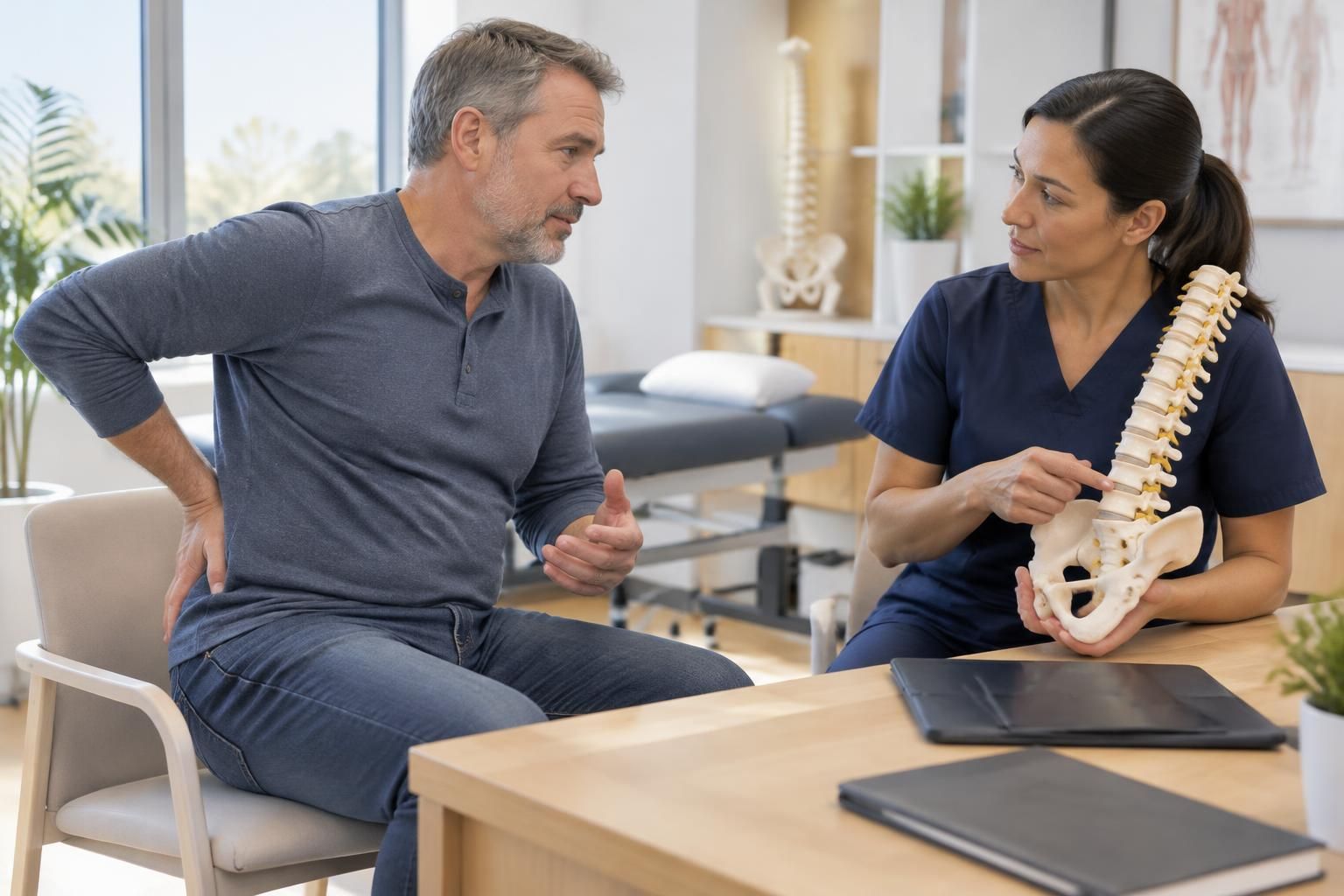
A consultation for pain consistent with sciatica is more useful when symptoms, how they have changed, and important questions have already been gathered. In Hampstead, as elsewhere in the Montreal area, simple preparation can help the professional understand what is limiting your activities and determine whether a clinical examination, conservative treatment, or further medical assessment is indicated.
The path of the pain alone is not enough to establish a diagnosis: pain that travels into the buttock or leg can have different causes. Notes taken before the appointment, relevant documents, and a precise description of what worsens or relieves symptoms can nevertheless allow more time to be devoted to the assessment and decisions that concern you.
To organize your information, a notebook or notes app can be used to record symptoms and questions; bring only medical documents that are useful for your situation.


In brief: preparing for a sciatica consultation in Hampstead
Note the path and progression. Identify where the pain is, state how long it has been present, and specify whether it travels below the knee.
Bring useful information. Prepare a list of your medications, allergies, and relevant tests, without assuming that imaging is always necessary.
Describe your specific limitations. Walking, sleeping, driving, or sedentary work can help measure the functional impact.
Recognize warning signs. Rapidly progressive weakness or loss of bladder or bowel control requires urgent assessment.
The goal is not to arrive with an already established diagnosis, but to present a clear history and leave with understandable instructions. Resources on the possible causes and assessment of sciatica can also help you prepare your questions without replacing a consultation.
What symptoms should you describe to guide the assessment?
Before the appointment, note where the pain begins and how far it travels: lower back, buttock, back or side of the thigh, calf, or foot. Specify whether it is accompanied by tingling, numbness, reduced sensation, or difficulty lifting the foot or climbing stairs.
Sciatica generally refers to pain associated with irritation of a lumbar or sacral nerve root. However, referred pain from another structure can follow a similar part of this path; therefore, the location where pain is felt does not by itself identify the cause or the affected root.
Indicate when the symptoms began, whether they are continuous or intermittent, and how they have changed. A concrete example — “after sitting in the car for twenty minutes, the pain travels to the calf; walking for a few minutes sometimes eases it” — is often more informative than a general statement such as “it hurts a lot.”
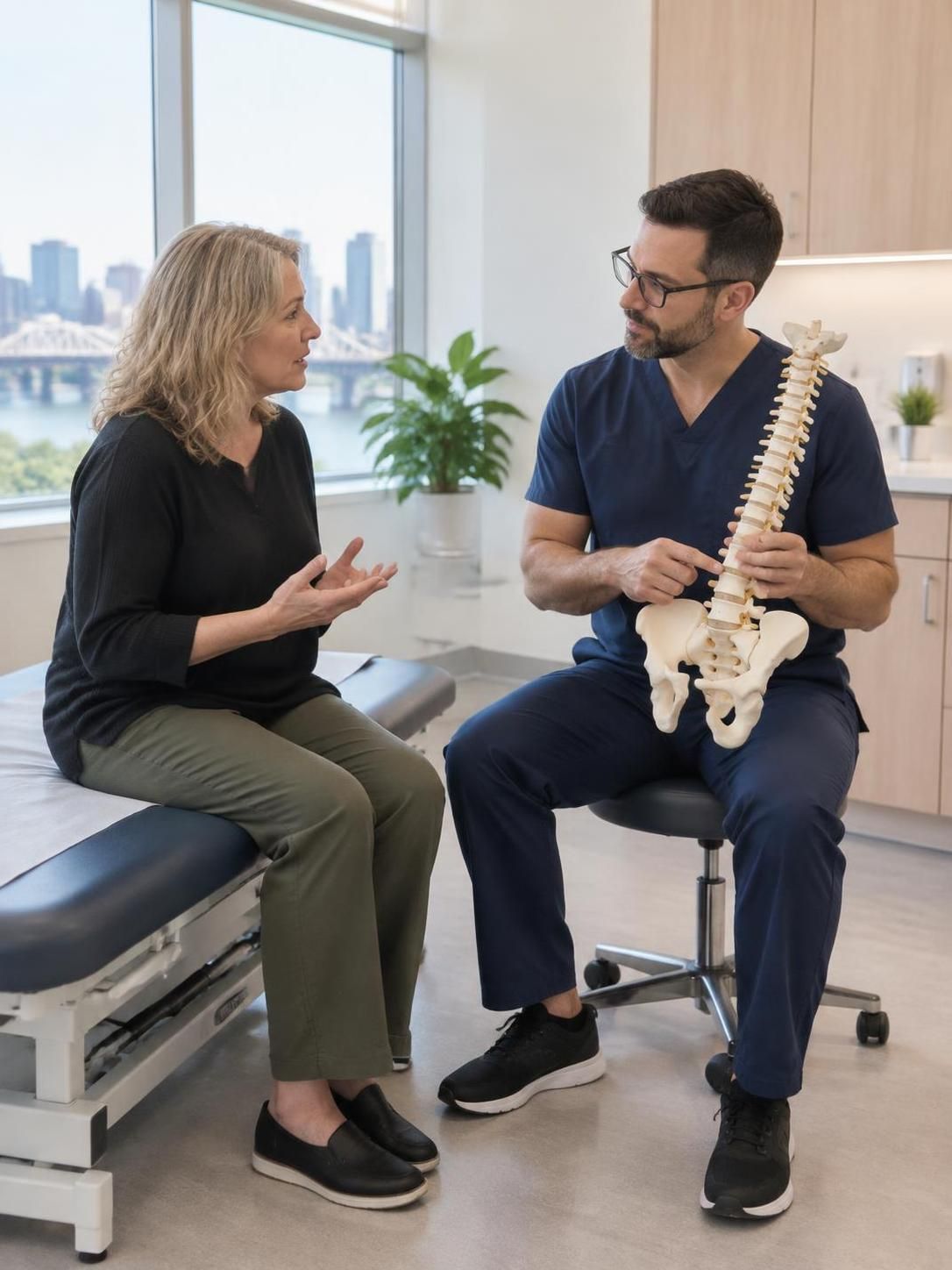
A brief but precise record
A daily note can include the intensity felt, the activity in progress, and factors that change the pain. There is no need to measure every sensation at every hour: a few representative observations are enough to identify a trend without making monitoring a source of worry.
If symptoms have fluctuated, also mention periods of improvement and methods already tried. This timeline helps discuss next steps and avoid mistaking an isolated episode for persistent worsening.
Documents, medical history, and questions to bring to the appointment
Gather an up-to-date list of the medications and health products you take, known allergies or previous reactions, as well as relevant medical history. If X-rays, an MRI, or other results already exist, bring the reports or make sure you know where they can be accessed; imaging is not necessary in every situation and should be interpreted alongside symptoms and the examination.
In Hampstead, a day of sedentary work, car travel, or organizing public transit may also change how symptoms occur. Explain the activities you need to do and those you avoid: this information helps establish realistic functional goals.
| To prepare | Example of useful information | Why discuss it? |
|---|---|---|
| Symptoms | Onset, path, frequency, and progression | To put the pain in context |
| Function | Walking, sleeping, sitting, work | To clarify specific limitations |
| Health record | Medications, allergies, tests already completed | To account for medical history and previous care |
| Questions | Signs to watch for, options, planned follow-up | To leave with clear instructions |
Write down two or three priority questions, for example: “What changes should lead me to seek care again?”, “Which activities can I continue?”, or “Under what circumstances would imaging be useful?” You can write down the answers, or a loved one can help you remember them with your consent.
For another way to organize before an appointment, this medical appointment preparation checklist can serve as a general guide. Adapt it to a consultation for pain radiating into the leg rather than trying to complete every irrelevant section.
What to expect during the consultation and questions about the diagnosis
The professional may ask you about when the pain began, associated symptoms, medical history, and their effect on your activities. An examination may then assess movement, sensation, strength, and certain reflexes; its scope depends on your situation and the person conducting the assessment.
Lower back pain accompanied by pain radiating into the leg may suggest nerve irritation, but several causes remain possible. A disc herniation or protrusion, narrowing of a nerve passageway, and pain from other structures cannot be distinguished solely by the path described; an image must also be interpreted in relation to clinical signs.
Ask what can be concluded from the findings and what remains uncertain. You can also clarify the follow-up plan: what changes are expected, when to reassess the situation, and whom to contact if function declines. For guidance on consultation and management, see information from Assurance Maladie on sciatica, keeping in mind that care pathways differ across health-care systems.
The appointment summary can be written in your own words: hypotheses discussed, recommendations, signs to watch for, and the next step. If an instruction is unclear, asking for it again is preferable to interpreting it on your own.
Treatment, physiotherapy, and decompression: what should you ask?
Management depends on the examination, the progression of symptoms, and functional goals. When appropriate, maintaining or gradually resuming activities, individualized advice, and tailored exercises may be among the options; physiotherapy may also be discussed according to needs and available services.
Medication requires professional advice that takes contraindications and other treatments into account. In some situations, an injection, specialist opinion, or surgery may be considered; these options have different roles and limitations, and none is automatically appropriate for every case of sciatic pain.
Motorized neurovertebral decompression is a form of controlled traction that may be considered for certain patients after an assessment, particularly when the clinical profile is consistent with disc or foraminal involvement. It aims to temporarily modify certain mechanical stresses; results vary, evidence does not support presenting it as a universal solution, and no number of sessions applies to everyone.
Before discussing it, ask why this approach would be relevant in your case, what its limitations are, and which medical situations require a different direction. It does not put a disc “back in place,” does not guarantee that surgery can be avoided, and never replaces urgent assessment of warning signs; traction, exercises, manual care, and other options are not interchangeable.

Approaches offered at a clinic should be verified directly and understood in terms of their scope. The overview of motorized neurovertebral decompression provides information about this modality; on its own, it cannot determine whether it is indicated for a given person.
When should you seek prompt care or urgent help?
A clinical assessment is indicated if pain persists or returns, travels below the knee, disrupts sleep, or limits walking and activities. Numbness, loss of sensation, or weakness should also be reported, particularly if these signs appear or worsen.
Seek urgent medical assessment in the event of loss of bladder or bowel control, numbness in the saddle area, significant or rapidly progressive weakness, or rapid worsening. Fever or feeling unwell, significant trauma, or pain in the context of cancer or infection also warrants prompt medical attention.
These signs cannot establish a diagnosis remotely, but they should not be dismissed. If you experience a severe symptom or rapid deterioration, contact emergency services or a health professional without waiting for a scheduled appointment.
Frequently asked questions about preparing for a sciatica consultation
{“@context”:”https://schema.org”,”@type”:”FAQPage”,”mainEntity”:[{“@type”:”Question”,”name”:”Faut-il apporter une IRM au rendez-vous?”,”acceptedAnswer”:{“@type”:”Answer”,”text”:”Apportez les ru00e9sultats et comptes rendus du00e9ju00e0 disponibles, mais ne commandez pas du2019imagerie uniquement pour pru00e9parer la consultation. Son utilitu00e9 du00e9pend de lu2019u00e9valuation, de lu2019u00e9volution et des signes pru00e9sents.”}},{“@type”:”Question”,”name”:”Comment du00e9crire une douleur qui descend dans la jambe?”,”acceptedAnswer”:{“@type”:”Answer”,”text”:”Indiquez son point de du00e9part, son trajet, sa fru00e9quence et les activitu00e9s qui la modifient. Mentionnez aussi tout engourdissement, picotement, perte de sensibilitu00e9 ou faiblesse.”}},{“@type”:”Question”,”name”:”Quand consulter pour des symptu00f4mes de sciatique?”,”acceptedAnswer”:{“@type”:”Answer”,”text”:”Une douleur persistante ou ru00e9cidivante, une limitation de la marche, un sommeil perturbu00e9 ou des symptu00f4mes neurologiques justifient une u00e9valuation. Une faiblesse rapidement progressive ou une perte de contru00f4le urinaire ou intestinal demande une aide urgente.”}},{“@type”:”Question”,”name”:”Est-il utile de venir accompagnu00e9?”,”acceptedAnswer”:{“@type”:”Answer”,”text”:”Un proche de confiance peut vous aider u00e0 retenir les explications ou u00e0 prendre des notes, si vous le souhaitez. Vous pouvez aussi pru00e9parer vos questions par u00e9crit et demander que les consignes soient reformulu00e9es.”}},{“@type”:”Question”,”name”:”La du00e9compression neurovertu00e9brale convient-elle u00e0 toute sciatique?”,”acceptedAnswer”:{“@type”:”Answer”,”text”:”Non. Elle peut u00eatre envisagu00e9e pour certains profils apru00e8s une u00e9valuation, mais les ru00e9sultats varient et des contre-indications existent. Elle ne remplace pas une u00e9valuation mu00e9dicale urgente ni les autres options lorsquu2019elles sont indiquu00e9es.”}}]}Should you bring an MRI to the appointment?
Bring any results and reports already available, but do not request imaging solely to prepare for the consultation. Its usefulness depends on the assessment, how symptoms are progressing, and the signs present.
How should you describe pain that travels down the leg?
Indicate where it starts, its path, its frequency, and the activities that change it. Also mention any numbness, tingling, loss of sensation, or weakness.
When should you seek care for sciatica symptoms?
Persistent or recurring pain, limited walking, disrupted sleep, or neurological symptoms warrant an assessment. Rapidly progressive weakness or loss of bladder or bowel control requires urgent help.
Is it helpful to bring someone with you?
A trusted loved one can help you remember explanations or take notes, if you wish. You can also prepare your questions in writing and ask for the instructions to be restated.
Is neurovertebral decompression suitable for every case of sciatica?
No. It may be considered for certain profiles after an assessment, but results vary and contraindications exist. It does not replace urgent medical assessment or other options when they are indicated.
If pain that travels down the leg complicates your activities, an assessment can help clarify possible causes, signs to watch for, and whether a conservative approach is appropriate. Clinique TAGMED sees patients in Mont-Royal, near Outremont and Côte-des-Neiges; options should be discussed based on each person’s situation.
Explore assessment and management options
Sylvain Desforges, B.Sc., D.O., N.D., osteopath and naturopath
This content is educational and does not replace a personalized assessment or medical advice.
