


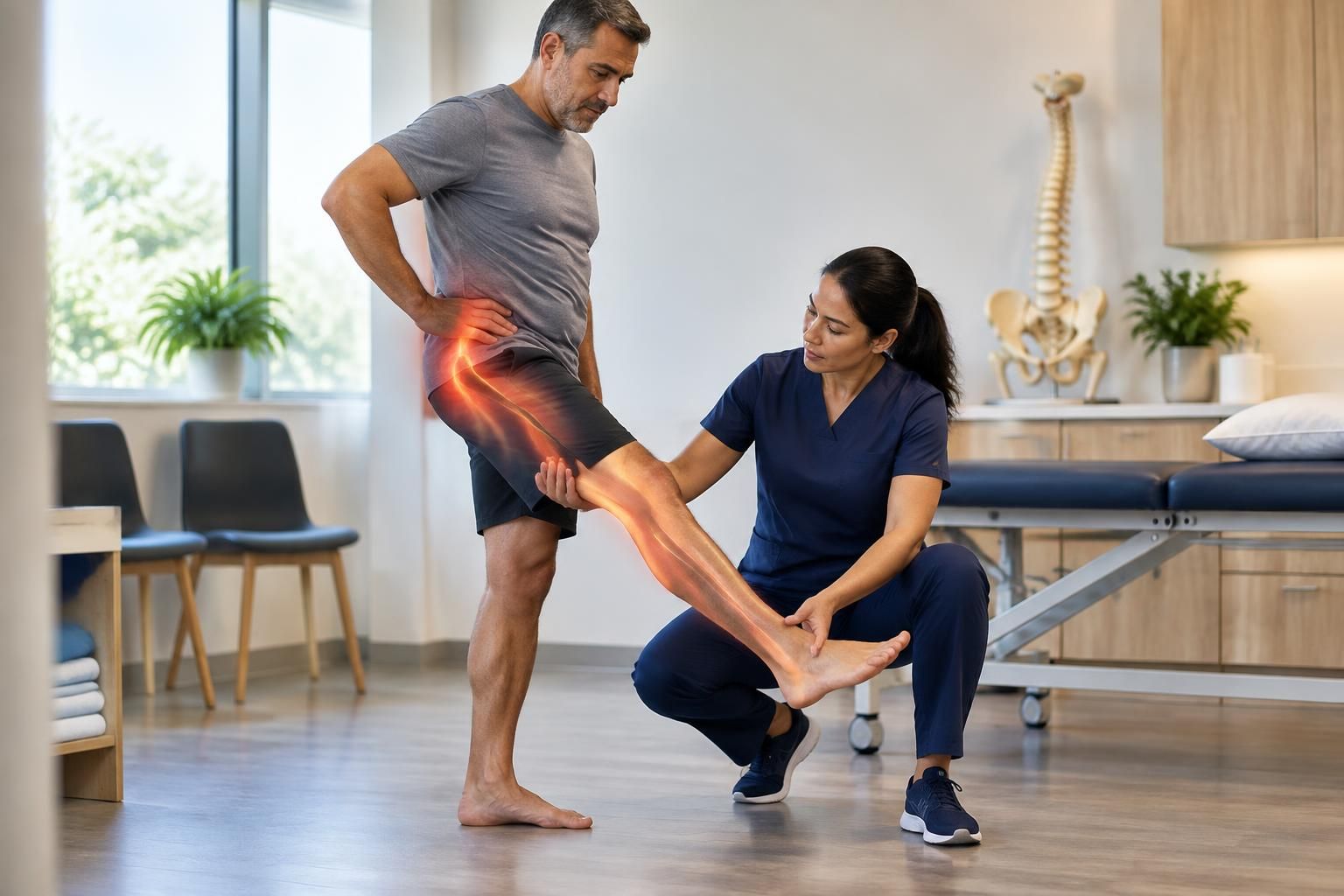
A thorough assessment of pain compatible with sciatica is not limited to checking whether the pain travels down the leg. In Montreal West, as elsewhere, the clinical examination aims to connect its course, the factors that affect it, strength, sensation, reflexes, and the activities that have become difficult. This process helps formulate a hypothesis without confusing an initial impression with a confirmed medical diagnosis.
A person who experiences low back pain after a long car trip, for example, may also have nerve root irritation, a hip problem, or another cause. The neurological and functional assessment helps clarify what should be monitored, whether tests are useful, and when medical referral becomes a priority. The most appropriate plan is one that can be revised according to the actual progression of symptoms.


In brief: what the clinical examination for sciatica should clarify
The course matters, but is not enough. Pain can guide the examination, but on its own it cannot identify the affected root or the cause.
Neurological findings are documented. Strength, sensation, reflexes, and gait provide reference points for comparison over time.
Function is part of the overall picture. Sleep, driving, work, walking, and sitting tolerance help measure the practical impact.
Imaging answers a question. An MRI or another test is mainly useful when its result may change management or clarify a particular situation.
How does a comprehensive clinical examination for sciatica take place?
The interview clarifies when symptoms began, how long they have lasted, the affected side, and the perceived course of symptoms, from the low back or buttock toward the thigh, calf, or foot. The clinician also asks about positions that worsen or relieve the pain, medical and surgical history, and treatments already tried.
Does the pain travel below the knee? Are tingling or loss of sensation present? These questions do not on their own confirm radiculopathy, but they help select the elements to assess and distinguish sciatica from other presentations, such as femoral neuralgia, hip pain, or peripheral neuropathy.
The examination may include observation of posture and gait, joint mobility, the strength of specific muscle groups, sensation, and certain reflexes. Orthopedic tests, such as controlled straight-leg raising, may reproduce certain symptoms; their results are interpreted alongside all findings rather than in isolation.
The L4, L5, and S1 roots can guide the assessment, but pain and sensory territories overlap. Difficulty lifting the foot, for example, should be described and compared with heel walking, without automatically concluding that there is a specific cause. To explore the steps of this process in more detail, see the clinical assessment guidelines for sciatica in Montreal.
Neurological and functional assessment: reference points to monitor
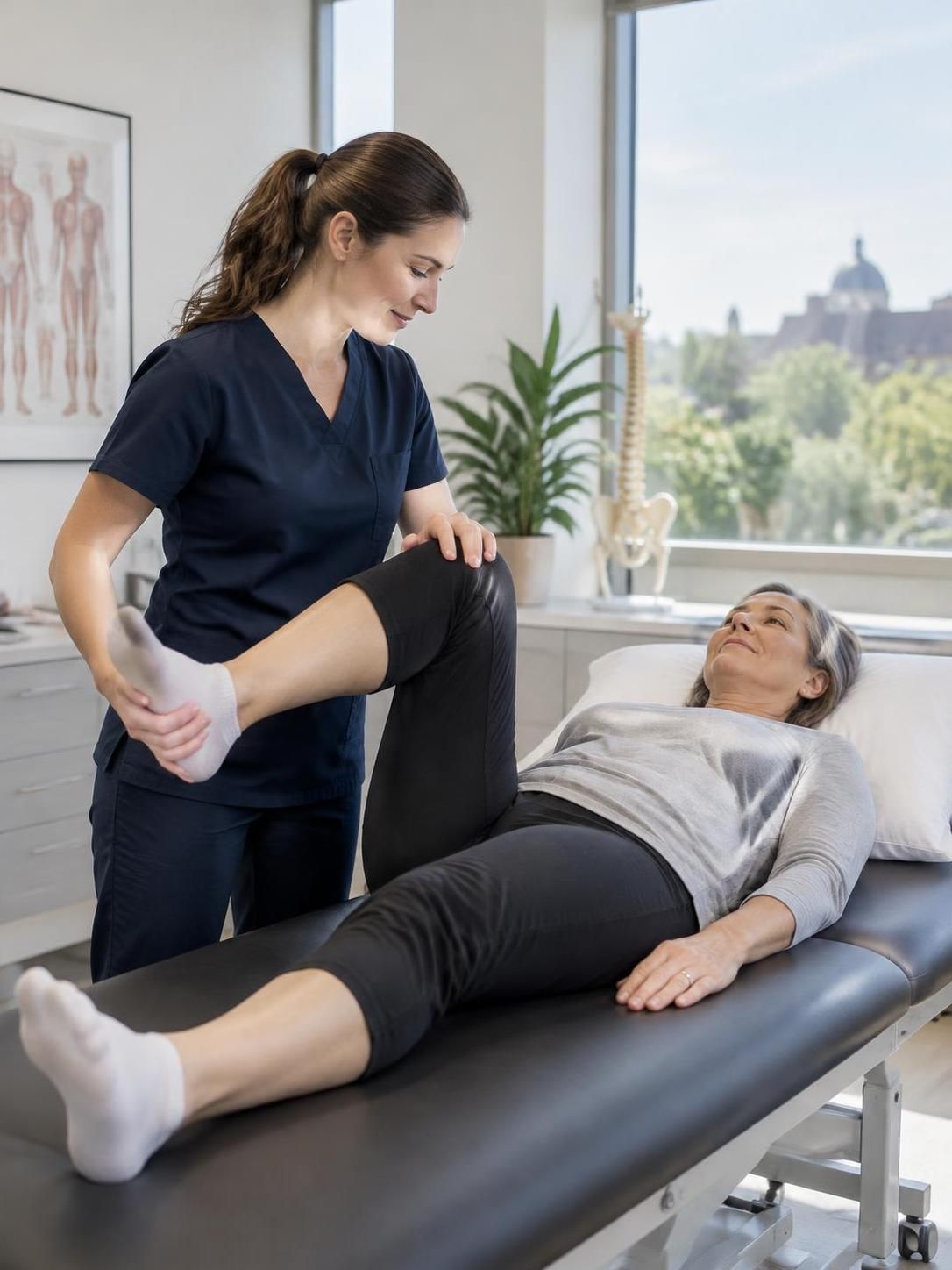
A comprehensive examination is not limited to the reported intensity of pain. It may document strength, sensation, reflexes, and walking ability, then relate these findings to the activities that matter to the person. For a Montreal West resident who drives regularly or works at a computer, sitting tolerance and the breaks needed may also be relevant.
A simple, reproducible measure repeated during reassessment is often more informative than a general impression of improvement. Follow-up can therefore include walking distance, sleep, time spent sitting, return to daily tasks, and changes in weakness or numbness.
| Observed element | What it can help clarify | Interpretation limitation |
|---|---|---|
| Course of pain | The areas involved and associated positions | The course alone confirms neither the root nor the cause |
| Strength and gait | The ability to lift the foot, stand on tiptoes, or walk steadily | Clinical comparison is necessary; new weakness warrants particular attention |
| Sensation and reflexes | The presence and distribution of neurological changes | Results may vary and must be interpreted together |
| Sleep and activities | Functional consequences and their progression | A reduction in pain does not on its own prove nerve recovery |
This approach avoids two common errors: attributing all leg pain to the sciatic nerve or treating an MRI finding without considering symptoms. A disc herniation or stenosis seen on imaging must be considered in relation to the history and examination; its presence does not automatically prove that it explains the pain.
Imaging tests and other investigations: when can they be useful?
Imaging is not routine for all pain compatible with sciatica. An MRI may be considered when symptoms persist, a neurological deficit is concerning, another cause needs clarification, or the result could guide an intervention. The decision depends on the clinical context and should be discussed with a professional authorized to order and interpret it.
An X-ray primarily shows bones and alignment; it does not allow direct examination of nerve roots as MRI does. A CT scan may answer certain bone-related questions or be used when MRI is not possible, while an electromyogram may be considered in specific situations where the location of the impairment remains uncertain.
Before a test, it is reasonable to ask what question it is meant to answer and whether its result would change the plan. The resource on imaging tests and other tests associated with sciatica outlines helpful distinctions. To understand the causes and differential diagnoses, you can also consult the guide to possible causes and assessment of sciatica.
Educational videos can help explain terminology, but they do not replace examining a person whose pain, strength, or sensation is changing. An online demonstration also cannot determine whether a test is appropriate or safe in a particular situation.
Signs that require prompt or urgent consultation
A clinical assessment is indicated if pain persists or returns, travels below the knee, disrupts sleep, or limits walking, work, or driving. Numbness, loss of sensation, or weakness should also be reported, especially if the change is progressing.
Urgent medical assessment is necessary in the event of loss of bladder or bowel control, new difficulty urinating, numbness in the saddle area, or significant or rapidly progressive weakness. Fever with spinal pain, poor general health, major trauma, or pain in the context of cancer or infection also requires prompt assessment.
If these signs are present, do not delay care to try exercises or wait for a routine appointment. Contact emergency services or go to the emergency department according to the severity; a remote assessment cannot rule out a serious condition.
The professional should explain what would warrant a prompt review of the plan and when to seek medical or specialist advice. This guidance is particularly useful when symptoms fluctuate: a variation in pain does not have the same significance as progressive loss of strength or function.
From examination findings to a measurable plan
When urgent signs have been ruled out and the presentation allows, management may prioritize maintaining or gradually resuming tolerated activities. Tailored advice and exercises, physiotherapy, or selected manual therapies may be considered based on the assessment; an activity that clearly causes pain to travel further down the leg or worsens numbness calls for reassessment rather than pushing through symptoms.
Medications require the advice of an authorized professional, who can take other health conditions and individual risks into account. An injection or specialist opinion may be considered in certain persistent or severe situations; surgery is evaluated when the neurological presentation or progression warrants it. None of these options is necessary for everyone.
Neurovertebral decompression is progressive, controlled motorized lumbar traction that may be considered for certain patients after assessment, particularly in profiles compatible with disc or foraminal involvement. It aims to temporarily change certain mechanical stresses, but results vary; it does not put a disc back in place, is not suitable for all cases of sciatica, and never replaces urgent assessment. Contraindications and reasons for medical referral must be considered.
In Mount Royal, near Outremont and Côte-des-Neiges, Clinique TAGMED offers non-surgical approaches that may include, depending on the assessment, motorized neurovertebral decompression or specific osteopathy. The appropriateness of these options, like that of other care, should be discussed without assuming an outcome; information on assessment and management options in Montreal is separate from a personalized diagnosis.
Before beginning an approach, ask which functional outcome will be monitored, when the plan will be reassessed, and which signs would require stopping it or seeking medical advice. These criteria make the care pathway clearer than accumulating techniques without a defined goal.
Frequently asked questions about the sciatica examination
Must pain reach the foot to suggest sciatica?
No. It may be limited to the buttock, thigh, or calf. The course helps guide the examination but does not by itself confirm the cause.
Is an MRI always necessary?
No. It is mainly considered when its result could change management, clarify a persistent presentation, or address a clinical concern. The need depends on the assessment.
What changes warrant a consultation?
Persistent pain, limitations in walking or sleep, numbness, or weakness warrant assessment. Rapidly progressive weakness or urinary or bowel problems require urgent care.
Does less pain mean the nerve has recovered?
Not necessarily. Strength, sensation, walking, sleep, and daily activities must also be considered during follow-up.
Is neurovertebral decompression suitable for all cases of sciatica?
No. It may be considered for certain profiles after an assessment, but results vary and contraindications exist. It does not replace urgent medical care.
If pain travelling down your leg disrupts your sleep, walking, or activities in Montreal West, an assessment can help clarify possible causes, signs to watch for, and the appropriateness of a conservative approach. The TAGMED clinic located in Mount Royal provides information about its services and assessment process.
View the information to contact the clinic
Dr. Sylvain Desforges, B.Sc., D.O., N.D., osteopath
This content is educational and does not replace a personalized assessment or medical diagnosis.
