


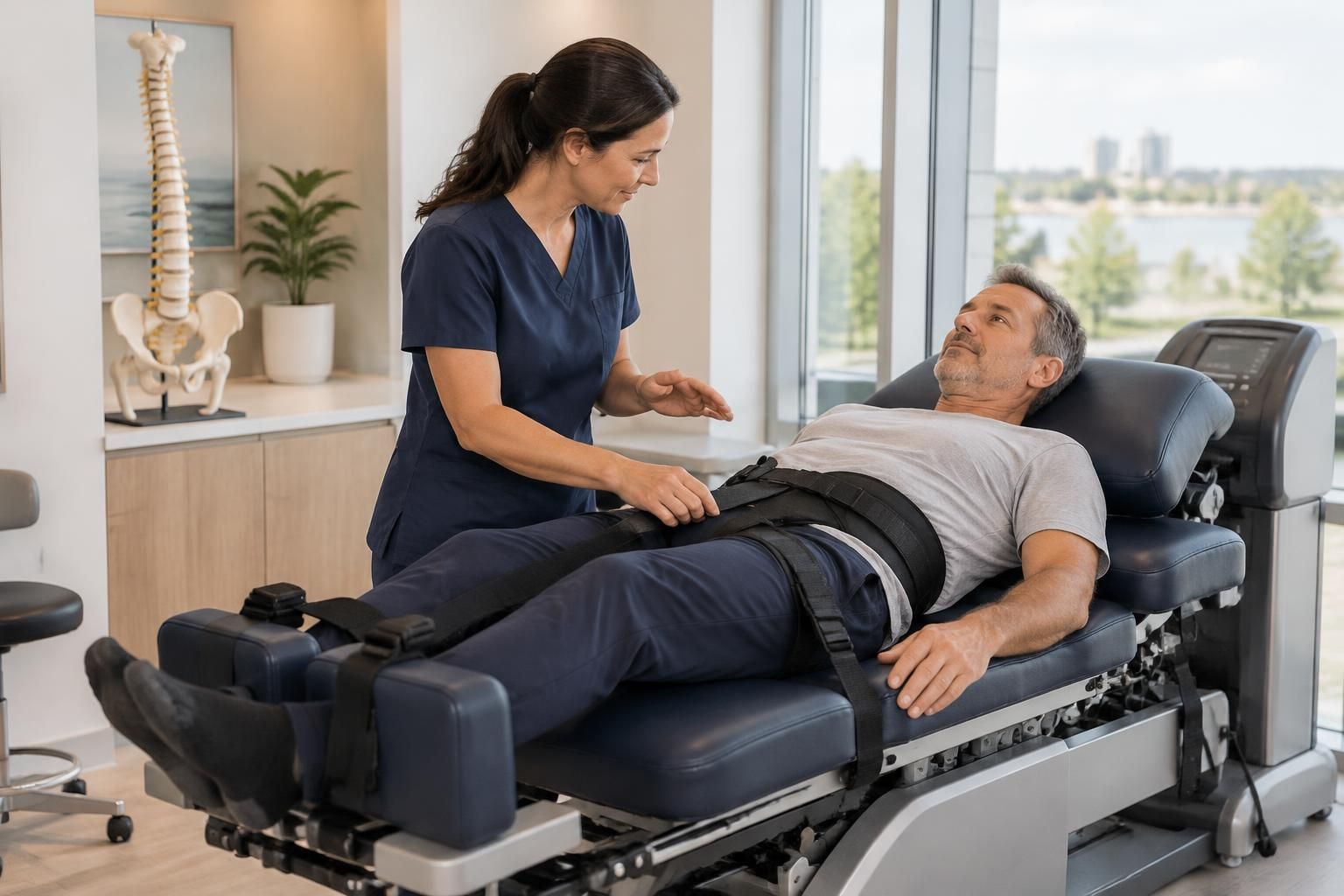
There is no universal number of lumbar decompression sessions to relieve sciatica. The duration of a trial depends, among other things, on the likely cause of the symptoms, their progression, tolerance of treatment, and measurable changes in daily activities; therefore, a program announced in advance does not guarantee an outcome.
In Brossard, as elsewhere on the South Shore, pain that travels into the buttock or leg should be assessed before choosing a non-surgical therapy. A disc herniation may irritate a nerve root, but the path of the pain alone cannot confirm this cause or determine the number of sessions.


Lumbar decompression and sciatica: key points to know
No quota applies to everyone. The number of sessions proposed in certain protocols does not replace an assessment or monitoring of the individual response.
The cause matters. Disc-related radicular pain is not necessarily managed in the same way as pain referred from muscles or joints.
Progress is measured. Walking, sleep, sitting tolerance, and leg symptoms are useful indicators.
Safety comes first. Progressive weakness or urinary problems require urgent medical assessment, not a traction session.
Commercial pages sometimes mention series of 10 to 20 visits or schedules in several phases. These numbers describe proposed protocols, not an amount shown to be necessary for every person; NICE recommendations advise against routine traction for low back pain with or without sciatica.
A resource on the causes and assessment of sciatica may help explain why a clinical examination is essential. For local management options, the TAGMED Clinic page on the number of sessions is a starting point to discuss with a professional, without treating an online estimate as a prescription.
Why the number of sessions varies for low back pain
Sciatica commonly refers to pain radiating from the low back or buttock into the leg. Nerve root irritation may also cause tingling, numbness, or weakness; however, some pains that travel down the leg are referred from other structures and do not correspond to nerve compression.
A disc herniation or protrusion may contribute to symptoms, but imaging alone is not enough to establish that it is the cause. The symptom history and examination—including strength, sensation, and movements that change the pain—must be interpreted together. The involved lumbar level cannot be determined with certainty solely from the painful area.
To determine whether lumbar decompression is appropriate, the assessment should clarify the duration of the problem, limited activities, neurological signs, and treatments already tried. A recent episode that is gradually improving does not automatically warrant the same plan as persistent or recurring pain.
Driving between Brossard and Montréal, office work, or long periods of sitting may make symptoms more noticeable for some people. Others find sitting tolerable but notice worsening with walking or bending; these differences guide the assessment rather than prove a specific cause.
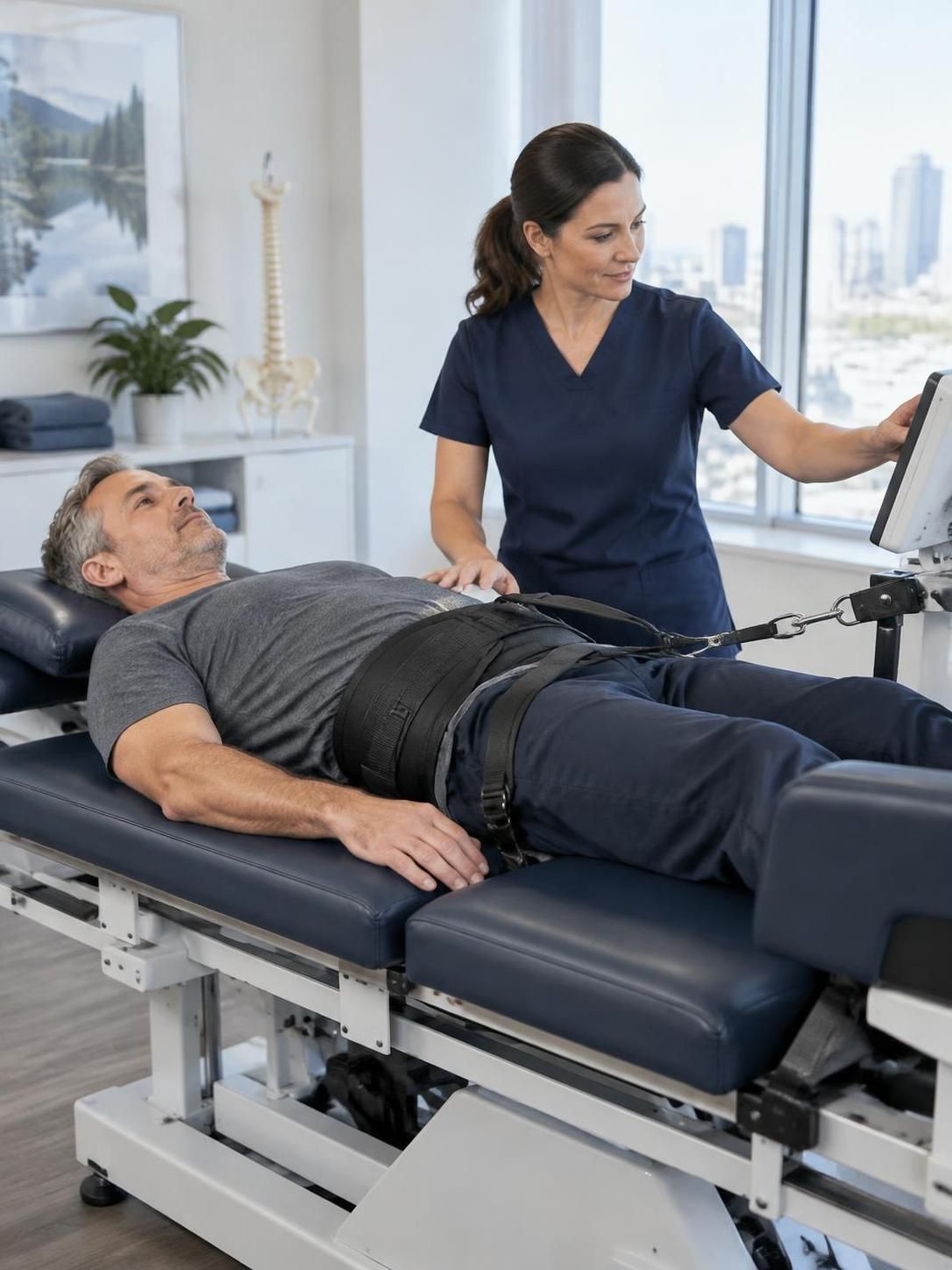
Neurovertebral decompression: what a trial should assess
Motorized neurovertebral decompression is a form of controlled traction applied to the spine. Depending on the profile and assessment, it may be considered to temporarily alter certain mechanical stresses, but it does not “put” a disc back into place and is not suitable for all cases of sciatica.
Systems such as SpineMED are presented by their promoters as distinct from conventional traction, notably because of their motorized control and method of adjusting force. However, technical features or device clearance alone do not demonstrate that it will relieve a given person’s pain. Claims about protocols, disc rehydration, or tissue regeneration should be interpreted with caution.
If a decompression clinic offers a program, ask how sessions will be reassessed and what criteria will guide whether to continue or stop. Meaningful improvement may include easier walking or less widespread pain; conversely, pain that travels farther down the leg, increasing numbness, or new weakness calls for reassessment.
- Before starting: clarify the functional goal and possible contraindications with the professional assessing your situation.
- During the trial: track changes in leg pain, sensation, sleep, and activities rather than simply counting visits.
- At each follow-up: review tolerance and whether it remains appropriate to continue; no number of sessions suits everyone.
- At the same time: discuss maintaining adapted activities and individualized exercises when safe to do so.
The overview of SpineMED technology in Brossard describes an approach offered locally; it does not replace independent advice about expected benefits, limitations, or alternatives. Decompression should not delay medical assessment when a warning sign is present.
Comparing back treatment options without a preset schedule
Back treatment may combine different measures depending on the clinical picture. When safe, maintaining or gradually resuming activities helps avoid prolonged immobilization; a professional may also recommend exercises adapted to the person’s tolerance and goals.
Physiotherapy and manual care may have a role in certain plans, without every method being suitable for everyone. Medication is managed by a regulated professional who can consider medical history and risks; an injection or specialist opinion may be discussed in selected situations. Surgery is considered, among other factors, when there is significant compression, a neurological deficit, or a course that warrants it.
Decompression is therefore one option among others, not an automatically superior alternative. Results vary, and evidence on traction does not support announcing a fixed series in advance as a condition for relief. To understand the different approaches, also see sciatica treatment options.
| Option | Possible role | Point to clarify |
|---|---|---|
| Adapted activity and exercise | Support movement and function according to tolerance. | Modify or stop if neurological symptoms progress. |
| Motorized decompression | Trial of controlled traction in selected patients. | Indication, contraindications, and reassessment criteria. |
| Medication or injection | Symptom management in certain situations. | Individualized choice with a regulated professional. |
| Specialist opinion or surgery | Assessment of compression or a deficit that warrants it. | Decision based on the examination, progression, and goals. |
A consultation can also help determine whether the pain instead suggests femoral neuralgia, muscle pain, or another condition. The right choice depends less on an advertising number than on a coherent clinical hypothesis and careful follow-up.
When to seek care in Brossard and which signs to watch for
A clinical assessment is indicated if the pain persists or returns, travels below the knee, disrupts sleep, or limits walking and activities. Numbness, loss of sensation, or weakness should also be reported, even if the pain itself appears moderate.
Seek urgent medical assessment in the event of loss of bladder or bowel control, numbness in the saddle area, significant or rapidly progressive weakness, fever, or feeling generally unwell. Significant trauma, pain in the context of cancer or infection, or rapid worsening also requires medical attention without delay.
These signs cannot establish a diagnosis remotely, but they should not wait for a decompression appointment. If you are unsure about the urgency, contact the appropriate medical services.
For persistent pain without an emergency, the professional can determine whether further testing is appropriate and whether a conservative approach is reasonable. People in Brossard who travel to Montréal for work can prepare for the consultation by noting when sitting, driving, or walking changes their symptoms.
Frequently asked questions about the number of sessions
{“@context”:”https://schema.org”,”@type”:”FAQPage”,”mainEntity”:[{“@type”:”Question”,”name”:”Combien de su00e9ances faut-il gu00e9nu00e9ralement pru00e9voir ?”,”acceptedAnswer”:{“@type”:”Answer”,”text”:”Il nu2019existe pas de nombre reconnu qui convienne u00e0 toutes les sciatiques. La du00e9cision devrait du00e9pendre de lu2019u00e9valuation, de la tolu00e9rance et de changements fonctionnels observables, avec des ru00e9visions ru00e9guliu00e8res plutu00f4t quu2019un engagement automatique u00e0 une su00e9rie fixe.”}},{“@type”:”Question”,”name”:”Une hernie discale signifie-t-elle que la du00e9compression est indiquu00e9e ?”,”acceptedAnswer”:{“@type”:”Answer”,”text”:”Non. Une hernie observu00e9e u00e0 lu2019imagerie ne prouve pas u00e0 elle seule quu2019elle cause les symptu00f4mes, et la du00e9compression nu2019est pas appropriu00e9e u00e0 chaque profil. Lu2019histoire clinique et lu2019examen guident la du00e9cision.”}},{“@type”:”Question”,”name”:”Quand consulter pour une douleur qui descend dans la jambe ?”,”acceptedAnswer”:{“@type”:”Answer”,”text”:”Faites u00e9valuer une douleur persistante ou ru00e9cidivante, une limitation de la marche, des troubles du sommeil, un engourdissement ou une faiblesse. Une faiblesse rapidement progressive, une anesthu00e9sie de la selle ou une perte de contru00f4le urinaire ou intestinal requiert une u00e9valuation urgente.”}},{“@type”:”Question”,”name”:”La du00e9compression garantit-elle du2019u00e9viter une chirurgie ?”,”acceptedAnswer”:{“@type”:”Answer”,”text”:”Non. Elle ne garantit ni le soulagement ni lu2019u00e9vitement du2019une chirurgie. Si une compression importante ou un du00e9ficit neurologique est suspectu00e9, lu2019orientation mu00e9dicale prime sur la poursuite du2019un traitement non chirurgical.”}},{“@type”:”Question”,”name”:”Que suivre entre les su00e9ances ?”,”acceptedAnswer”:{“@type”:”Answer”,”text”:”Notez la distance de marche, la tolu00e9rance u00e0 la position assise, le sommeil et lu2019u00e9tendue de la douleur dans la jambe. Signalez rapidement toute progression de lu2019engourdissement ou apparition du2019une faiblesse.”}}]}How many sessions should generally be expected?
There is no recognized number that suits every case of sciatica. The decision should depend on the assessment, tolerance, and observable functional changes, with regular reviews rather than an automatic commitment to a fixed series.
Does a disc herniation mean decompression is indicated?
No. A herniation seen on imaging does not by itself prove that it causes the symptoms, and decompression is not appropriate for every profile. The clinical history and examination guide the decision.
When should you seek care for pain that travels down the leg?
Have persistent or recurrent pain, limited walking, sleep problems, numbness, or weakness assessed. Rapidly progressive weakness, saddle anaesthesia, or loss of bladder or bowel control requires urgent assessment.
Does decompression guarantee avoiding surgery?
No. It guarantees neither relief nor avoidance of surgery. If significant compression or a neurological deficit is suspected, medical referral takes priority over continuing non-surgical treatment.
What should be tracked between sessions?
Note walking distance, sitting tolerance, sleep, and the extent of leg pain. Promptly report any progression of numbness or the onset of weakness.
If sciatica limits walking, work, or travel from Brossard, an assessment may help clarify the likely cause, signs to watch for, and the appropriateness of a conservative approach, including neurovertebral decompression for certain patients. TAGMED’s Montréal clinic is located in Mont-Royal; its information on sciatica management may help you prepare your questions.
Sylvain Desforges, B.Sc., D.O., N.D., osteopath and naturopath
This content is educational and does not replace a personalized assessment or medical advice.
