


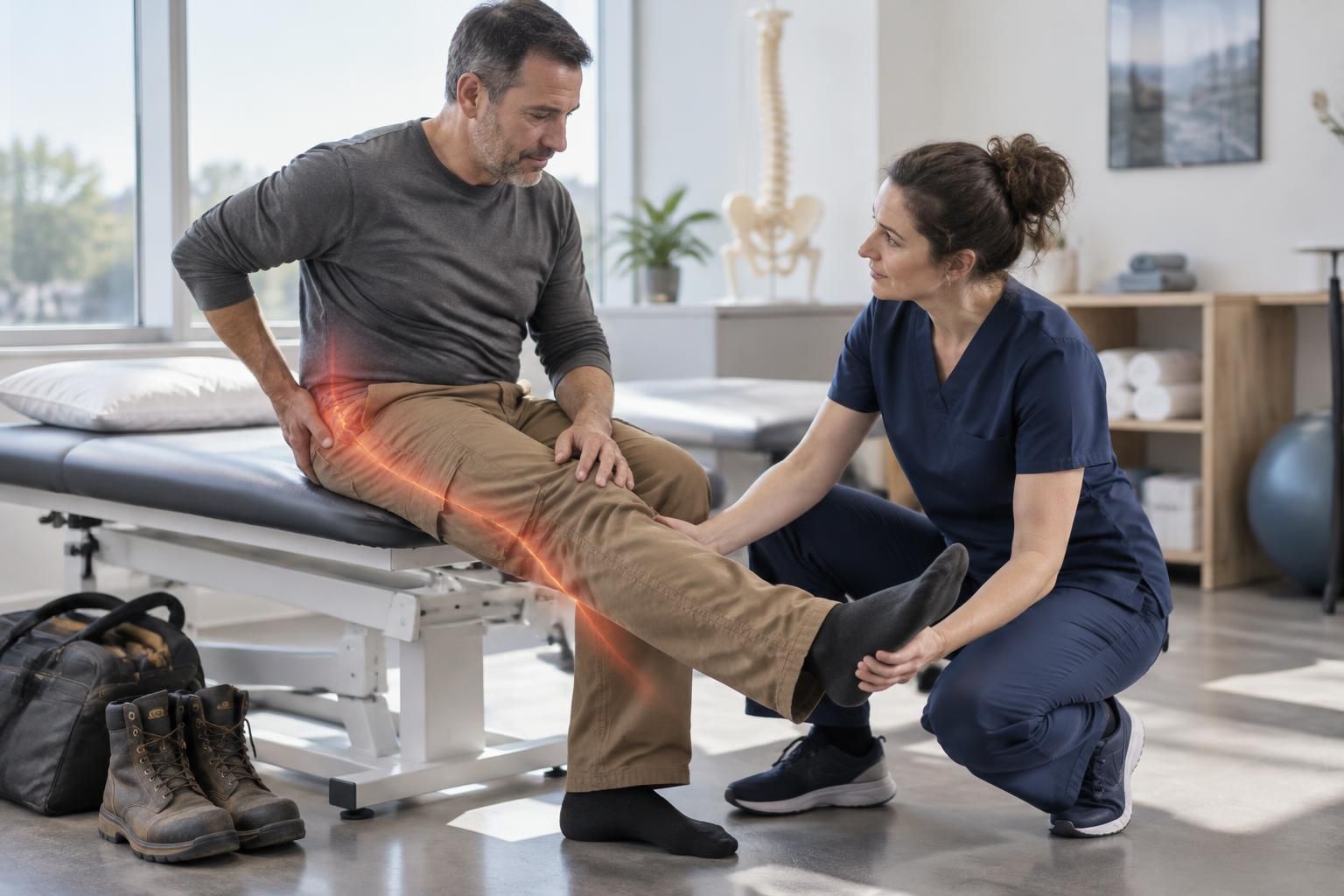
Among manual workers in Laval, low back pain that travels into the buttock or leg can make lifting loads, moving around, and repetitive tasks more difficult. It may be consistent with irritation of a nerve root, sometimes called sciatica, but the path of the pain alone is not enough to determine its cause or choose a treatment.
The priority is to recognize signs that warrant an assessment, temporarily adjust movements that worsen symptoms, and gradually resume activity when it is safe to do so. An approach tailored to the job and the progression of symptoms is generally more useful than an accessory or exercise chosen at random.
In brief: useful guidance for manual workers in Laval
Sciatica is not an automatic diagnosis. Leg pain can have several causes, and an examination helps clarify whether a nerve root appears to be irritated.
Physical tasks matter. Lifting loads, repeated twisting, and vibration can affect symptoms; the response varies from person to person.
Staying active, without pushing through pain, is often preferable. A gradual return and temporary adjustments can help preserve function.
Some signs require prompt attention. Progressive weakness or loss of bladder or bowel control requires urgent assessment.
Lumbar belts, stretching boards, or supports may be offered online as back aids. However, they cannot diagnose sciatica and are not suitable for everyone; before making one part of your work or treatment, it is prudent to seek advice from a professional.


A belt or support does not replace either task modification or an assessment if pain travels down the leg or is accompanied by numbness.


Sciatica and manual work: understanding symptoms without jumping to conclusions
The term sciatica generally refers to pain related to irritation of a nerve root in the lower back. It may begin in the lumbar region or buttock and extend into the thigh, calf, or foot; tingling, loss of sensation, or weakness may also occur.
However, low back pain that radiates is not always radicular pain. Muscles, joints, or other structures can produce referred pain, while pain at the front of the thigh may suggest a different condition, such as femoral neuralgia. Therefore, the pain pattern alone confirms neither the affected root nor the cause.
A disc herniation or protrusion can irritate a nerve root, particularly in the lower back. Narrowing of the spaces where nerves exit, called foraminal stenosis, or joint changes may also be considered depending on the clinical picture; conversely, an abnormal image alone does not prove that it explains the pain.
In a material-handling job, a day may involve several demands: lifting materials, working bent over, turning while carrying a load, or remaining in a constrained position for a long time. These movements can trigger or worsen symptoms, but on their own, they do not establish that a nerve is compressed. An assessment takes into account the history, strength, sensation, mobility, and, where relevant, imaging tests.
To better understand possible causes and the assessment process, see guidance on the causes and diagnosis of sciatica. In Laval, where work tasks and commutes can differ greatly from one trade to another, a precise description of the movements that affect pain can help guide the consultation.
Workplace ergonomics and injury prevention: adjusting tasks without becoming inactive
Injury prevention does not rely on maintaining a perfect posture all day. Rather, it involves varying positions, organizing work, and reducing avoidable effort, to the extent permitted by the job. When a task regularly triggers pain, noting its duration, the load handled, and how symptoms change can provide useful information.
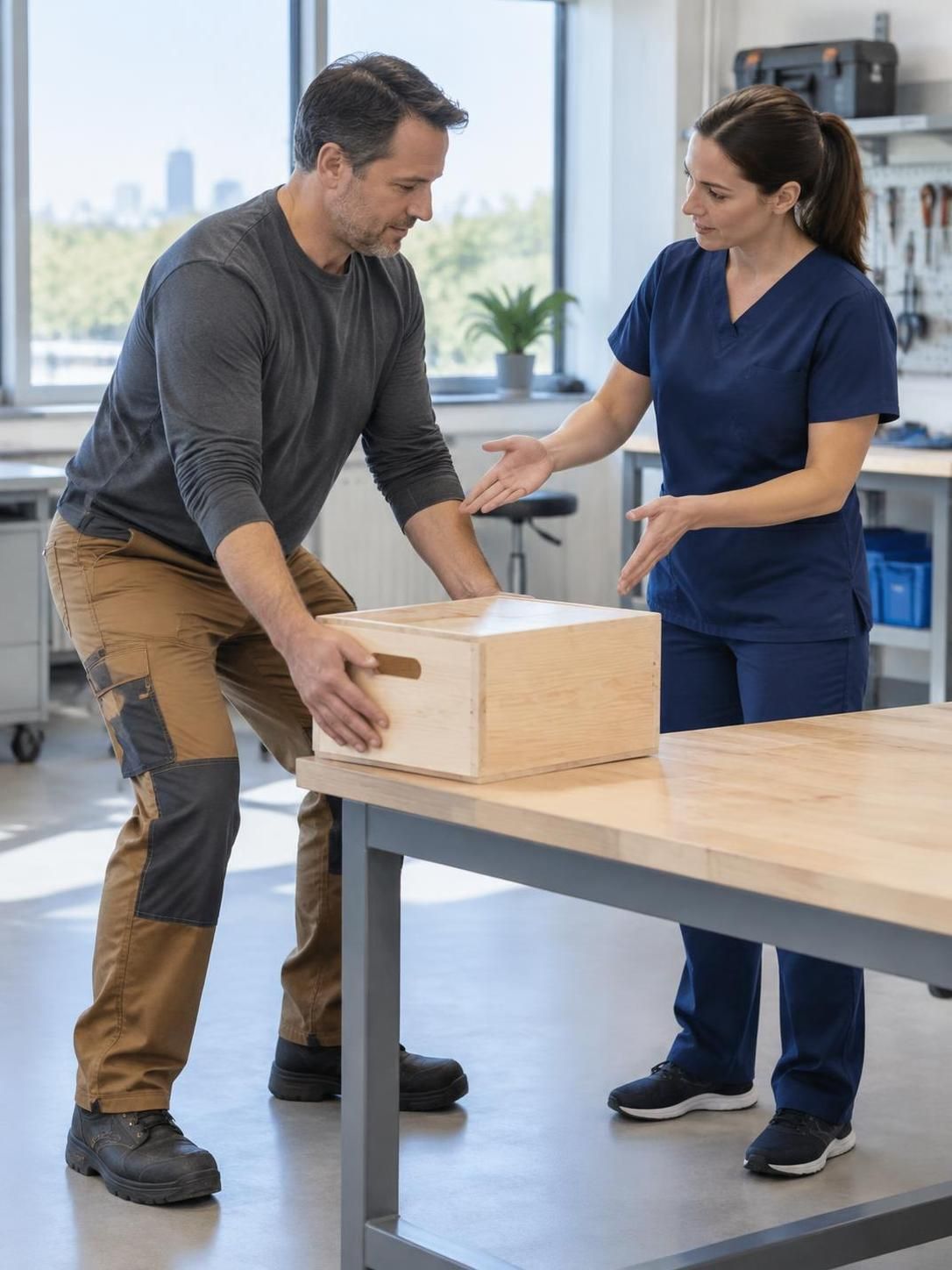
For lifting: keep the load close to your body and, whenever possible, avoid twisting your torso while carrying it. Ask for mechanical or human assistance when the weight, shape, or height makes the manoeuvre difficult.
For repetitive tasks: alternate movements or workstations if work organization allows, and plan brief periods of movement rather than remaining in the same position for a long time.
For driving and periods of sitting: adjust the seat to avoid a strongly hunched position, and take a break to move when symptoms and working conditions allow.
For tools and work surfaces: keep frequently used objects close by and adjust task height to limit prolonged bending or repeated twisting.
These adjustments do not guarantee that recurrence will be avoided and do not replace job-specific health and safety measures. They may nevertheless reduce certain demands and make tasks more tolerable during recovery. A discussion with a supervisor or the resources responsible for occupational health may help plan modified duties or a gradual return to work, depending on the situation.
Appropriate exercises can help maintain mobility and return to activities, but they are not universal. A movement that relieves one person may worsen pain in another; stop the exercise and have the situation reassessed if pain travels farther down the leg, if numbness progresses, or if weakness appears.
General advice on workplace movements is offered in this resource on exercises and active breaks in the workplace. However, recommendations intended for a seated workstation must be adapted to the reality of a manual job.
What treatments may be considered for work-related sciatica?
The treatment of sciatica depends on the symptoms, their progression, and the cause considered likely. When there are no urgent signs, conservative management may include maintaining or gradually resuming activities, advice on tasks, and exercises selected based on tolerance.
Physiotherapy may be considered to work on mobility, strength, and function, with an appropriate progression. Manual care or a specific osteopathic approach may be considered in certain contexts; they do not replace medical assessment when a concerning neurological sign is present. Medications require the advice of an authorized professional, who can explain their potential benefits, limitations, and side effects.
An injection may sometimes be discussed for certain profiles, while a specialist opinion becomes relevant when symptoms persist, a motor deficit is observed, or assessment results warrant it. Surgery is not indicated for every case of sciatica; the decision depends in particular on clinical findings and progression. The options and their limitations are described in the guidance on consultation and management.
Neurovertebral decompression: an option for certain profiles only
Motorized neurovertebral decompression is a form of controlled lumbar traction, applied gradually using a device. It aims to temporarily modify certain mechanical stresses on the spine; it does not put a disc back in place and does not guarantee either pain relief or avoidance of surgery.
It may be considered for certain patients after an assessment, particularly when symptoms and findings are compatible with disc or foraminal involvement. Results vary, and no number of sessions is appropriate for everyone. A fracture, instability, or certain other conditions may make this approach inappropriate; urgent assessment must never be delayed in order to try it.
Decompression is not equivalent to exercise, manual care, medication, or injections, and none of these options is superior in every situation. Clinique TAGMED, located at 1140 Beaumont Avenue in Mont-Royal, includes motorized neurovertebral decompression among its approaches; people coming from Laval should consider this address a service location in the Greater Montreal area, not a clinic located in Laval.
When should you seek care for pain that travels down the leg?
Seek a clinical assessment if pain persists or returns, travels below the knee, disrupts sleep, or limits walking and work. Numbness, loss of sensation, weakness, or loss of function also warrant particular attention, especially if these signs progress.
Seek urgent assessment in the event of loss of bladder or bowel control, numbness in the so-called “saddle” region around the perineum, or significant or rapidly progressive weakness. Pain accompanied by fever or a general decline in health, after major trauma, or in the context of cancer or infection also requires prompt medical assessment.
These signs cannot establish a diagnosis remotely, but they change the degree of urgency. In their absence, a consultation may still be useful if pain prevents you from working normally or if symptoms do not improve; the signs indicating when to seek care provide additional guidance.
An assessment can also help distinguish radicular pain from other causes and determine whether imaging is useful. It is not necessary in every situation; its usefulness depends in particular on the examination, the duration of symptoms, and the presence of concerning signs.
Frequently asked questions about sciatica in manual workers
Does leg pain always mean sciatica?
No. Pain radiating into the leg may come from a nerve root or other structures. The history of symptoms and clinical examination help distinguish the possibilities.
Should you stop working completely when you have sciatica?
Not necessarily. Depending on symptoms and job demands, modified duties or a gradual return may be considered. The decision must take safety and functional capacity into account.
When should you seek care promptly?
Seek care if pain persists, limits walking, or is accompanied by numbness or weakness. Loss of bladder or bowel control, saddle anaesthesia, or rapidly progressing weakness requires urgent assessment.
Is neurovertebral decompression suitable for all workers?
No. It should be considered only after an assessment that verifies whether the profile may be suitable and whether contraindications are present. Results vary from person to person.
Can a lumbar belt treat the sciatic nerve?
A belt may provide temporary support for some people, but it does not necessarily treat the cause of the symptoms. Its use should be part of a strategy tailored to the work and clinical assessment.
If low back pain or leg symptoms complicate your tasks in Laval, an assessment may help clarify the likely cause, signs to watch for, and the relevance of a conservative approach. To review the options offered in the Greater Montreal area, visit the page on sciatica management at Clinique TAGMED.
Sylvain Desforges, B.Sc., D.O., N.D., osteopath and naturopath
This content is educational and does not replace a personalized assessment by a health professional.
