





Persistent Sciatica After Treatment in Montreal: What Should Be Reassessed?
Sciatica that persists despite several treatments in Montreal does not automatically mean surgery is required, but it does justify reassessing the diagnosis, goals, adherence, aggravating factors and neurological signs.
Persistence may reflect ongoing nerve irritation, an incorrectly identified cause, poorly tolerated daily load, a neurological deficit, stenosis, a complex psychosocial context or a plan that was not sufficiently individualized.

Reassess before stacking more treatments
Adding interventions without revisiting the clinical hypothesis increases the risk of cost, confusion and delay. A structured reassessment looks for what truly changed and what was never measured.
Review diagnosis, neurological progression, chronicity factors, daily load and escalation thresholds.
Clinical profile
Connect onset, distribution and modifying factors.
Neurology
Document strength, sensation, reflexes and gait.
Participation
Measure sleep, work, driving and meaningful activities.
Reassessment
Define when to continue, modify or refer.
Clinical, functional and neurological assessment
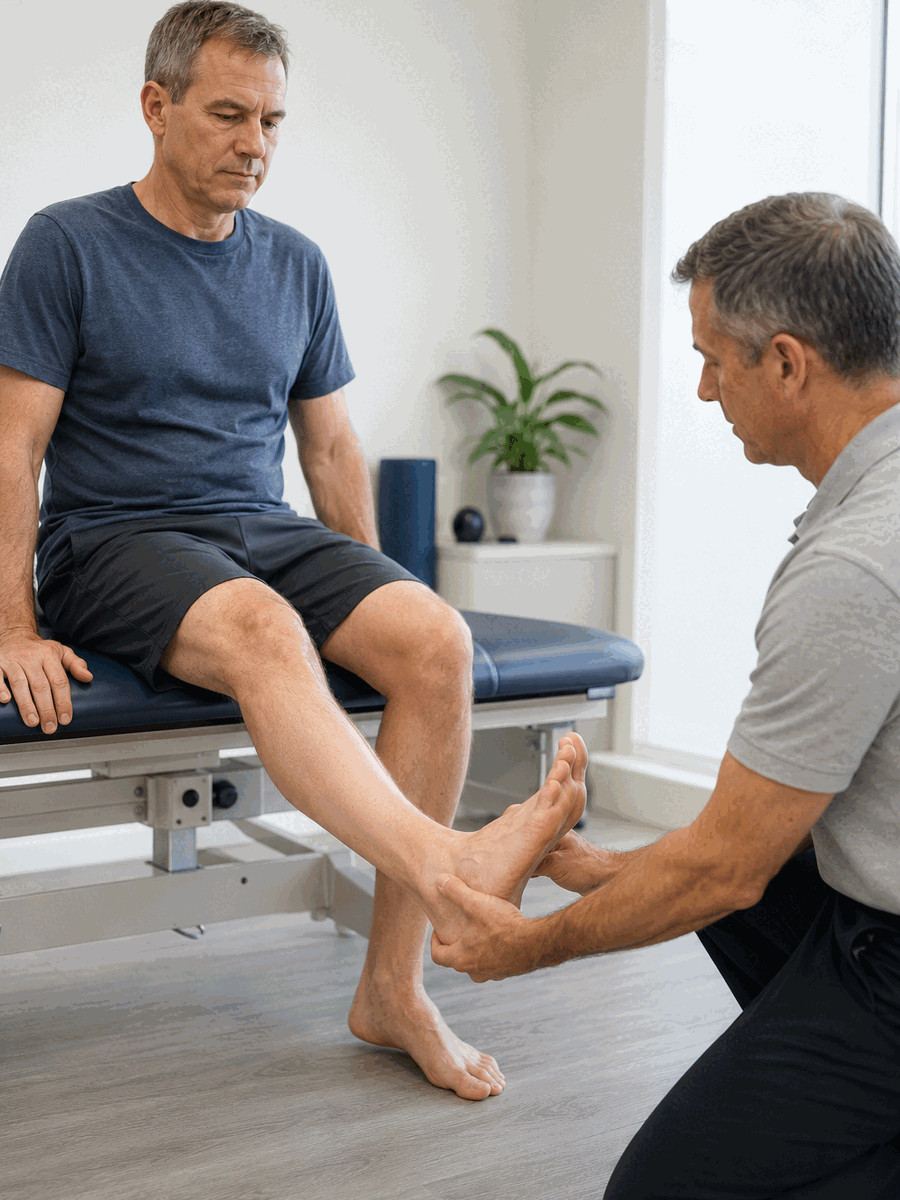
History should define onset, duration, side, aggravating positions, relieving factors, previous treatment and relevant medical or surgical history. Examination may compare mobility, neural tension, strength, sensation, reflexes and gait. A simple reproducible measure is more useful than a vague impression of feeling better.
Review diagnosis, neurological progression, chronicity factors, daily load and escalation thresholds. Imaging does not replace examination and is not routine; it is most useful when it can change the decision.
| Clinical situation | Possible step | Why |
|---|---|---|
| Pain unchanged, function stable, no deficit | Review goals, graded exposure and plan coherence | The issue may be lack of functional progression rather than an emergency. |
| More distal pain or expanding numbness | Repeat the neurological examination | A changing distribution may alter priorities and investigations. |
| Progressive weakness or loss of bladder/bowel control | Urgent referral | Evolving neurological compromise should not wait for a protocol to end. |

Build a measurable and revisable plan
The pathway may combine education, adjusted activity, progressive exercise, selected manual care and medical interventions when justified. Coherence matters more than accumulating techniques. Each option should answer a specific clinical question and include a functional goal the patient can understand.
Adding interventions without revisiting the clinical hypothesis increases the risk of cost, confusion and delay. A structured reassessment looks for what truly changed and what was never measured. Expected benefits, limitations, risks and the reassessment schedule should be explained before starting.
Information to document before and during care
A credible pathway turns observations into verifiable goals and explicit progression criteria.
- Onset, duration, side and symptom distribution.
- Aggravating and relieving factors and positional tolerance.
- Strength, sensation, reflexes, gait and balance.
- Agreement among symptoms, function and imaging when available.
- Functional goals: sleep, walking, work, driving or daily activities.
- Stopping, escalation and urgent referral signs.
Follow function rather than a single number
Follow-up should not rely only on pain intensity. It should also monitor symptom distribution, strength, sensation, sleep quality, sitting tolerance, walking, work and meaningful activities. Neurological deterioration requires faster review than ordinary pain fluctuations.
Centralization of pain toward the back, improved walking or more stable strength may be encouraging. Conversely, more distal pain, expanding numbness or loss of capacity requires review.
Common mistakes to avoid
- Constantly changing technique without baseline measures.
- Continuing an intervention only because it relieves pain for a few hours.
- Underestimating sleep, work, fear of movement or deconditioning.
- Neglecting new weakness or worsening gait.
- Concluding too quickly that all conservative care has permanently failed.
Questions to ask before starting
What is the working diagnosis?
Ask what supports it and which other causes remain possible.
What outcome will be measured?
Pain alone is insufficient; function and neurology complete follow-up.
When will the plan be reviewed?
Set a date and concrete criteria to continue, adjust or stop.
What are the referral thresholds?
Clarify signs requiring imaging, medical review or emergency care.

Related guides in the Montreal sciatica silo
Sciatica assessment in Montreal
Explore this clinical intent and its role in the pathway.
Decompression, injection or surgery
Explore this clinical intent and its role in the pathway.
Sciatica treatment in Montreal
Explore this clinical intent and its role in the pathway.
Disclosed clinical resource
Readers who wish to verify a local service may consult this separate, disclosed resource. Transactional information should be confirmed directly with the clinic.
TAGMED Clinic — Mount Royal / Montreal
Information about assessment and selected non-surgical care for pain compatible with sciatica. Address: 1140 Beaumont Avenue, Mount Royal, Quebec, H3P 3E5.
Frequently asked questions
Is sciatica always caused by a herniated disc?
No. Herniation is common, but foraminal stenosis, spinal stenosis, arthritis, spondylolisthesis or another condition can produce a radicular pattern.
Is MRI always required before treatment?
No. Imaging is most useful when it can change management, when a neurological deficit is present, when symptoms persist or when another cause must be clarified.
Does pain have to reach the foot?
No. Symptoms may stop in the buttock, thigh or calf. Distribution helps guide assessment but does not confirm the affected root by itself.
Is walking always recommended?
Walking is often useful when tolerated, but it may aggravate some patterns. Monitor whether pain travels farther, numbness increases or function declines.
When is sciatica an emergency?
Loss of bladder or bowel control, saddle anaesthesia, major or rapidly progressive weakness, fever with spinal pain or serious trauma requires urgent assessment.
Can treatment be selected from an X-ray alone?
X-rays mainly show bone, alignment and some degenerative changes. They do not directly show nerve roots or discs as MRI does.
How long should an approach be tried?
Timing depends on diagnosis, severity and the plan. A credible trial defines baseline measures, a reassessment point and criteria to continue, modify or stop.
Does less pain mean the nerve has recovered?
Not necessarily. Strength, sensation, gait, sleep and participation in activities should also be followed.
Does The Spine Page directly provide treatment in Montreal?
No. The Spine Page is a separate educational publication. The external clinical resource is disclosed and should be contacted directly for service information.
Which professional should be consulted?
The choice depends on symptoms and urgency. A clinician able to assess neurology, differential diagnoses and imaging indications can guide a safer pathway.
Main clinical sources
- NICE — Low back pain and sciatica in over 16s
- American College of Radiology — Low Back Pain
- World Health Organization — non-surgical management of chronic primary low back pain
- Cochrane — Traction for low-back pain
Last editorial review: August 2026. General educational information only.
Dr. Sylvain Desforges, B.Sc., D.O., N.D., osteopath – The Spine Page
Continue your research on sciatica in Montreal
Compare this page with the general guide, assessment pages and treatment options to maintain a coherent overview.
Dr. Sylvain Desforges, B.Sc., D.O., N.D., osteopath