

A vertebral pedicle is one of two short bony bridges connecting the vertebral body to the posterior arch. It contributes to the spinal canal walls and to the boundaries of the intervertebral foramina, where spinal nerves pass between neighbouring vertebrae.
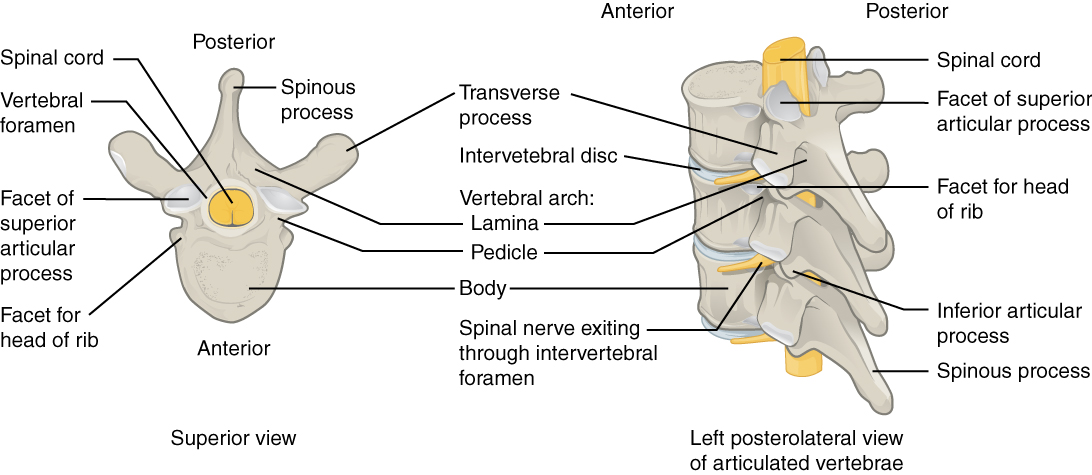
OpenStax College — CC BY 3.0. Image source.

Structure and function
A typical vertebra has a right and a left pedicle. They transmit forces between the body and posterior elements. Notches in neighbouring pedicles help outline an intervertebral foramen. Their dimensions and direction vary with the spinal level, which matters when interpreting scans or planning an operation.
Possible manifestations
A pedicle fracture, bone lesion or developmentally narrow canal may make this region clinically important. Short pedicles can contribute to restricted space without invariably causing symptoms. Radiating pain, numbness or weakness would reflect associated neural involvement rather than a unique pedicle symptom. An incidental anatomical finding should therefore be interpreted alongside the examination.
Assessment and management
CT shows the bone and, when present, the position of surgical hardware. MRI adds information about neural and surrounding soft tissues when clinically indicated. Some surgical implants use a pedicle as an anchoring route, requiring careful planning. The presence of pedicle screws does not establish that hardware explains a new episode of pain.
Role of TAGMED care
At TAGMED, fracture and operative reports help determine precautions. Pain after instrumentation should be assessed before considering traction or manual techniques. This anatomical term alone does not establish an indication for a device, and treatment should respect the surgeon’s restrictions and healing status.
Warning signs
New weakness after surgery, substantial pain after trauma or new bladder or bowel dysfunction requires urgent medical assessment. Suspected fracture requires avoiding local mechanical loading until the appropriate assessment has clarified safety and stability.
Frequently asked questions
Is a pedicle a nerve?
No. It is bone located near neural passageways.
What does a short pedicle mean?
An anatomical feature that may restrict space in context.
Is a screw always necessary?
No. Screws serve selected surgical stabilization indications.
Can it be directly palpated?
No. The pedicle lies deep within the spine.
Does every abnormality need treatment?
Only when assessment identifies a relevant consequence or risk.
Conceptual anatomical and clinical relationships; not drawn to scale.
Medical references
- OpenStax — Rice University. The Vertebral Column.
- AAOS — OrthoInfo. Fractures of the Thoracic and Lumbar Spine.
- ACR — RSNA. Spine MRI.
References document the topic; their inclusion does not imply endorsement of TAGMED services by those organizations.
Educational information from The Spine Page. This entry does not replace an individual assessment. Documentary version: October 12, 2026. Sylvain Desforges, B.Sc., D.O., N.D., osteopath and naturopath.
TAGMED clinic contact details
For non-urgent consultations and information about available services.
Clinique TAGMED — Terrebonne
1150, rue Lévis, Suite 200
Terrebonne (Québec) J6W 5S6
450‑704‑4447
Clinique TAGMED — Montréal
1140, avenue Beaumont
Mont-Royal (Québec) H3P 3E5
1‑877‑672‑9060