

Osteoarthritic changes in spinal joints, sometimes associated with pain, stiffness or narrowing of neural spaces.
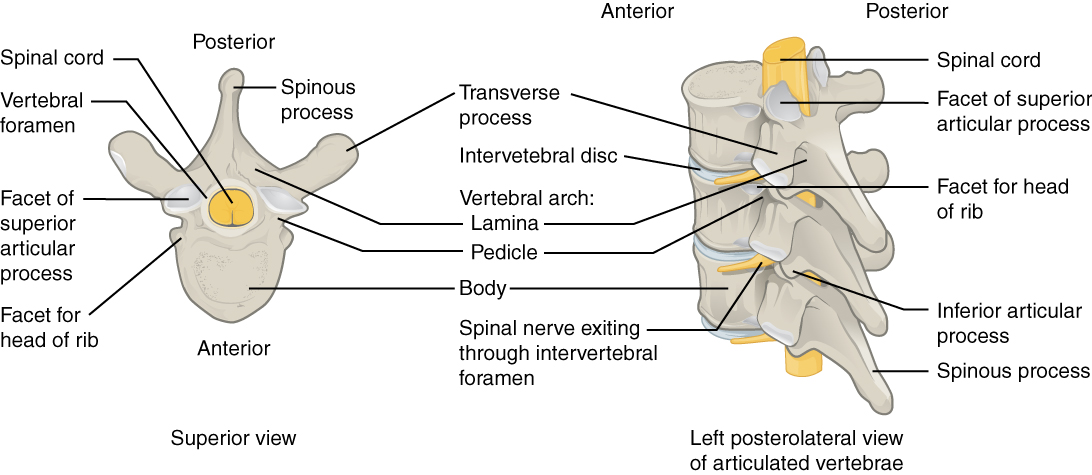
OpenStax College — CC BY 3.0. Image source.

Understanding the mechanism
Spinal osteoarthritis affects spinal joints, especially the posterior facet joints. It may coexist with disc changes, bone spurs and ligament thickening. These findings have different implications: some are incidental, while others contribute to local pain or narrow the space available for nerves. A radiology report alone cannot identify which tissue, if any, is causing a person's pain.
Symptoms and warning signs
Neck or low-back stiffness and mechanically influenced pain are possible. Pain radiating into a limb, numbness or restricted walking raises the possibility of associated neural involvement. Fever, unexplained weight loss, pain following trauma or progressive weakness needs a separate assessment. Such findings should not automatically be attributed to previously documented arthritis or dismissed as part of ageing.
Diagnosis and investigations
Examination assesses movement, daily function and the hips or shoulders as appropriate, together with neurological status. Imaging is selected when it can change care: radiographs answer some bone-related questions, while MRI provides information about nerves and soft tissues. Visible facet degeneration is not sufficient by itself to establish that a facet joint is the painful structure.
Treatment and outlook
Management centres on practical goals such as getting out of a chair, walking, driving or sleeping more comfortably. Activity and strengthening progress within the person's limitations. Medication, specialist injections or surgery have particular indications rather than being automatic responses to a scan. Persistent radiographic changes do not necessarily prevent meaningful and sustained improvement in function.
The role of TAGMED care
TAGMED may offer individualized conservative care after contraindications and referral needs are assessed. Motorized decompression does not dissolve bone spurs or reverse arthritis. Suitable manual techniques can aim to improve comfort and available mobility, while laser and other modalities need condition-specific justification. Response should be measured, and new neurological symptoms require reassessment rather than continuation of the same plan.
Practical follow-up
Follow-up should distinguish local pain, radiation and walking fatigue. This helps determine whether the programme is improving general capacity or a neural problem is becoming more apparent. Goals can then be adjusted to the actual course rather than the original scan label.
Frequently asked questions
Is this the same as disc degeneration?
No, although joint and disc changes commonly coexist in the same region.
Does arthritis explain every painful episode?
No. Other tissues and health conditions can contribute to the presentation.
Should scans be repeated frequently?
Not without a new clinical question or an expected effect on management.
Can mobility improve despite arthritis?
Often, by developing available capacity without promising to erase bone changes.
When is a specialist opinion useful?
With ongoing major disability or new weakness, gait disturbance or other neurological loss.
Conceptual diagram: the steps depend on clinical findings and do not provide an individual diagnosis.
Medical references
- NIAMS. Osteoarthritis.
- American Academy of Orthopaedic Surgeons. Lumbar Spinal Stenosis.
- Multispecialty international working group. Consensus practice guidelines on interventions for lumbar facet joint pain.
References document the topic; their inclusion does not imply endorsement of TAGMED services by those organizations.
Educational information from The Spine Page. This entry does not replace an individual assessment. Documentary version: October 12, 2026. Sylvain Desforges, B.Sc., D.O., N.D., osteopath and naturopath.
TAGMED clinic contact details
For non-urgent consultations and information about available services.
Clinique TAGMED — Terrebonne
1150, rue Lévis, Suite 200
Terrebonne (Québec) J6W 5S6
450‑704‑4447
Clinique TAGMED — Montréal
1140, avenue Beaumont
Mont-Royal (Québec) H3P 3E5
1‑877‑672‑9060