

Excessive or abnormal movement between vertebrae, assessed in clinical context and, when appropriate, with targeted investigations.
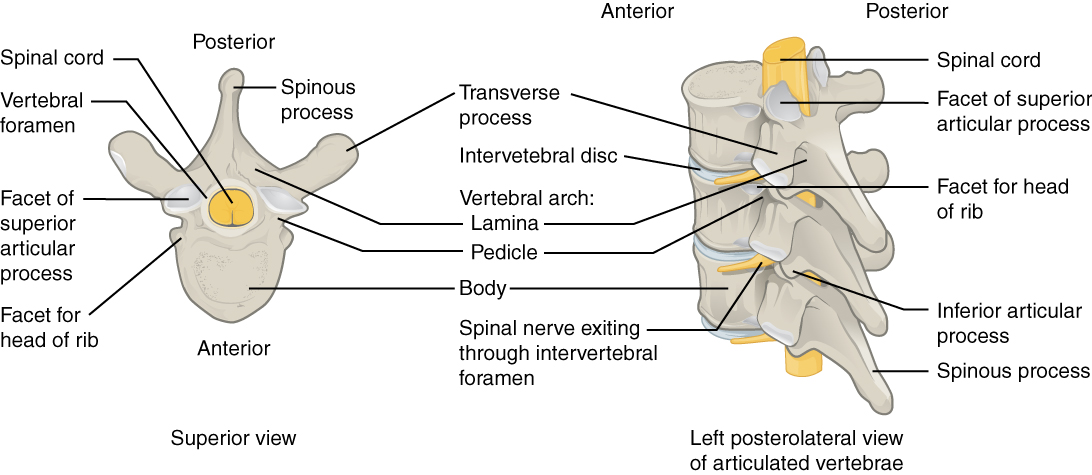
OpenStax College — CC BY 3.0. Image source.

Understanding the mechanism
Spinal instability refers to a spinal segment that cannot maintain mechanical behaviour compatible with tissue protection and useful function. It may be traumatic, degenerative or postoperative. The term is used in different ways, so a feeling that the back gives way or unusually large movement does not, on its own, demonstrate a structurally unstable vertebra.
Symptoms and warning signs
Pain during particular loads or transitions may raise the question, but these symptoms are not specific. Instability can also involve neural structures. After trauma, significant spinal pain accompanied by weakness or numbness needs urgent evaluation. Inflammatory disease and bone fragility change the precautions required and should be considered before the symptoms are treated as an ordinary mechanical episode.
Diagnosis and investigations
Assessment first establishes the cause and any neurological consequences. Standing or movement radiographs may be requested for specific situations, while CT and MRI investigate fractures, ligaments and neural tissues. Movement thresholds need interpretation in context. A decision should not rest on a commercial posture assessment, a single palpation finding or an assumption that any displacement is unstable.
Treatment and outlook
Management varies widely. Traumatic instability may require immobilization and surgery, whereas selected degenerative situations allow appropriate rehabilitation. Strengthening cannot replace essential stabilization, but it can improve capacity when the segment can be managed conservatively. Restrictions, load progression and follow-up need to be explicit. A surgical decision considers risk and function rather than a label alone.
The role of TAGMED care
At TAGMED, suspected instability needs clarification before traction or manual procedures are considered. Forceful manipulation is not a way to stabilize a genuinely unstable segment. Any conservative support should focus on permitted movements and meaningful functional goals, respecting medical restrictions. Worsening pain together with neurological changes calls for medical reassessment rather than further loading of the uncertain segment.
Practical follow-up
Ask what instability specifically means in the clinical record. The clinician should be able to identify the segment, cause, consequences and restrictions. These details are more useful for planning safe activity than a vague statement that the whole spine is fragile.
Frequently asked questions
Is a very flexible spine unstable?
Not necessarily. Mobility, hypermobility and clinically significant instability are different concepts.
Does a vertebral slip prove instability?
No. Some slips remain stable; movement and symptoms must be assessed together.
Can touch alone diagnose it?
Palpation cannot independently establish structural spinal instability.
Is fusion always needed?
No. The cause, neurological risk and disability determine the need for stabilization.
Why bring previous reports?
They document trauma, surgery and change over time, helping define safe treatment precautions.
Conceptual diagram: the steps depend on clinical findings and do not provide an individual diagnosis.
Medical references
- American Academy of Orthopaedic Surgeons. Adult Spondylolisthesis of the Low Back.
- American Academy of Orthopaedic Surgeons. Fractures of the Thoracic and Lumbar Spine.
- American Academy of Orthopaedic Surgeons. Spondylolysis and Spondylolisthesis.
References document the topic; their inclusion does not imply endorsement of TAGMED services by those organizations.
Educational information from The Spine Page. This entry does not replace an individual assessment. Documentary version: October 12, 2026. Sylvain Desforges, B.Sc., D.O., N.D., osteopath and naturopath.
TAGMED clinic contact details
For non-urgent consultations and information about available services.
Clinique TAGMED — Terrebonne
1150, rue Lévis, Suite 200
Terrebonne (Québec) J6W 5S6
450‑704‑4447
Clinique TAGMED — Montréal
1140, avenue Beaumont
Mont-Royal (Québec) H3P 3E5
1‑877‑672‑9060