

A spinal ependymoma is a glial tumour with ependymal differentiation, often located within the spinal cord. Some forms arise near the conus medullaris or filum terminale. Behaviour and treatment depend on tumour type, anatomical relationships and whether disease extends beyond its original site.
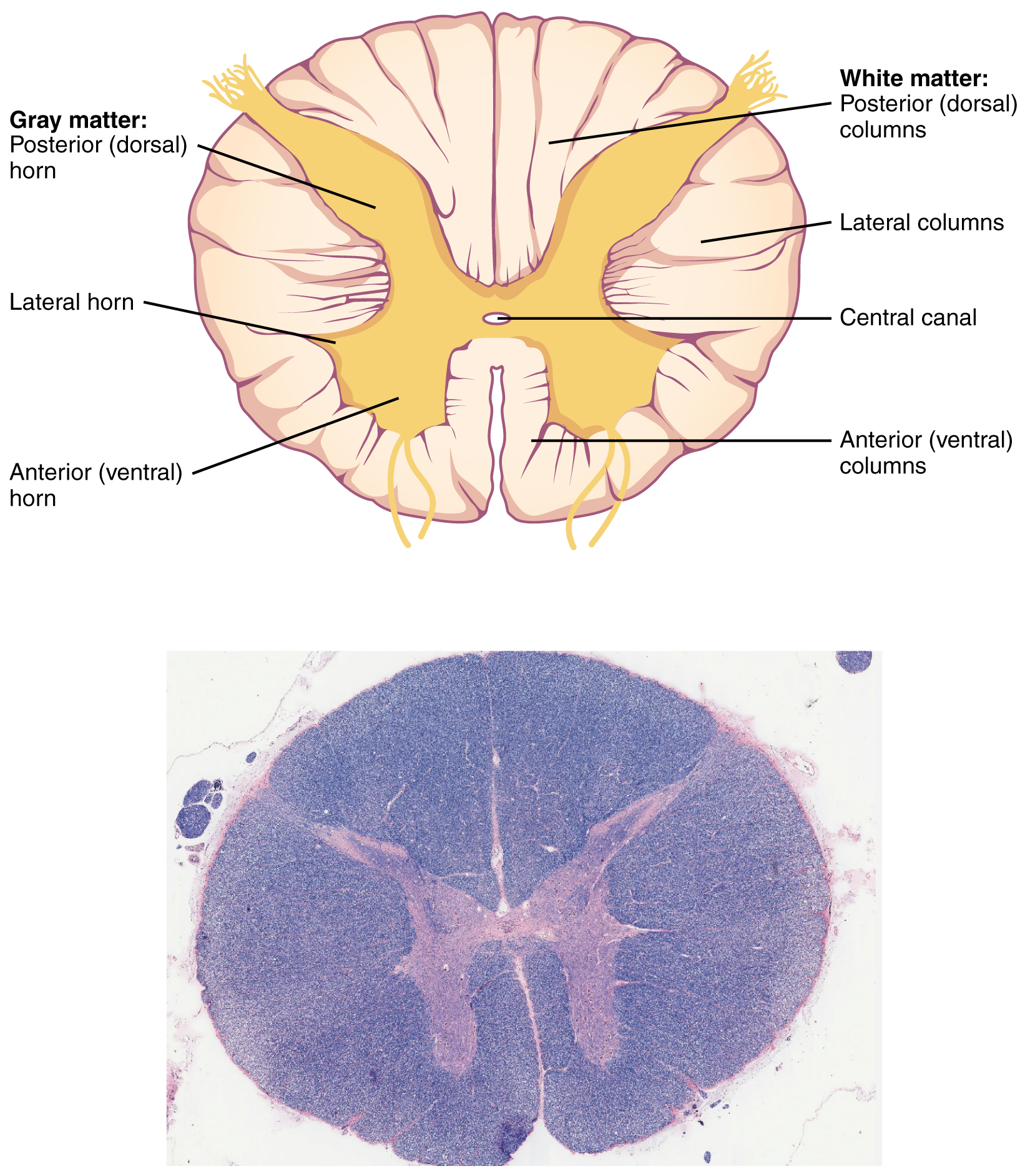
OpenStax — CC BY 4.0. Image source.

Different locations and tumour types
Ependymomas are associated with ependymal cells of the central nervous system. An intramedullary tumour has different anatomical relationships from a lesion of the filum terminale. Classification considers tissue features and sometimes molecular findings, so the name alone does not establish an individual prognosis.
Manifestations and warning signs
Persistent spinal pain, numbness, weakness or walking difficulty may develop. Lower lesions can affect bladder and bowel function. New urinary retention, saddle numbness, loss of sphincter control or rapidly increasing weakness requires immediate emergency assessment; severe pain does not need to be present.
Diagnosis and staging
Contrast-enhanced MRI locates the tumour and evaluates its effects on nervous structures. Specialist staging may examine the whole central nervous system for spread through cerebrospinal fluid. Tissue analysis establishes the diagnosis. Other cord tumours or inflammatory lesions can produce similar imaging appearances and must be considered.
Treatment and surveillance
Surgery aims for removal that is as complete as safely possible while preserving neurological function. Radiotherapy may be added depending on tumour type, residual disease or recurrence. These decisions belong to a specialist team. Long-term surveillance is necessary because some recurrences develop years after initial treatment.
Role of TAGMED care
TAGMED does not treat the tumour or replace neurosurgery and oncology. Support for associated musculoskeletal pain can only be considered with the treating team’s agreement. Motorized traction is not a treatment for an intramedullary mass, and supportive care must respect postoperative and neurological restrictions.
Frequently asked questions
Is an ependymoma a metastasis?
Not by definition. It is a primary central nervous system tumour.
Is it always inside the cord?
No. Some forms arise near the filum terminale.
Does MRI replace tissue analysis?
No. Imaging does not always provide the definitive tumour classification.
Is radiotherapy always necessary?
No. The indication depends on several features of the individual case.
Why continue follow-up for years?
It monitors recurrence and addresses the long-term functional effects of the disease and treatment.
Conceptual diagram: location, tumour type and extent determine the management strategy.
Medical references
- NIH — National Cancer Institute. Ependymoma: Diagnosis and Treatment.
- Canadian Cancer Society. Treatments for spinal cord tumours.
- NIH — National Cancer Institute. Central Nervous System Tumors Treatment (PDQ®).
References document the topic; their inclusion does not imply endorsement of TAGMED services by those organizations.
Educational information from The Spine Page. This entry does not replace an individual assessment. Documentary version: October 12, 2026. Sylvain Desforges, B.Sc., D.O., N.D., osteopath and naturopath.
TAGMED clinic contact details
For non-urgent consultations and information about available services.
Clinique TAGMED — Terrebonne
1150, rue Lévis, Suite 200
Terrebonne (Québec) J6W 5S6
450‑704‑4447
Clinique TAGMED — Montréal
1140, avenue Beaumont
Mont-Royal (Québec) H3P 3E5
1‑877‑672‑9060