

Spinal biomechanics studies interactions between forces, movement and tissue properties in the spine. It considers discs, joints, ligaments and muscles. Mechanical models can clarify loading, but they do not automatically explain an individual's pain or establish a need for correction.
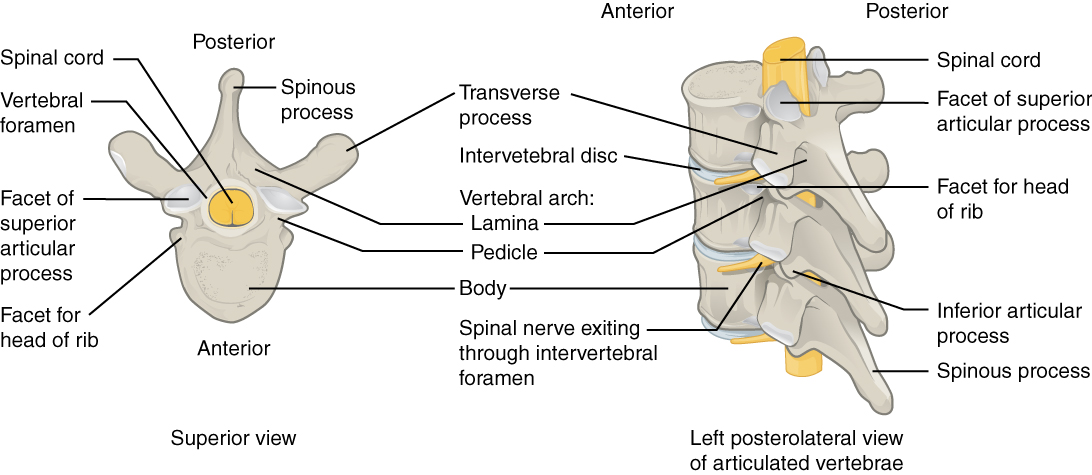
OpenStax College — CC BY 3.0. Image source.

Function and mechanism
The spine provides support, mobility and protection for neural structures. Loads are shared among tissues according to position, movement and muscle activity. Compression, bending, rotation and shear can occur together. A useful mechanical explanation therefore goes beyond imagining vertebrae as blocks stacked beneath the weight of the upper body.
Assessment and interpretation
Models and experiments describe behaviour under specified conditions. They cannot calculate a person's pain from a posture photograph. Clinical assessment considers activities, symptoms, strength and circumstances. A different posture does not, by itself, establish instability, disc injury or a need for correction, even when a mechanical explanation sounds plausible.
Role of TAGMED care
At TAGMED, biomechanical reasoning can help adapt a task, vary positions and progressively develop capacity. Any care should pursue measurable benefits. A change in comfort does not demonstrate that vertebrae have been permanently repositioned or tissues repaired. Practical advice should remain compatible with the person's diagnosis and priorities.
Follow-up and warning signs
Follow-up compares meaningful activities and recovery after them. Following major trauma, or with bone fragility, new pain requires assessment before mechanical loading or manipulation. Neurological changes also need their own evaluation rather than a purely postural explanation.
Frequently asked questions
Is there one perfect posture for everyone?
No. Tasks, preferences and tolerance differ between people and circumstances.
Is mechanical loading always harmful?
No. Tissues tolerate ordinary loads; capacity and context determine their significance.
Can curvature alone predict pain?
No. An anatomical measurement does not summarize the clinical experience.
Do computer models predict every patient's outcome?
No. Their assumptions and input data limit individual interpretation.
What is the practical goal?
Find appropriate activities and loads with progression, rather than seeking an ideal geometry.
Mechanical relationships require clinical interpretation; this diagram does not predict injury.
Medical references
- American Academy of Orthopaedic Surgeons. Spine Basics.
- Spine — Wilke and colleagues. New in vivo measurements of pressures in the intervertebral disc in daily life.
- Academy of Orthopaedic Physical Therapy — JOSPT. Interventions for the Management of Acute and Chronic Low Back Pain: Revision 2021.
References document the topic; their inclusion does not imply endorsement of TAGMED services by those organizations.
Educational information from The Spine Page. This entry does not replace an individual assessment. Documentary version: October 12, 2026. Sylvain Desforges, B.Sc., D.O., N.D., osteopath and naturopath.
TAGMED clinic contact details
For non-urgent consultations and information about available services.
Clinique TAGMED — Terrebonne
1150, rue Lévis, Suite 200
Terrebonne (Québec) J6W 5S6
450‑704‑4447
Clinique TAGMED — Montréal
1140, avenue Beaumont
Mont-Royal (Québec) H3P 3E5
1‑877‑672‑9060