

Sagittal alignment describes the arrangement of the spine and pelvis viewed from the side. It considers spinal curves and their relationships with overall posture. Its assessment helps explain selected balance problems without defining a single ideal posture or set of angles for everyone.
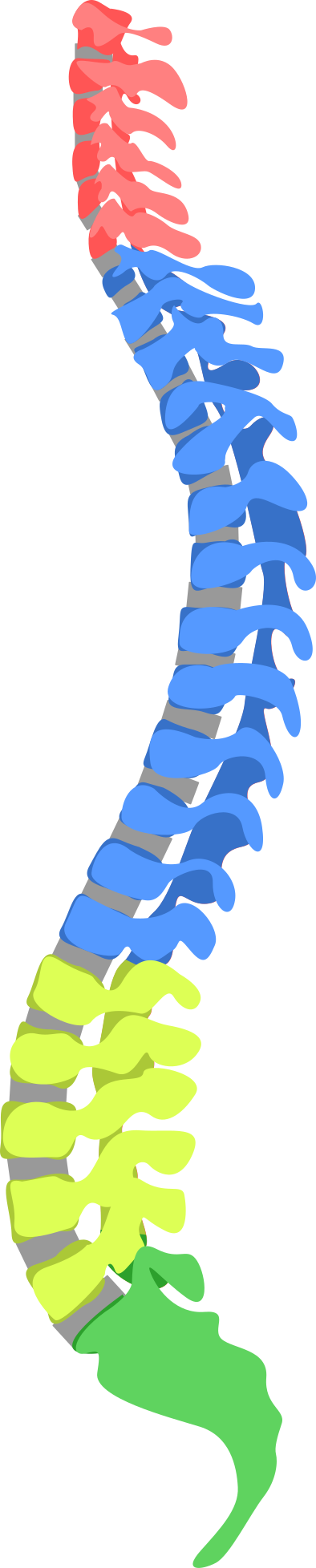
mikeingram1; recoloration : MJL — CC0 1.0. Image source.

Meaning on imaging
The spine has curves that help position the head and trunk above the pelvis. Sagittal alignment examines these relationships from the side. A person may compensate for imbalance by changing the position of the pelvis, hips or knees to remain upright. These adjustments may influence effort during standing and walking.
Indications and assessment
Assessment combines observation of posture with walking fatigue, pain and neurological examination. Standing radiographs can measure relationships between the spine and pelvis when this information is useful. A lying-down MRI does not fully reproduce how the body supports itself under load or how the person compensates while standing.
Limitations and interpretation
Measurements need interpretation according to age, anatomy and the clinical situation. One parameter cannot explain every episode of pain. A flexible postural adaptation must be distinguished from a more fixed structural deformity, because management options and the potential for change differ. Radiographic improvement and better daily function are also distinct outcomes.
Role of TAGMED care
At TAGMED, care goals may focus on activity tolerance and suitable symptom management. No device should be presented as guaranteeing restoration of an ideal alignment. Significant or progressive imbalance, particularly following spinal surgery, may require specialist assessment before a plan of physical treatment is agreed.
Frequently asked questions
Is this simply standing up straight?
No. Assessment considers curves, the pelvis and compensatory changes throughout the body.
Should everyone have the same angles?
No. Measurements need to be interpreted in relation to individual characteristics.
Is a photograph enough for measurement?
It can show posture but cannot replace radiographic measurements of the bones.
Can exercise correct every deformity?
Exercise may support function, but cannot guarantee correction of a fixed structural deformity.
When should specialist advice be sought?
When balance deteriorates, walking becomes difficult or neurological symptoms appear.
Original conceptual diagram; no patient diagnostic image.
Medical references
- Scoliosis Research Society. Fixed Sagittal Imbalance.
- Scoliosis Research Society. Glossary — Three-Dimensional Terminology of Spinal Deformity.
References document the topic; their inclusion does not imply endorsement of TAGMED services by those organizations.
Educational information from The Spine Page. This entry does not replace an individual assessment. Documentary version: October 12, 2026. Sylvain Desforges, B.Sc., D.O., N.D., osteopath and naturopath.
TAGMED clinic contact details
For non-urgent consultations and information about available services.
Clinique TAGMED — Terrebonne
1150, rue Lévis, Suite 200
Terrebonne (Québec) J6W 5S6
450‑704‑4447
Clinique TAGMED — Montréal
1140, avenue Beaumont
Mont-Royal (Québec) H3P 3E5
1‑877‑672‑9060