

Nociception is the detection and neural processing of events that could damage body tissues. It contributes to protective responses but is not, by itself, the conscious personal experience of pain, which involves additional processing and context.
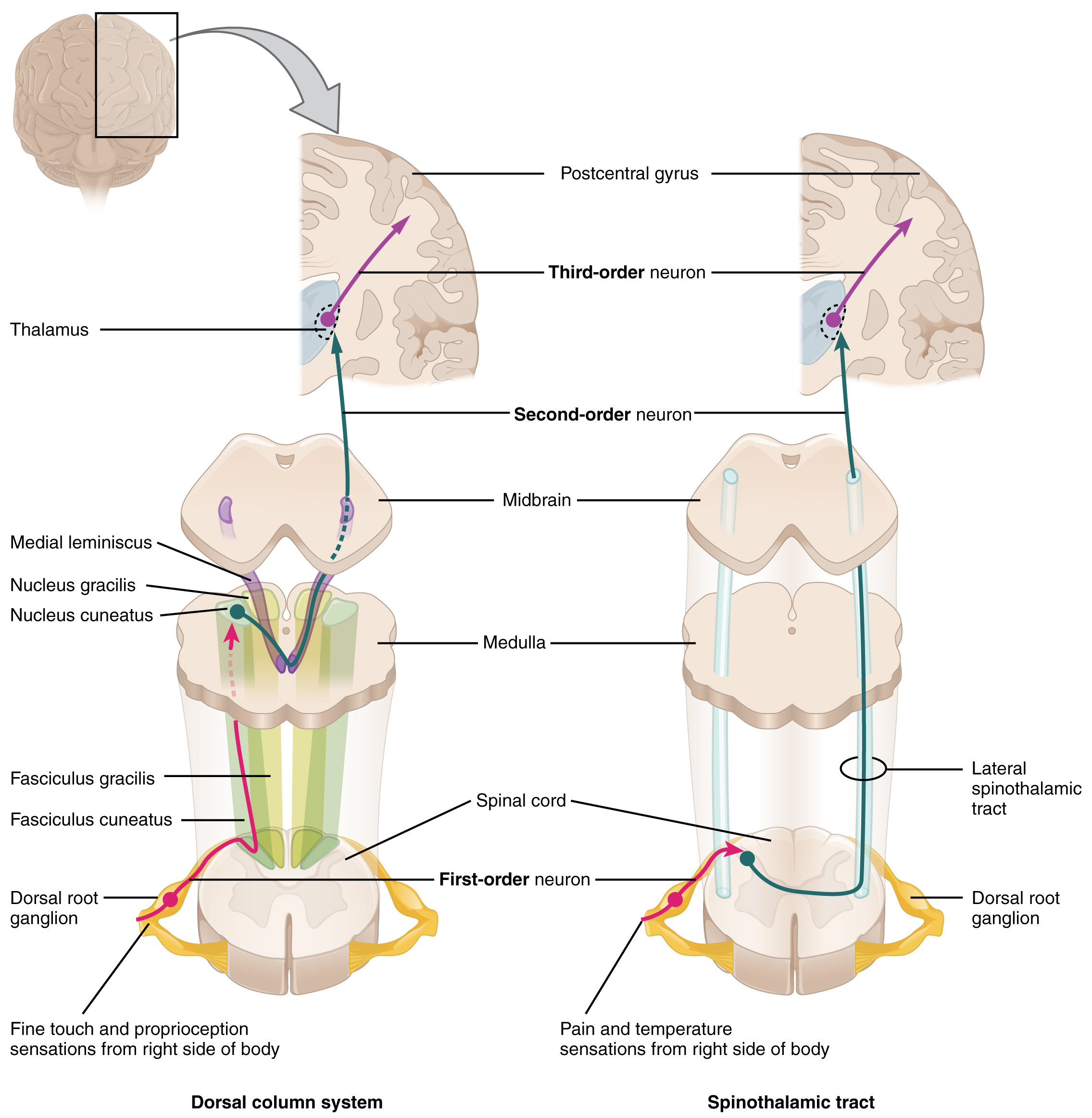
OpenStax College — CC BY 3.0. Image source.

Function and mechanism
When tissue encounters potentially damaging stimulation, specialized endings generate electrical messages. Information travels to the spinal cord and other neural networks. A withdrawal reflex can occur before conscious assessment. This organization supports protection, but it is not a simple instrument that precisely measures the amount of tissue injury.
Assessment and interpretation
Pain also depends on context, previous experience and modulation within the nervous system. Nociceptive activity therefore cannot directly calculate perceived intensity. Conversely, persistent pain deserves recognition when imaging shows no sufficient structural explanation. Listening to the person's account remains essential rather than treating a scan as a complete description of their experience.
Role of TAGMED care
At TAGMED, explaining this distinction can support realistic activity goals. Assessment still looks for treatable causes and contraindications. Relief following manual care does not establish that a disc has been repaired or that a particular tissue has been conclusively identified as the source.
Follow-up and warning signs
Follow-up considers sleep, movement and participation alongside pain. New weakness needs prompt assessment; new urinary retention or saddle numbness requires immediate emergency care, regardless of the presumed pain mechanism.
Frequently asked questions
Are nociception and pain interchangeable?
No. A neural process and a conscious experience describe different aspects of the response.
Can an X-ray measure nociception?
No. It mainly describes structures rather than the complete pattern of neural messages.
Does a reflex prove conscious pain?
No. A protective response alone does not establish that conclusion.
Is pain without visible injury real?
Yes. An unexplained scan does not invalidate the person's experience.
Must all stimulation stop during recovery?
No. Activity is adapted to diagnosis and tolerance, without automatically prescribing prolonged immobilization.
Conceptual diagram: neural activity does not directly measure the pain a person experiences.
Medical references
- International Association for the Study of Pain. IASP Terminology.
- National Institute of Neurological Disorders and Stroke. Pain.
References document the topic; their inclusion does not imply endorsement of TAGMED services by those organizations.
Educational information from The Spine Page. This entry does not replace an individual assessment. Documentary version: October 12, 2026. Sylvain Desforges, B.Sc., D.O., N.D., osteopath and naturopath.
TAGMED clinic contact details
For non-urgent consultations and information about available services.
Clinique TAGMED — Terrebonne
1150, rue Lévis, Suite 200
Terrebonne (Québec) J6W 5S6
450‑704‑4447
Clinique TAGMED — Montréal
1140, avenue Beaumont
Mont-Royal (Québec) H3P 3E5
1‑877‑672‑9060